
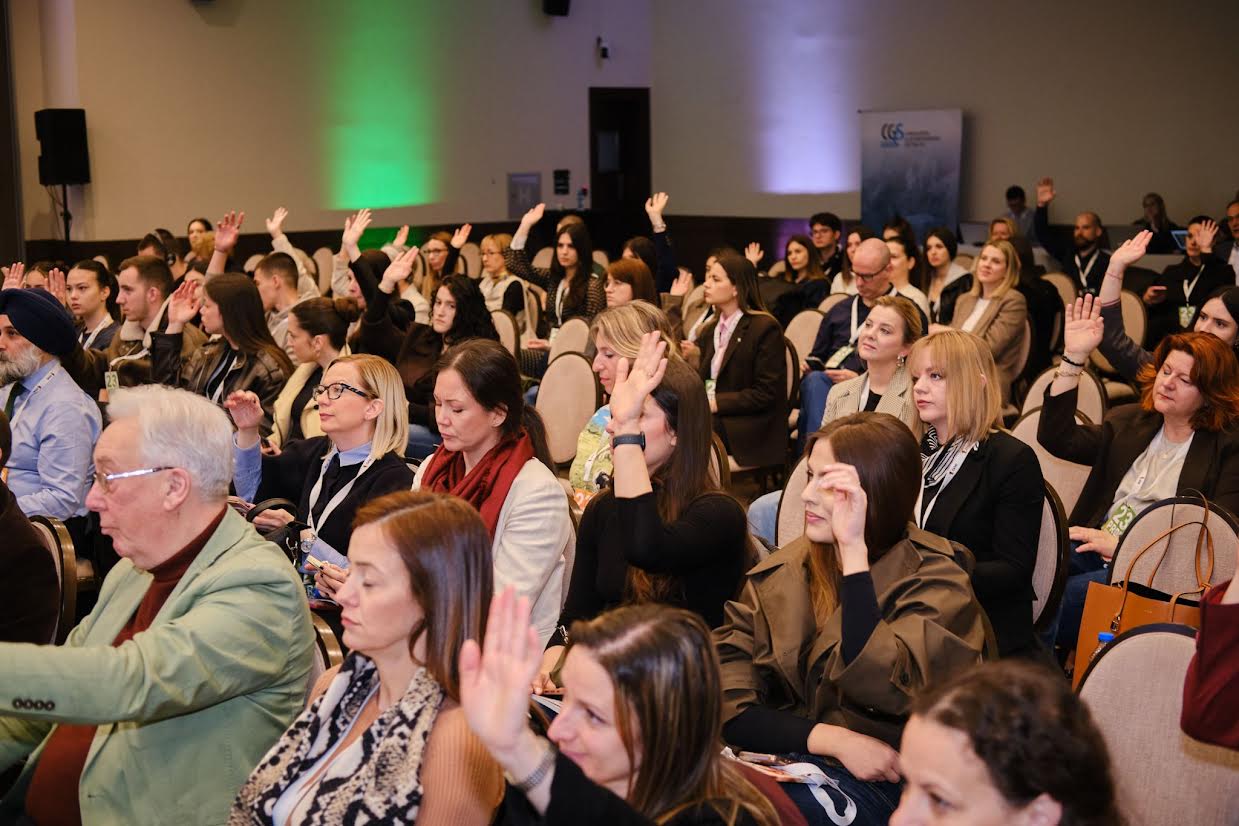
“PR professionals are the strategic pillar of every company, needed already at the moment when the house begins to be built, and not only when it is necessary to put out a fire! Proactive, present alongside top management, they are there to create a reputation on which business results ultimately depend,” these and similar statements were certainly wonderful to hear for everyone who has dedicated their career to PR. It is a great responsibility, but finally also a deserved position for all those who live by the pen, and to whom numbers are not foreign either. Because analyses and metrics are essential for the right direction of every PR ambition and communication.
The industry of influence, as the PR profession was defined at the 23rd PRO PR conference, is becoming increasingly significant in the world. From contributing to stability and peace, through company transformation, recruitment processes and employer branding, to integrated campaigns and successful sales results, well-managed PR is successfully positioning itself as an important profession in all spheres. During the three days of the professional conference held in Podgorica, the city where PRO PR was “born,” we truly heard a lot, and in the overview before you we reveal reflections and facts shared with us by some of the world’s leading PR practitioners.
The Importance of Data and the Emotion of Numbers
Hollywood portrays them as handsome agents with guns leading dangerous operations, but they are far from that. “We don’t carry guns, we don’t go into the field, we don’t arrest and we don’t kill. We mostly work in offices,” said Samuel Heath, Director of Communications at Interpol, breaking the established image of Interpol in the general public. He did not explain whether and how this important international police organization fights stereotypes, but he did share with the audience what he considers important in communications.
“Clearly defined goals, audiences and messages help organizations stay focused and avoid communication risks in today’s complex social and political environment,” Heath emphasized and added: “We know that we all hate mathematics, but we must know and use data in communication plans. They give us direction and context.”
Social media analytics, research and measurable results, according to him, are not only a tool for improving content, but also a way for communications to become an equal part of strategic decision-making in organizations. He also reminded the audience of the importance of good storytelling, of getting closer to people through sincere stories “from another angle.” “Ordinary announcements, press releases, conference records are boring. Offer simple stories, look at people differently.” Even such a large and important organization recommends stakeholder partnership in a PR approach, as well as a good choice of influencers for mass impact. Within the entire approach of “commitment to kindness,” a kind and sincere relationship with journalists, to whom the truth is always presented, alongside nurturing personal relationships, is a winning combination.
And what happens when in communication we perhaps use numbers too much, simply because the core business requires it, as is the case with banks that want to promote their credit products, and most often do so through depictions of happiness and warmth? Does the “mere addition” of emotion offer balance and can it sell the product?
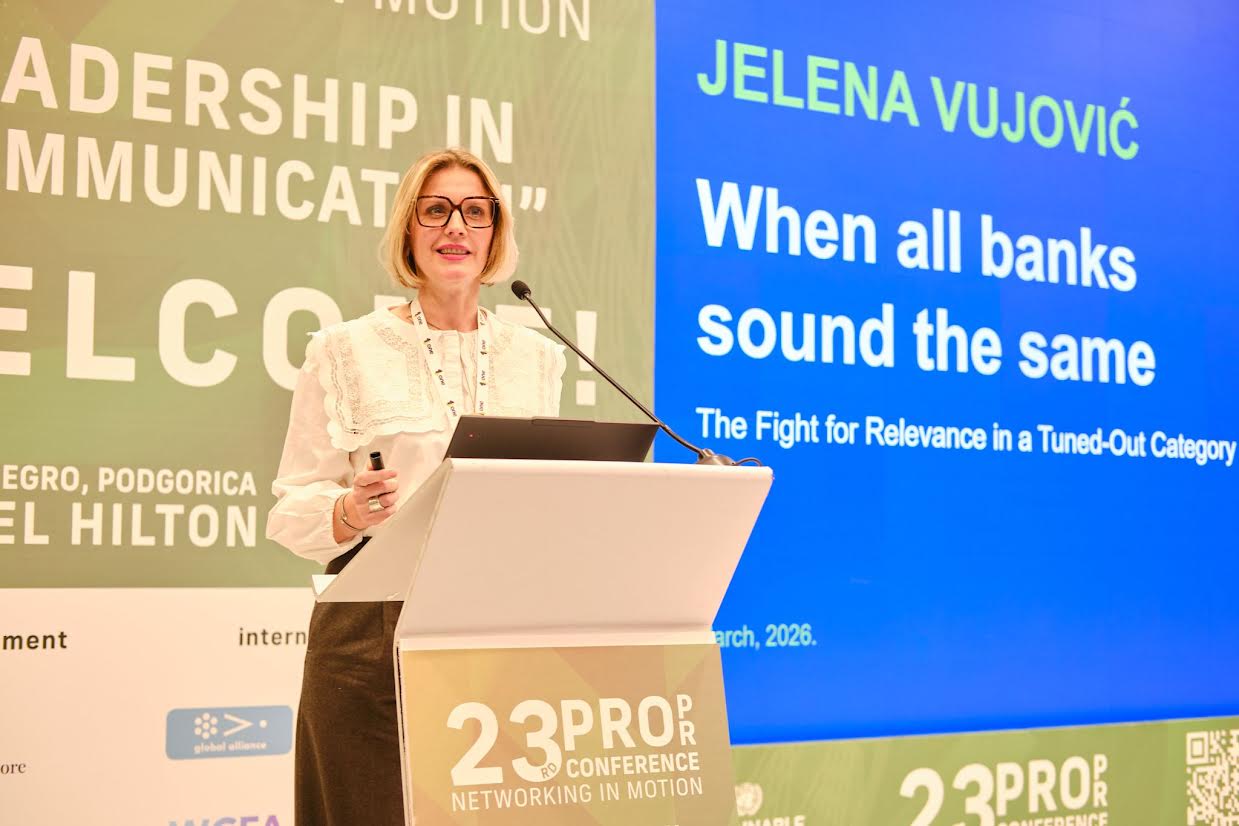
“Such stories simply become invisible, because the matrix of sameness makes them boring. Numbers do need a story, not to replace the facts, but to make them meaningful. When a number gains meaning, it is remembered more quickly (for example, 3724 people who created a home with the help of a bank),” said Jelena Vujović, Head of Strategic Marketing and Communications at NLB Banka AD Podgorica, Montenegro. Emotions can open doors in finance, but only concrete proof will earn the trust of audiences and clients, she added, emphasizing that “it is not important to have a different message, but a clear one, because the brain has limitations and remembers what is clear.”
The Future of Business with AI: Disappear, Survive, Emerge
In 2026, the emergence of AI was marked as the greatest threat to the PR industry, where both the advantages and the boundaries of its use are continuously being questioned. In general, for the first time in history, technology has challenged humanity in such a way that for now it can only conclude with certainty that some jobs will disappear, some will survive, while entirely new professions will also emerge. This was also the observation of Irena Merkaš, Head of Communications at Microsoft for the Adriatic and Balkan region, Ukraine, the Commonwealth and Croatia. “A general-purpose technology, which is changing the way we live and work, reached 1.2 billion users in less than three years. The United Arab Emirates integrated it at 64%, while in Bosnia and Herzegovina that integration is around 20%,” she points out.
Our productivity, efficiency and creativity have declined – constant distractions, even every two minutes, around 275 times a day, are one of the reasons why companies are introducing or considering the introduction of AI agents into business. “They are available 24 hours a day, full of information and ideas that the average person is sometimes not able to offer, and they are always in the mood,” says Irena.
In PR, AI is most often used for analyses and reporting, but it is also useful in recommendations and projections. Automatic translation, subtitling, animation, best shot selection – all of these are tools that speed up work. Although everyone loves it for its speed, AI does not offer authenticity, and that is where the “human touch” is still important, especially in PR. It is definite that “contextual judgment, empathy, ethical thinking and the ability to shape powerful narratives remain key human competencies,” emphasized Advita Patel, founder of CommsRebel.
The use of AI in PR, but also in journalism, opens important ethical questions – especially when mistakes or inaccurate information appear. Apart from the duty of accurate informing, the question of ethics in AI toward the public also implies the question of transparency. The audience expects openness about when and how it was used, as well as a guarantee that a human still stands behind every message. That is why regulation in this domain is important, though not yet defined. It was commendable to hear that RTV Crne Gore has introduced a code for journalists on the use of AI, but such examples do not exist in other media, nor in PR agencies or companies. The importance of this regulation was also emphasized by conference organizer Danijel Koletić, pointing out that a lack of transparency could completely endanger the PR profession. There is hardly any need to further elaborate on the importance of regulation in the world of media.
AI Against AI
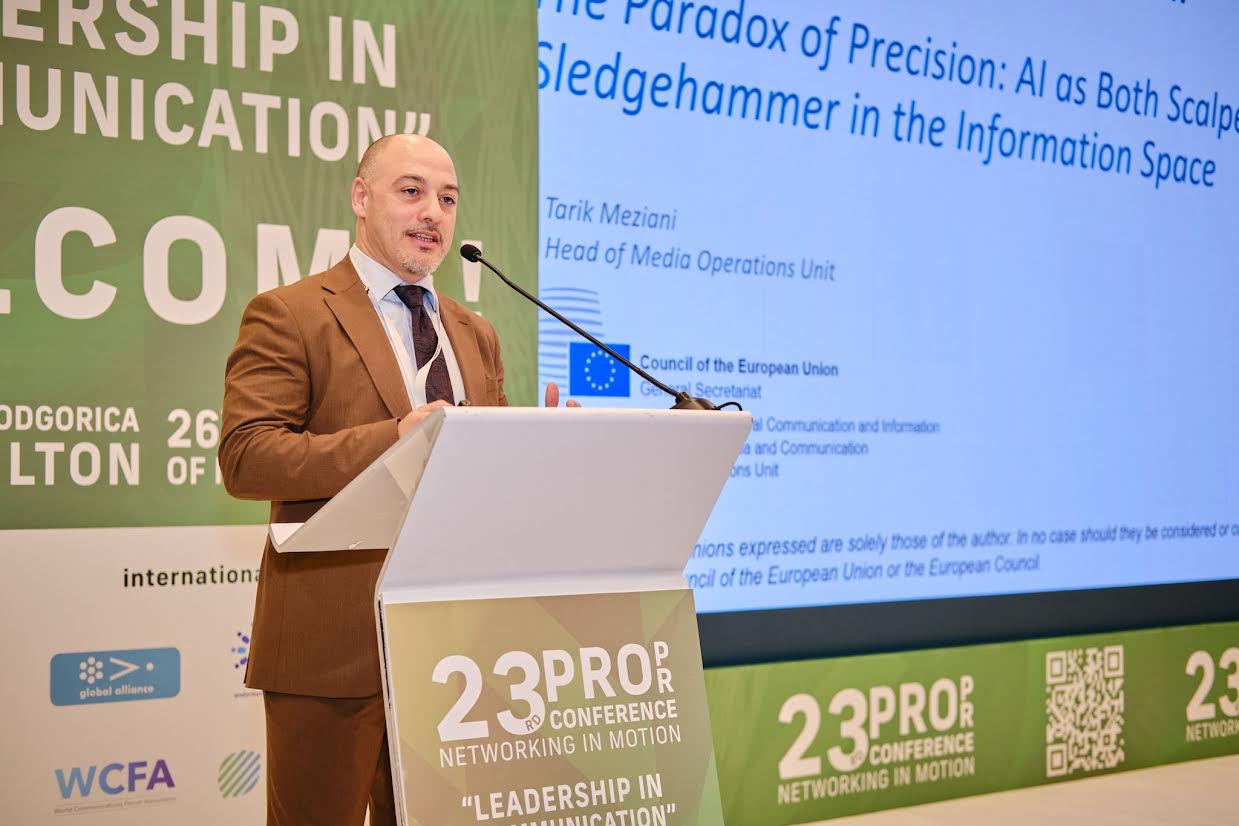
One of the biggest challenges of generative AI is the so-called “hallucinations,” situations in which systems create convincing but inaccurate information. It is precisely for this reason that “in professional communications, especially in the political and institutional context, the credibility of content remains crucial, which is why many organizations still insist on human control and verification of materials before publication,” pointed out Tarik Meziani, Head of Media Operations at the Council of the European Union, Brussels.
With the help of AI, it is possible to quickly create and distribute video or audio content that looks convincing, but is completely false. Such content can be automatically translated into several languages and spread through coordinated account networks, often much faster than institutions can react. Because of this, communicators must develop new defense strategies, including monitoring the digital space, quick reaction and the use of AI tools to detect manipulated content. Still, these tools are not infallible and can produce incorrect results, so they still rely on human judgment.
“AI should be viewed as a tool, not as a replacement for human judgment. Especially in crisis communication and in situations that require a high level of public trust, human responsibility, ethics and professional standards remain irreplaceable,” he concluded.
Trust – The New Currency
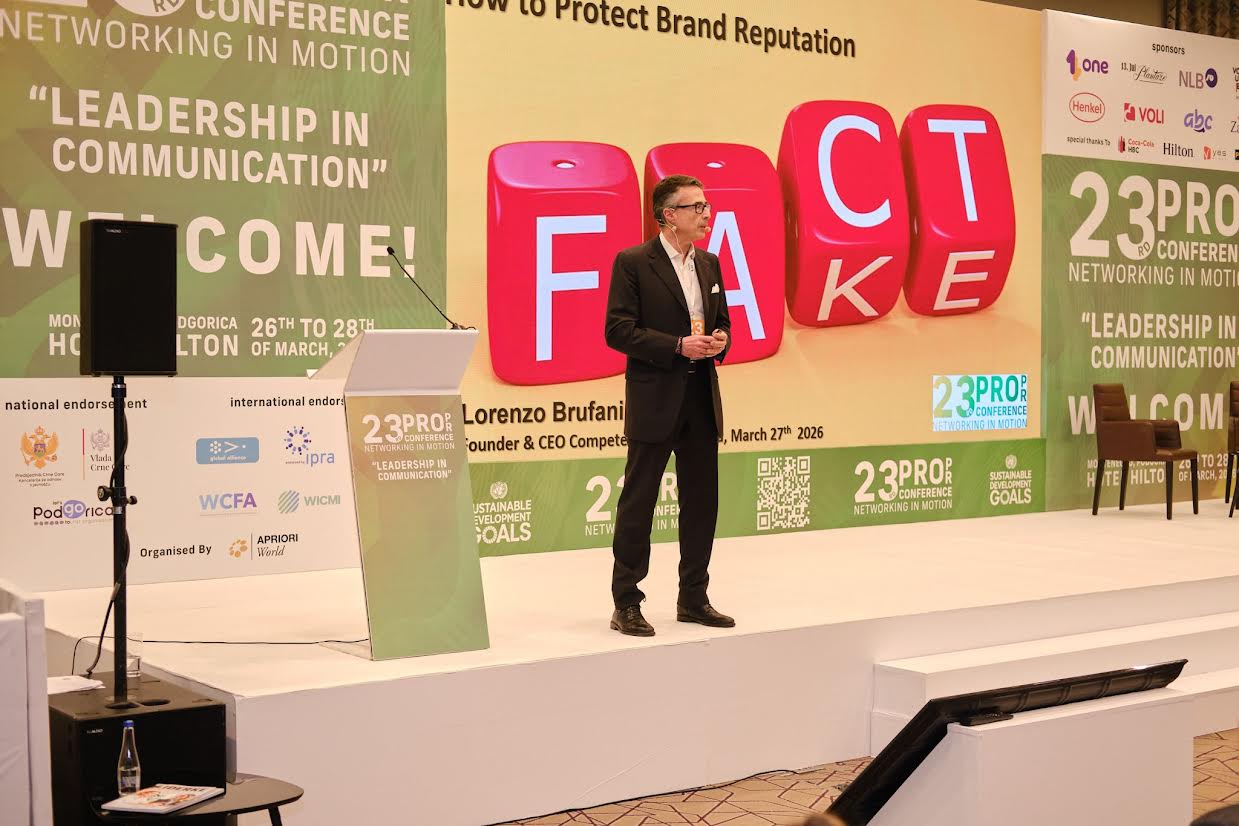
“I worry more about people becoming like robots than about robots,” is the powerful message of Lorenzo Brufani, founder and director of Competence Communication, Italy. During PRO PR, Lorenzo was also worried about the outcome of the football match Italy – Bosnia and Herzegovina, which certainly turned out to be justified 😊 (Bosnia and Herzegovina is going to the 2026 FIFA World Cup), and in his talk he also justified his opening sentence.
“I love artificial intelligence. Today it is ChatGPT, tomorrow some other tool, but can we preserve critical thinking,” he said.
It is incredible how AI can write a profile or a business plan, but an AI-generated LinkedIn profile is just an empty box, in his opinion. “I have worked for many clients and realized that reputation depends on us – we are the architects of reputation. It is not always easy to convince a CEO to have a personal profile and speak about social issues, but when they start doing that, the reputation of the company grows significantly. People trust people.”
He also reminded the audience that some agencies are already selling the GEO (Generative Engine Optimization) service in PR (the process of optimizing content with the aim of visibility within AI platforms), and that PR without innovation will not survive.

The Fight Against Greenwashing
The importance of trust was also discussed at PRO PR in the context of sustainability and ESG communication. It is paradoxical that companies, at a time when ESG is becoming a standard, are increasingly afraid to communicate sustainability – precisely because of the risk of being accused of greenwashing, of which, hand on heart, there is plenty. That is why the importance of the “Rome Declaration” was highlighted, an initiative that sets a common ethical and professional framework for the way green communication should be designed, implemented and evaluated, thereby additionally emphasizing the role of PR as a guardian of communication integrity.
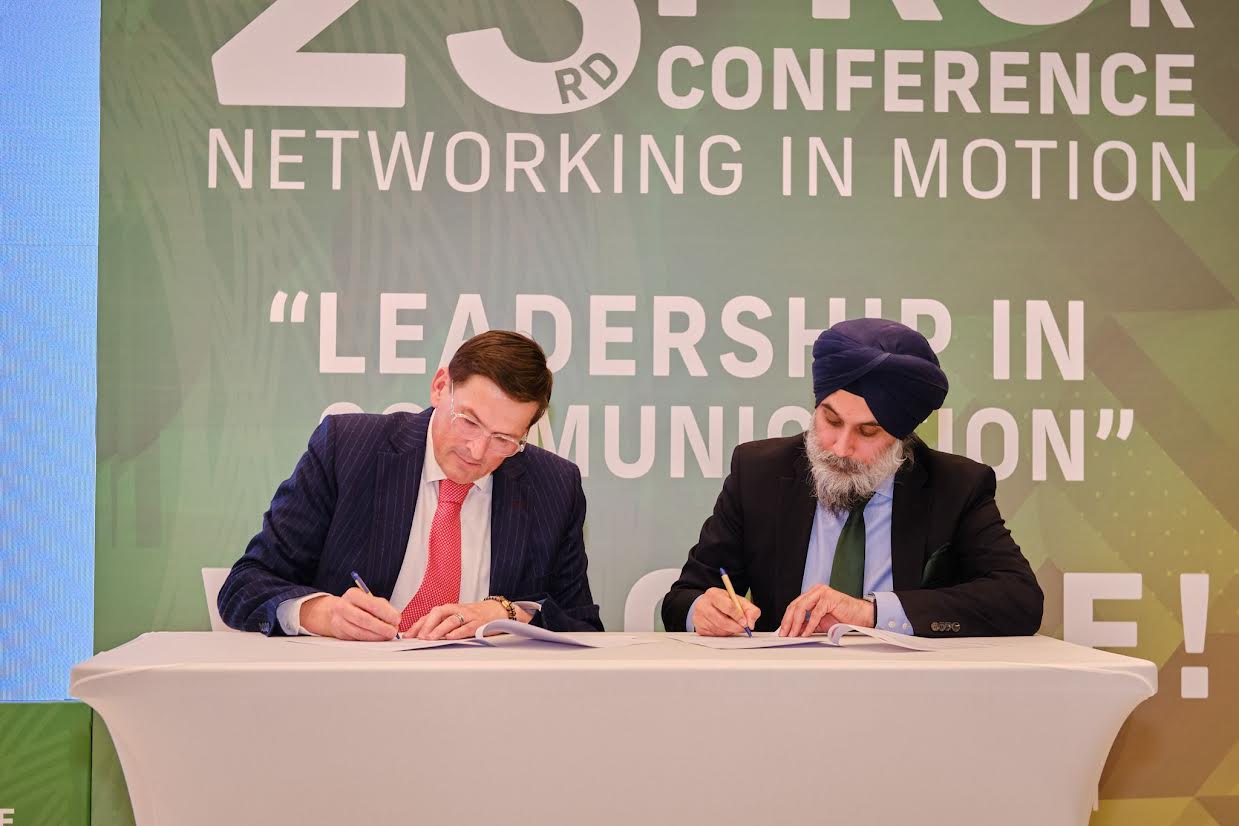
Justin Green, President of the Global Alliance organization, which gathers more than 320,000 communication professionals worldwide, put his signature on the declaration at the conference, and recognized its importance in the fact that it “encourages communication professionals to prioritize transparency, accountability and scientific accuracy when presenting sustainability strategies.”
This time, at the conference we could not hear presentations on sustainability in AI, that is, whether companies deal with the issue of sustainability and green communication when it comes to the use of AI in workflow. Given that increasingly complex modules consume more and more energy, and that there are ever greater emissions of harmful gases because of AI, we believe that this very topic will soon impose itself as a leading one in the domain of science, but also ESG and communications.
PR Licensing
Trust in the PR profession was also emphasized through the necessity of licensing PR professionals, which would position this profession at a higher level, and thus ensure service relevance for clients. In this domain as well, the conference served as a platform for progress, because its founder and the director of Apriori World, Danijel Koletić, signed a cooperation agreement with the Chartered Institute of Public Relations (CIPR), one of the most influential professional bodies in the field of public relations, which offers international certification. Koletić was also appointed CIPR Ambassador for Southeast Europe, thereby giving the region a direct connection to global standards and practices in the communications industry.
The Importance of Internal Communication: People First!
While new technologies are slowly reducing the workforce and pushing us to sharpen every possible AI management skill so that we do not end up on the redundancy list, markets are simultaneously facing a labor shortage. That is why the importance of internal communication is increasingly being emphasized, especially in the context of recruitment and talent retention.
Organizations that manage to retain people are not necessarily the ones that offer the best conditions, but the ones that build trust and a sense of belonging, it was emphasized at the conference. PR has a key role here – not only in shaping messages toward the public, but also in creating internal culture.
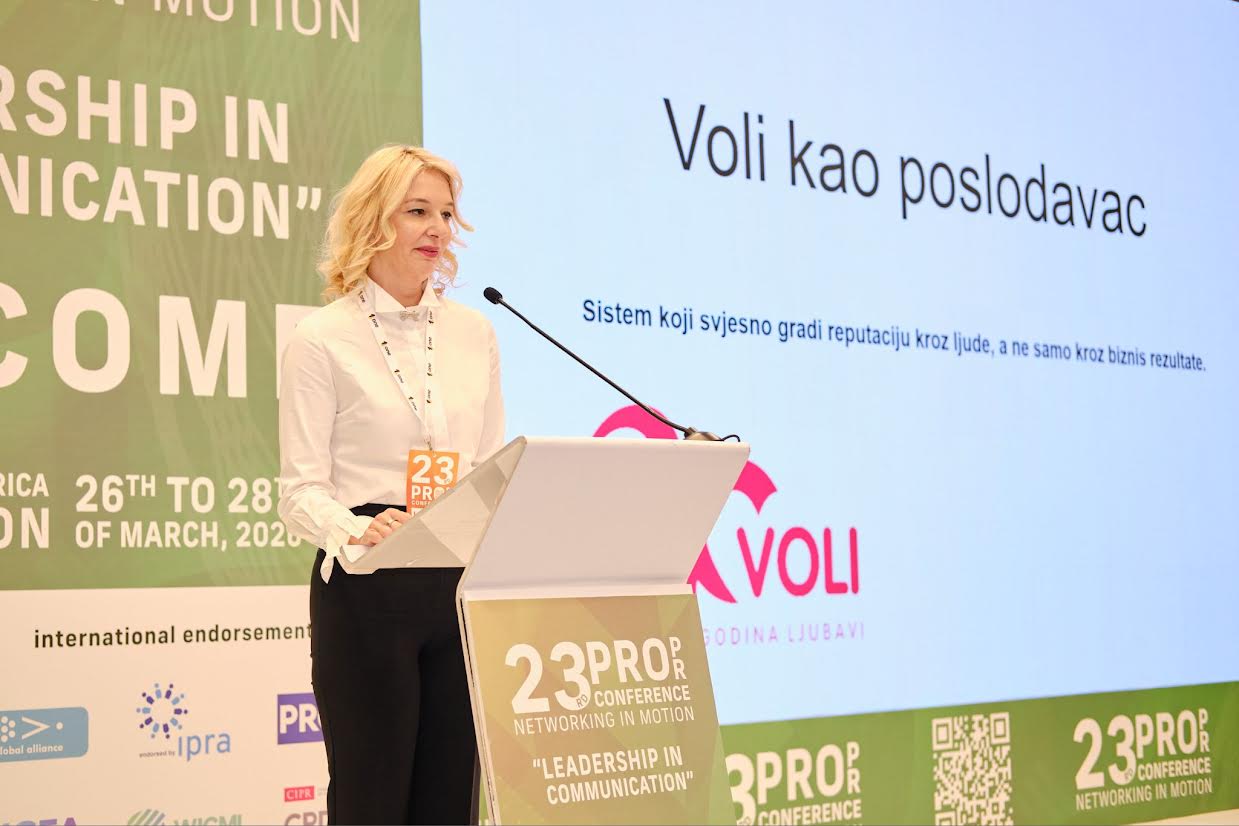
Those who are particularly good at this, and in whose business “respect for people comes first,” is the Montenegrin retail chain Voli. It was truly praiseworthy to hear how they celebrated 30 years of existence by investing 2 million euros in employees – not in facilities, not in marketing, but in people. That is why, with ease, they created authentic employer branding stories featuring happy Voli salespeople, warehouse workers and other employees, who proudly conveyed their work experiences as a strong message to future employees.
And how important authenticity in communication and a human, direct approach are, we also had the opportunity to experience from the conference organizer himself, Danijel Koletić. A witty promotion of hygiene products from conference sponsor Henkel surely led many participants to wash their hair at least three times during this three-day conference. 😊
The 23rd PRO PR conference opened many more interesting and important topics, which Justin Green, President of the Global Alliance, described as global rather than regional, due to the reputation of the participants who took part. In the summary above, we tried to reflect on the most important ones.
Montenegro: An Ideal Place for a Digital Detox
Besides the lectures, during our stay in Podgorica, the city where “foreigners are not measured by where they come from, but by how long they will stay,” we also enjoyed the excellent content provided by the Tourist Organization of the City of Podgorica. We visited Plantaže, the largest vineyard in Europe and a wine treasury, the magnificent wine cellar Šipčanik, as well as the building of the Parliament of Montenegro. Our gracious hosts also managed to bring us closer to the idea that the essence of happiness is to look at nature and recognize what we should be grateful for. In the case of Montenegro, that is five national parks, six nature parks and around 20% of protected territory, which is why this country is excellent for active tourism and digital detox, badly needed at a time when, despite all the speed of AI, we are simply no longer efficient.