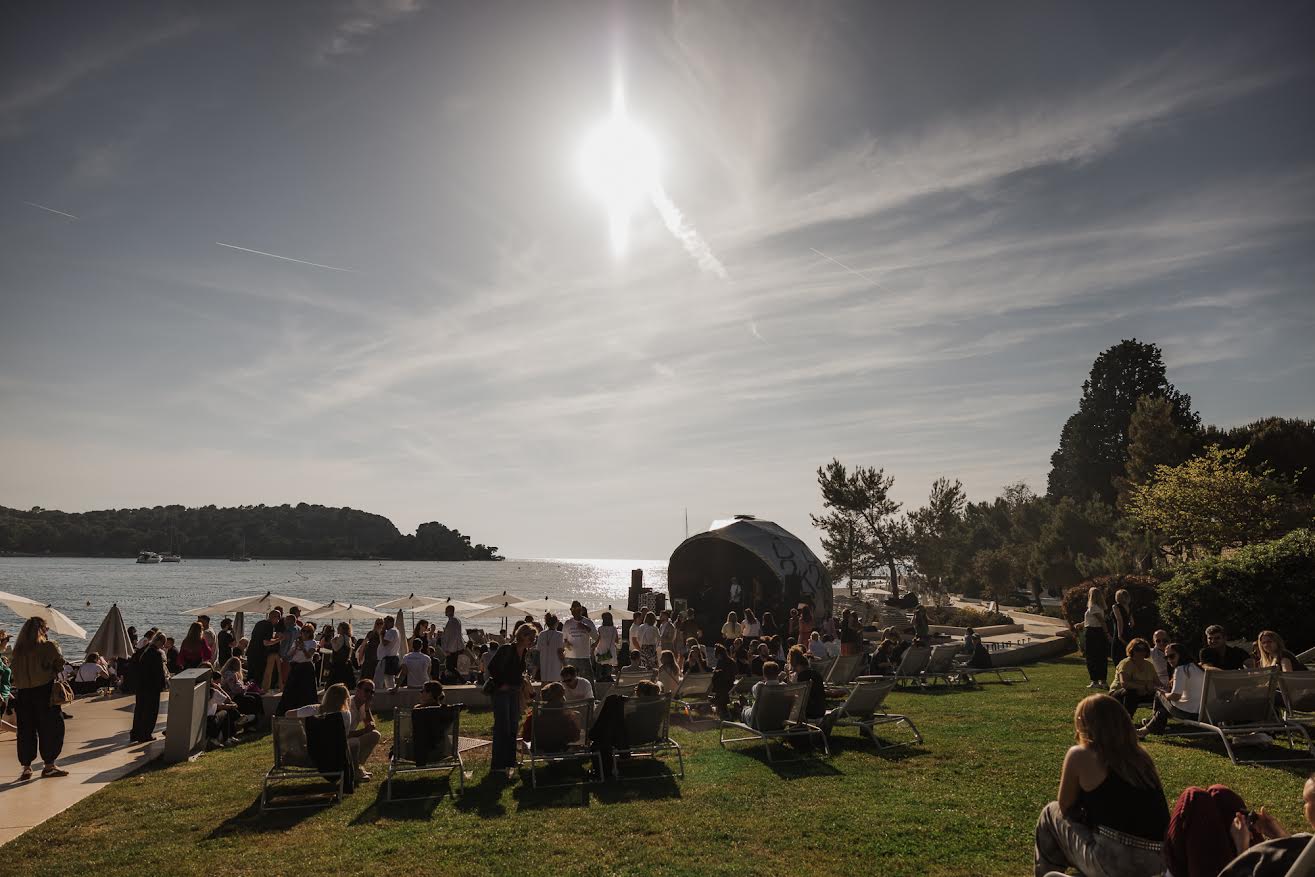
An entire work week has passed since Dani komunikacija 2026 ended, yet the impressions are still settling, rearranging themselves and returning to mind. And maybe that is the best proof of why it is worth attending a festival like this. Not because of beautiful seaside photos, networking or the impressive numbers that sound bigger every year (although there is some of that too 😊), but because of the feeling that after a few days you return different. A little braver. A little more open to change. A little more ready to question your own limits.
Today, communications are no longer just campaigns, slogans and advertisements. They are speed of adaptation, understanding people, and the ability to remain relevant in a world that changes hour by hour. And those were exactly the topics that dominated Rovinj this year.
While talks were taking place in hotel halls, by the pools and in hotel gardens, people were discussing very serious issues that our success may depend on – audience attention, trust, artificial intelligence, the generations that are coming, and a world in which it is no longer enough to simply be good.
Women who created change
On the very first day, Dora Pekeč took the stage, a woman of Croatian roots who, at only 25 years old, has become one of the biggest names in political communications in America. She spoke about the campaign for New York mayor Zohran Mamdani, a campaign that fought against enormous political and media pressure, against the “big players”, but still succeeded. All the most influential American media outlets were against their campaign, so they decided to use social media to gain attention, millions of views and, in the end, victory. But it was not only about the communication channels, it was about what they were saying and what they stood for.
“Social media was a way to amplify the message, but everything was in the message and the content,” she said during her talk, emphasizing that at a time when everyone is trying to go viral, she reminded the audience that without a genuine message there can be neither trust nor long-term success.
Instead of trying to appeal to the media, they decided to control their own story and reduced the entire campaign to one simple message: “New York is too expensive and people’s lives need to become easier.” And it was precisely in that message that many people recognized themselves and began listening to what Mamdani had to say.
And it was interesting how women marked some of the most inspiring talks at this year’s festival, because women today truly lead some of the world’s biggest communication stories. Among them was Julie Supan, one of the key people behind the growth of platforms such as YouTube, Airbnb, Dropbox and Discord. Today, the platforms she helped build generate billions of views and users, but behind all of it, as she explained, stood persistence and the ability to keep the vision clear even when others could not yet see its potential.
“What differentiated us from competitors was the ability to listen to user behavior and recognize the deeper value people were searching for,” Supan said.
We can all agree that in marketing we use many different ways to reach our goals and position a brand far ahead of others, and this year we also learned how important sound has become for brand identity. Because today we no longer remember only a logo or a color, but also a tone of voice, a rhythm, the sound of an app or the way a brand speaks to us. Sometimes sound unconsciously drives us to reach for a brand and make a purchasing decision.
The AI era
It was also fascinating to listen to the panel about Generation Z’s relationship with artificial intelligence. McCann and UM, members of AMA Group, conducted a study called “Tool, Toy, or Trojan Horse”, involving 3,300 young respondents across seven markets. The results showed that Gen Z does not seek perfection, but honesty. They do not blindly trust AI, they verify the information they receive and want authentic content. They agree that AI will accelerate the industry and that we already use it every day, but for now it will not replace human emotion, intuition and authenticity. That is precisely why people increasingly say that technology will not defeat creativity, but instead force it to become even better.
The same conclusion was reached by Jürgen Schmidhuber, a man many describe as the father of modern artificial intelligence. Listening to someone whose work laid the foundations for technologies now used by almost every AI system felt almost surreal. While we admire the creations of ChatGPT and other AI programs, he is already observing how artificial intelligence could transform the entire universe, thinking and researching on which other planets it could possibly be used more efficiently. But in the end, he said that robots will not replace humans just yet because they still lack fine motor skills. However, in the near future it will not only become possible to replace us, but robots will also exist that can repair and control one another. Still, perhaps the most important thing was that he did not speak sensationalistically. He did not spread fear. He spoke about responsibility, development and the fact that technology itself is never good or bad – it depends on the people who use it.
And between all those serious topics, the festival also had its other, almost cinematic side. We petted robot dogs that walk, jump and react almost like real pets. We watched technology become part of everyday life faster than we ever thought possible. And probably for the first time, we truly felt that the future is no longer something that is coming, but something that has already arrived.