
This year’s Dani komunikacija 2026 once again confirmed why it is considered one of the region’s most relevant meeting points for the creative industry, marketing and business. Some of the world’s leading experts in branding, digital communication and the future of business took the stage in Rovinj, while audiences spent several days listening to a series of inspiring, educational and highly practical talks about how brands that endure are built today.
How YouTube and Airbnb Found Their Identity by Listening to Users
Julie Supan, the woman who served as the first CMO of platforms such as YouTube, Airbnb, Dropbox, Reddit and Discord, spoke about something many companies today try to skip: defining identity before growth. She emphasized that brands most often fail not because of a bad product, but because they never clearly defined who they are.
Speaking about companies that have become part of the everyday lives of billions of people, Supan reminded the audience that neither YouTube, Airbnb nor Discord knew from the beginning what they would eventually become. What separated them from competitors was their ability to listen to user behavior and recognize the deeper value people were searching for.
YouTube did not win because it was the most technologically advanced platform, but because it simplified video sharing and enabled people to express themselves, upload their own videos and potentially become famous or build careers through the platform, as happened with Justin Bieber. Airbnb did not build global success solely on accommodation rentals, but on the feeling of authentic travel experiences and the opportunity for travelers to feel like locals in a “foreign city.” Dropbox was not selling file synchronization, but a sense of security and simplicity.
In all of these examples, as she explained, the key was not aggressive expansion, but clarity. The strongest brands do not try to be everything to everyone. They define what they are, but even more importantly, what they will never become.
The Biggest Problem of Modern Brands? They Appear Like Different People Across Different Channels
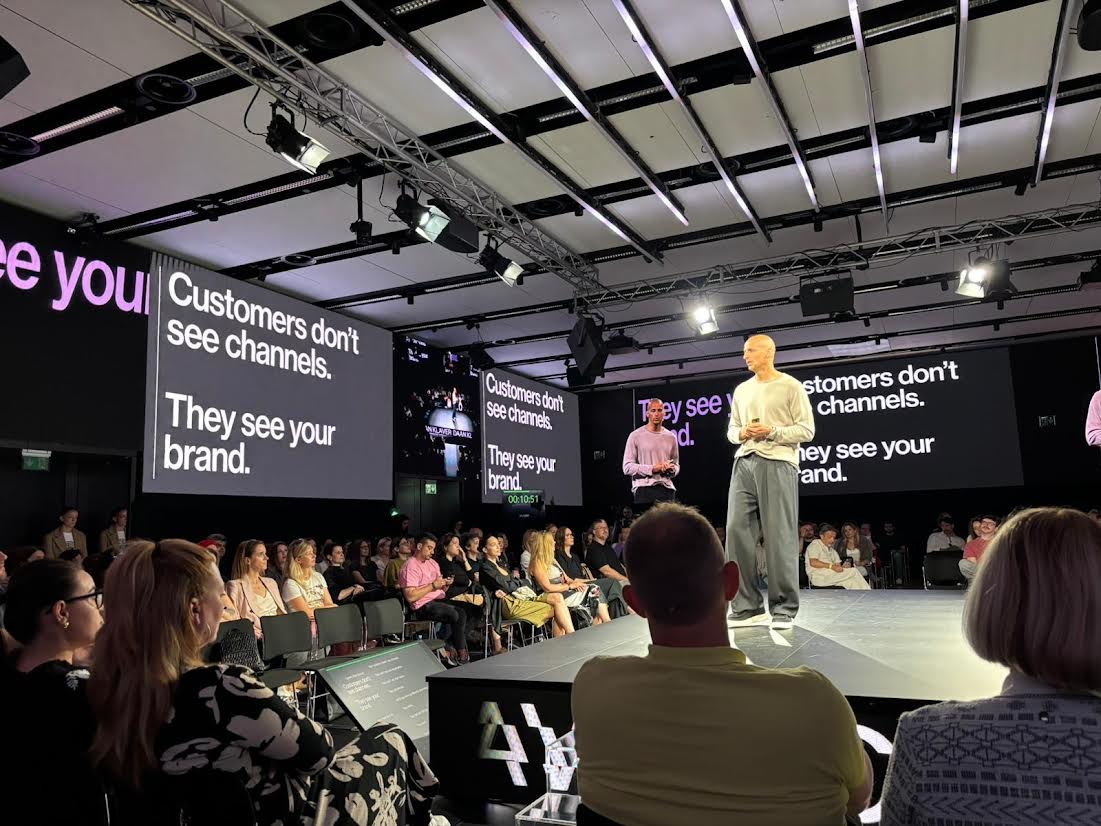
That idea was further explored in the talk by Daan Klaver, co-founder and creative director of Build in Amsterdam, about brand consistency and the “connected commerce” approach.
It was a lesson in why the world’s biggest brands do not win because they have the best product, but because they spend years building recognizable and emotional relationships with people. Klaver said that people do not buy rationally. “We buy what feels familiar, what we recognize and what we trust.” According to him, consistency is therefore not an aesthetic detail, but a business strategy.
Using the example of Coca-Cola and Pepsi, he showed how Coca-Cola spent decades winning through consistency in its logo, color and taste, even though research often showed that people preferred Pepsi in blind taste tests. When Coca-Cola attempted to change its formula through “New Coke,” audiences did not react rationally, but emotionally, fighting to restore the original version because the feeling of familiarity had been disrupted.
He connected the same logic to Apple and the evolution of the iPhone. The strength of Apple, he explained, is not only in technology, but in the fact that users never feel they have to “relearn” the brand. From product packaging to user experience, everything feels familiar, controlled and consistent.
He particularly warned that modern brands today often behave like different personalities across different channels, one thing on Instagram, another on the website and something entirely different in stores. The problem is that users do not see internal company departments. They see only one brand. And if that brand is not consistent, trust disappears.
He sees the solution in the concept of “connected commerce,” a unified customer experience across every touchpoint. According to him, a website is no longer just a website, but the central place of identity, data and relationships with users.
At a time when Artificial Intelligence is increasingly taking over communication with consumers, Klaver warned that consistency will become even more important. AI can represent a brand well only if the brand identity is clearly defined and systematized. Otherwise, technology will only amplify confusion even further.
A brand is a feeling that remains the same regardless of where the user encounters it.
What Today’s Brands Can Learn from YouTube, Apple and Coca-Cola
This year’s Dani komunikacija 2026 once again confirmed why it is considered one of the region’s most relevant meeting points for the creative industry, marketing and business. Some of the world’s leading experts in branding, digital communication and the future of business took the stage in Rovinj, while audiences spent several days listening to a series of inspiring, educational and highly practical talks about how brands that endure are built today.
How YouTube and Airbnb Found Their Identity by Listening to Users
Julie Supan, the woman who served as the first CMO of platforms such as YouTube, Airbnb, Dropbox, Reddit and Discord, spoke about something many companies today try to skip: defining identity before growth. She emphasized that brands most often fail not because of a bad product, but because they never clearly defined who they are.
Speaking about companies that have become part of the everyday lives of billions of people, Supan reminded the audience that neither YouTube, Airbnb nor Discord knew from the beginning what they would eventually become. What separated them from competitors was their ability to listen to user behavior and recognize the deeper value people were searching for.
YouTube did not win because it was the most technologically advanced platform, but because it simplified video sharing and enabled people to express themselves, upload their own videos and potentially become famous or build careers through the platform, as happened with Justin Bieber. Airbnb did not build global success solely on accommodation rentals, but on the feeling of authentic travel experiences and the opportunity for travelers to feel like locals in a “foreign city.” Dropbox was not selling file synchronization, but a sense of security and simplicity.
In all of these examples, as she explained, the key was not aggressive expansion, but clarity. The strongest brands do not try to be everything to everyone. They define what they are, but even more importantly, what they will never become.
The Biggest Problem of Modern Brands? They Appear Like Different People Across Different Channels
That idea was further explored in the talk by Daan Klaver, co-founder and creative director of Build in Amsterdam, about brand consistency and the “connected commerce” approach.
It was a lesson in why the world’s biggest brands do not win because they have the best product, but because they spend years building recognizable and emotional relationships with people. Klaver said that people do not buy rationally. “We buy what feels familiar, what we recognize and what we trust.” According to him, consistency is therefore not an aesthetic detail, but a business strategy.
Using the example of Coca-Cola and Pepsi, he showed how Coca-Cola spent decades winning through consistency in its logo, color and taste, even though research often showed that people preferred Pepsi in blind taste tests. When Coca-Cola attempted to change its formula through “New Coke,” audiences did not react rationally, but emotionally, fighting to restore the original version because the feeling of familiarity had been disrupted.
He connected the same logic to Apple and the evolution of the iPhone. The strength of Apple, he explained, is not only in technology, but in the fact that users never feel they have to “relearn” the brand. From product packaging to user experience, everything feels familiar, controlled and consistent.
He particularly warned that modern brands today often behave like different personalities across different channels, one thing on Instagram, another on the website and something entirely different in stores. The problem is that users do not see internal company departments. They see only one brand. And if that brand is not consistent, trust disappears.
He sees the solution in the concept of “connected commerce,” a unified customer experience across every touchpoint. According to him, a website is no longer just a website, but the central place of identity, data and relationships with users.
At a time when Artificial Intelligence is increasingly taking over communication with consumers, Klaver warned that consistency will become even more important. AI can represent a brand well only if the brand identity is clearly defined and systematized. Otherwise, technology will only amplify confusion even further.
A brand is a feeling that remains the same regardless of where the user encounters it.