

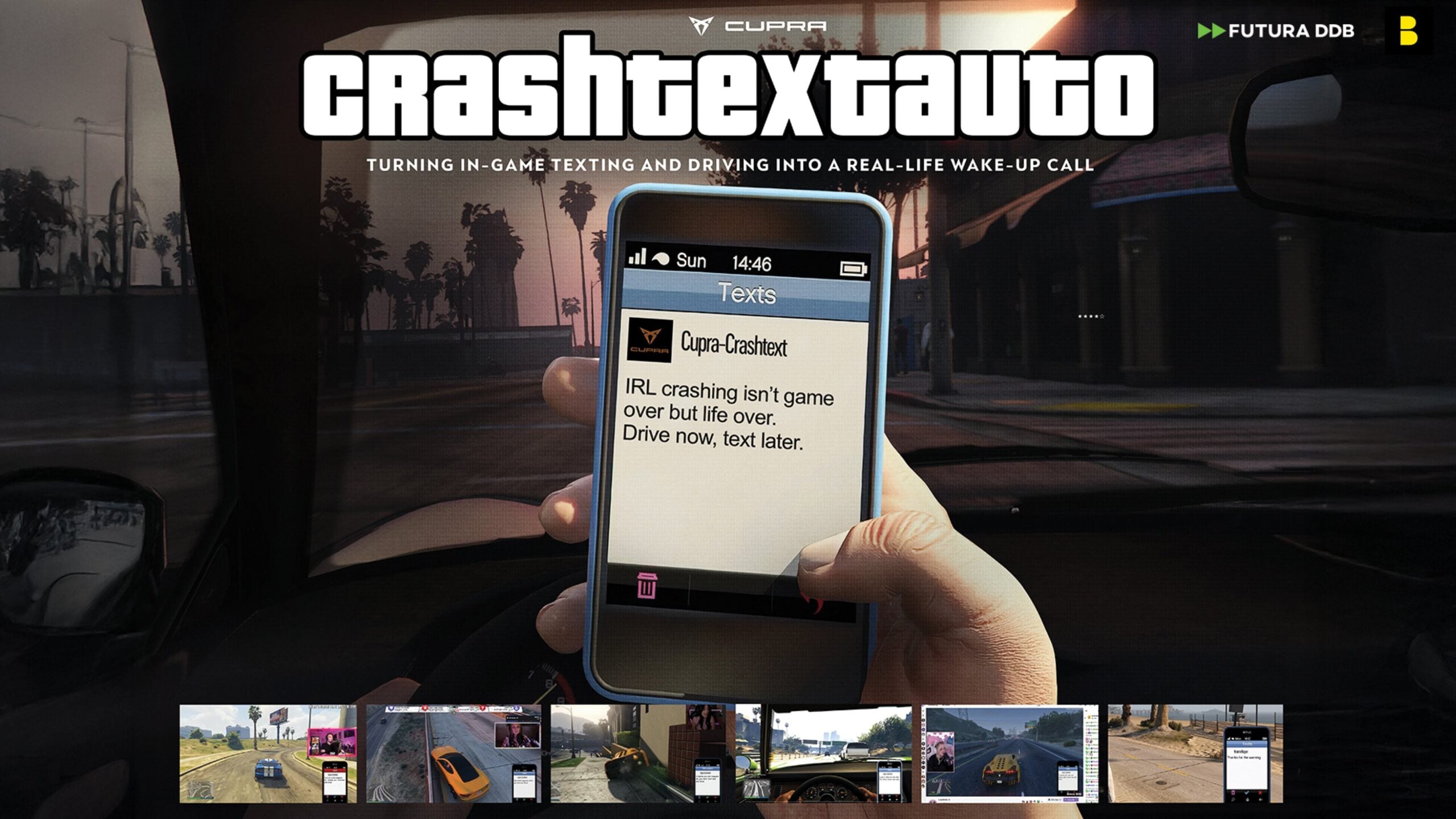
In GTA Online, a message can arrive while a player is behind the wheel. They glance at it, lose focus, perhaps crash, and then carry on playing. Futura DDB recognised an opportunity in this familiar part of the game for a campaign about a danger that, beyond the screen, has no retry button. Instead of explaining to players why they should not look at their phones while driving, the team decided to catch their attention precisely while they were driving.
This is how Crash Text Auto came about, a project developed with DDB Group Germany and SEAT/CUPRA Germany. The starting point was not an ad appearing in front of players, but a situation many of them had already experienced, one so ordinary that they had probably never even thought about it. That was precisely why a serious topic could enter the game without changing its rules. The question was whether players would recognise it as something relevant to their driving outside the game as well.
Between that idea and a campaign that could actually reach its audience lay several delicate decisions. The message had to attract attention without sounding like an institution that had suddenly appeared in GTA. It needed to arrive at a moment when its meaning would become clear, and then find its way to people who had not been in that game session. None of these steps could be addressed with a good sentence alone.
Crash Text Auto won gold at BalCannes in the Entertainment category. In the next instalment of the Behind the Winning Idea series, we talk to the Futura DDB team about how they found the right language for this topic, what executing it within the game required and how they planned to spread a campaign whose reactions they could not predict.
GTA Online is a world where risky driving and crashes are part of the fun, while the consequences are short-lived. How did you recognise an opportunity in that environment to address the serious issue of using a phone while driving?
That contrast was actually the whole insight. In GTA, players text and drive constantly, crash, respawn, and do it again with zero consequence. It’s the exact behaviour road safety campaigns spend years trying to discourage, except here it’s built into the game mechanics and nobody thinks twice about it. Gen Z is largely immune to classic PSA messaging, but they spend hours a day inside exactly this kind of environment. So instead of interrupting the game with an ad, we let the “consequence” come from inside the game itself, in a way that actually mirrored real distraction.
The messages had to feel natural within the world of GTA Online while still conveying a serious road-safety warning. How did you choose the language, tone and references that players would recognise without diminishing the gravity of the issue?
We started from how Gen Z actually talks, not how an organisation talks. This is a generation sometimes called “the unserious generation” because they meme about everything and often use irony and humour to talk about difficult topics. That doesn’t mean they take those topics less seriously, it’s simply part of the language they use to process them.
So if CupraCrashText sounded like a brand or a road-safety institution, players would clock it as corporate communication and tune out instantly. It had to read like it could genuinely come from another player: short, direct, using the gamer language and references native to GTA.
What we didn’t touch was the seriousness of the message itself. The voice around it could be culturally fluent, but the road-safety facts were never turned into a punchline or softened for entertainment. If anything, it proves that younger audiences don’t reject serious topics, they reject being spoken to in a voice that feels artificial or patronising.
The project brought together Futura DDB, DDB Group Germany and SEAT/CUPRA Germany, while the activation depended on sending a large number of messages in real time. How were responsibilities divided among the teams, and what was the most challenging part of the technical and operational execution?
The collaboration was much less complicated than the number of countries and teams might suggest. Rather than dividing the project by agency or market, we worked around expertise: whoever was strongest at a given part of the job took the lead on it. That gave us a broad mix of skills, while CUPRA stayed hands-on throughout. Having a client that genuinely believed in the idea, and was willing to stay close to something this unconventional, was crucial.
In that sense, working internationally wasn’t a challenge at all. If the team is good, it matters very little where people are sitting. What matters is clear responsibilities, fast communication and the wheels turning. Having access to different specialisms across the network was one of the project’s strengths, not a complication.
The hard part was the execution itself, on two fronts. First, timing: the message had to reach players in exactly the right moment, and doing that consistently took a genuinely manual, hands-on operation. Second, getting it in front of streamers was just as difficult.
The reactions of GTA streamers expanded the campaign from individual lobbies to the wider gaming community. To what extent was their involvement part of the original plan, and how much of the campaign’s reach developed organically?
Streamers weren’t a hopeful outcome, they were the plan from day one. With zero media budget, we knew from the very first briefing that we needed streamers to pick this up, otherwise the campaign stayed contained to individual players and never reached beyond them.
Almost none of it can be predicted, whether a streamer gets the message at all, whether it lands mid-stream at the right moment, how they’ll react once it does. So a whole part of the team was dedicated to trying to plan and predict as much of that as possible anyway: who to target, how to time it, how to give ourselves the best odds in something that’s fundamentally unpredictable.
Reddit was our other big target from the start. We wanted this to land on the largest GTA community, and it did better than we hoped: over 250,000 views in the first 24 hours, and the #1 daily post on the subreddit.
So the strategy was deliberate, but the reactions and the spread were organic.
Crash Text Auto won Gold at BalCannes in the Entertainment category. What allowed a road-safety message to function as a credible part of the gaming experience rather than as advertising inserted into it?
Mostly, we never asked for attention, we borrowed something that already existed. The in-game messaging mechanic was already part of how players communicate in GTA Online, so the format wasn’t foreign, even though the message itself was designed to catch people off guard. That’s a very different starting point from building a branded moment and dropping it into the experience.
There was also no branding to see through. No banners, no branded virtual objects, nothing signalling “ad” anywhere in the interaction. The brand only entered the story after the reaction had already happened, once the curiosity had been earned.
Because the mechanic, timing and tone all followed the logic of the game, it felt like part of the experience rather than a layer placed on top of it. That’s really the difference. Most advertising interrupts an experience and asks you to pay attention. Crash Text Auto was built to behave like it belonged there from the start, so the attention came without being asked for.

