

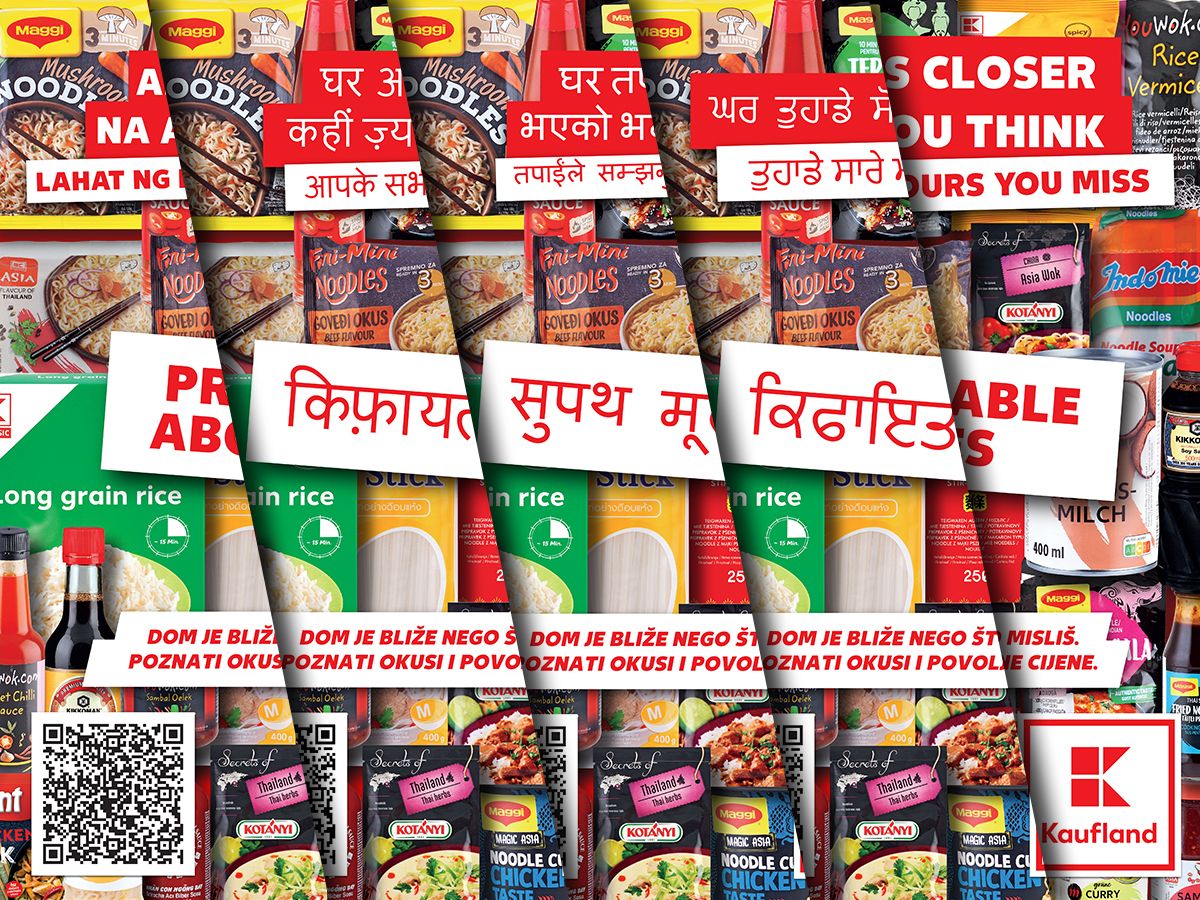
Large retail campaigns usually rely on weeks of media presence, prominent shelf displays, special prices, POS materials and various forms of in-store promotion. The Home Is Closer Than You Think campaign had none of these. It had 25 new products placed on existing shelves, a few carefully selected outdoor locations, digital ads and messages in the languages of the people the offering was intended for.
The outdoor campaign ran for six days and the digital campaign for four, while only 42 percent of the planned budget was spent. Despite this, revenue from the new Asian product range rose by 56.6 percent in the launch month compared with the previous month, nearly three times the target.
The relationship between limited resources and the results achieved explains why the project by Kaufland Croatia, creative agency Cvoke and strategic media partner OMD Zagreb won the Grand Prix at the Effie Awards Croatia. Its strength lay not in the number of ads, but in the fact that the product selection, creative idea and media plan all grew from the same understanding of the customer.
An audience retailers could no longer regard as small or temporary
By July 2025, the number of Asian workers in Croatia had exceeded 100,000. Most came from Nepal, the Philippines, India and Bangladesh, and together they made up nearly three percent of the active population. For large retailers, they had become a substantial group of customers with their own food habits and specific expectations of the products on offer.
Research showed that 79 percent of Asian workers regularly buy Asian food products, while 88 percent also purchase such items in retail chains. At the same time, the growth in the number of specialised ethnic stores in previous years showed how great the need was for places where they could find familiar ingredients.
Kaufland already stocked 117 Asian products, but had not specifically presented them to this group of customers. The business task was to expand the range by another 25 products and encourage sales, while the communication challenge was to show people who already knew what they were looking for that they could find it in a large retail chain too.
Kaufland employees from Asian countries were involved in developing the range. Their recommendations helped determine which new items to stock, what package sizes to choose and which products to highlight in the campaign. The decisions were therefore based on the experience of people familiar with the customers’ food habits, how the products are used and the cultural context they come from, rather than on assumptions about them.
The product range and the campaign were thus not developed as two separate processes. The selected range provided a solid business foundation, and the creative and media teams then sought the most direct way to bring news of it to the communities it was intended for.
Speaking the customer’s language, literally this time
Asian workers were already buying Asian food and visiting large retail chains, but none of those chains had addressed them directly. That silence created an opportunity for communication that would go beyond product availability and show that the brand understood their habits, needs and everyday lives.
When someone lives far from their home country, familiar flavours and their native language take on added value. Language attracts attention and makes the message more personal, while familiar ingredients connect with the dishes and food habits they know from home.
This insight led to the Home Is Closer Than You Think campaign, with the sales message Familiar Flavours and Affordable Prices. The team applied one of the basic rules of copywriting, speaking the consumer’s language, literally.
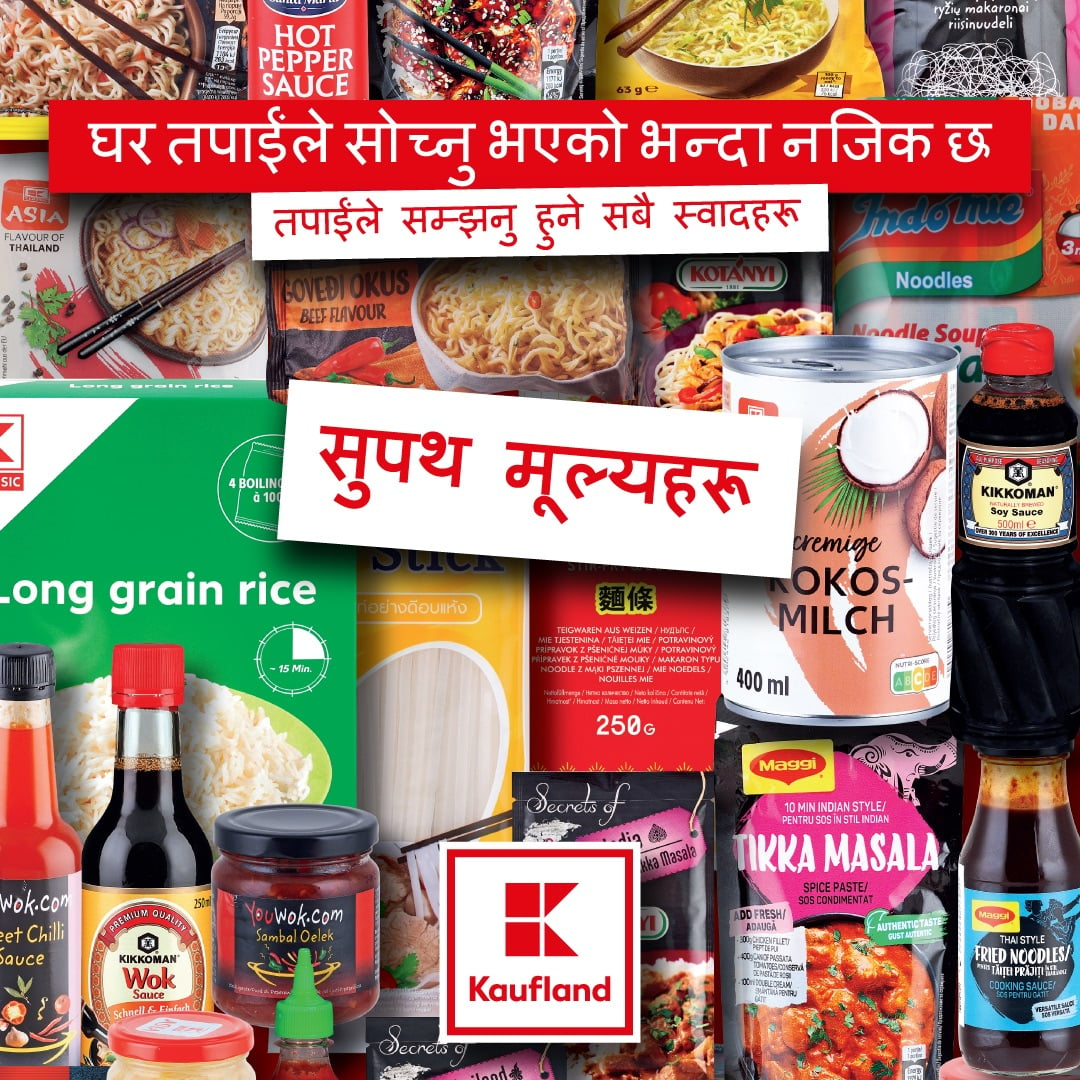
The campaign was prepared in Nepali, English, Hindi, Punjabi and Tagalog. The copy and visuals were adapted for each group, while products from the new range remained at the centre. A familiar language was meant to catch the eye and show whom the ad was addressing, while the featured products and affordable prices provided a concrete reason to visit the store.
Behind the simple final result was a demanding production process. The team worked with languages and scripts for which it had no existing infrastructure, while Kaufland, which does not operate in those markets, did not have all the necessary fonts. Latin-script rules for laying out text could not simply be applied, because words could not be broken arbitrarily to fit into two lines. In some cases, doing so could have changed their meaning entirely.
Professors from the Faculty of Humanities and Social Sciences in Zagreb were therefore brought in to check the work. The translations, their clarity and the way the text appeared in the visuals went through several rounds of review. Language corrections affected the design, and design changes required further checks, so a few words on a poster went through a large number of creative and production iterations.
The goal was not to produce five formally correct versions of the same ad, but to ensure that each one sounded natural and was legible and understandable to the people it addressed.

Locations were chosen as carefully as the words
The media strategy followed two main directions. OOH and DOOH ads were placed along routes and in locations important to the selected communities, including parts of Zagreb where larger numbers of Asian workers live and places where delivery riders often spend time, such as areas near McDonald’s restaurants. Digital ads were divided by language, with separately adapted copy and visuals.
Ad placement and language versions formed a connected media plan. Instead of seeking broad visibility, the teams selected points where the ads were most likely to reach the people the new range was intended for. Outdoor advertising presented the range in public spaces, while digital advertising made it possible to direct communication more precisely towards individual language groups.
The new products and the campaign launched at the same time, shortening the path from seeing an ad to making a purchase. When a customer came to Kaufland, the advertised product was already available on an existing shelf. There were no special displays, promotional prices, tastings or additional POS materials in the store to repeat or reinforce what the customer had seen in the ad.
This approach required close cooperation among all the teams involved. Kaufland contributed its knowledge of the product range, employees and customers, and involved people from Asian countries in the process. Cvoke developed the idea of addressing customers in their own languages and advocated for an approach that was simple in expression but unusual in Croatia’s outdoor advertising space. OMD Zagreb turned the creative concept into a plan for locations, formats and digital targeting.
Decisions about products, languages, messages and media were made jointly. The proposal came from the agency, as did the insistence on retaining the boldness of the approach, but it could not have been carried out without the support of Kaufland’s marketing team. Involving employees also prevented the product range and communication from being based on superficial assessments of what this new customer group needed.
The campaign ended early, but growth continued
The use of foreign languages in outdoor advertising drew reactions from some members of the public and political figures. Comments on social media, counter-posters and strong media pressure followed, prompting a decision to end the paid activity early so that the communication would remain within its original commercial purpose.
Kaufland did not enter the political debate or change the campaign’s fundamental position. Shortening the advertising period nevertheless meant that OOH ran for only six days and digital for four, with 42 percent of the planned budget spent.
Despite its short run, revenue from the new Asian range rose by 56.6 percent in the launch month compared with June 2025, against a target of 20 percent. Sales did not return to their initial level after the ads were removed. By December 2025, the unit sales index had reached 297, with June set as the baseline of 100, and in January 2026 revenue was still 23.5 percent higher than in July 2025.
A post-campaign study also showed a change in customers’ attitudes towards the retail chain. After the campaign, 17 percent of respondents began visiting Kaufland more often, compared with a target of ten percent. The campaign was noticed by 47 percent of respondents, against a target of 30 percent, and 53 percent had a better opinion of Kaufland afterwards.
The public debate also generated substantial organic media coverage. Over 18 days, 181 media items were recorded, with a total reach of 39.7 million and an estimated AVE of €298,384. Relative to the budget spent, media ROI was 1:23.4, without paid PR support.
That publicity, however, cannot be the main explanation for the sales success. The debate took place primarily in Croatian and in domestic media, which many Asian workers do not follow regularly because of limited familiarity with the language. Organic reach increased the brand’s overall visibility, while the change in purchasing behaviour can be linked more directly to the few days of paid communication aimed at this audience.
Efficiency with every step accounted for
Home Is Closer Than You Think won the Grand Prix and gold in the Low-Budget Campaigns category at the Effie Awards Croatia. For the jury, the project’s value lay not only in the scale of its results, but in the clearly demonstrated link between the business problem, strategic decisions and their impact.
The growing number of Asian workers created a business opportunity. Employees’ insights helped shape the selection of 25 new products, while an understanding of the value of familiar languages and flavours shaped the creative idea. Language versions were matched with selected locations and digital targeting, and sales and post-campaign data confirmed changes in customer behaviour, brand perception and revenue.
Writing the Effie entry required the team to demonstrate this cause-and-effect relationship. The strategy, product range, creative execution and media were therefore presented as connected decisions arising from the same understanding of the customer, rather than as separate parts of the project.
The limited budget provided an additional test of whether those decisions were justified. There was no room for broad targeting, a long advertising period or promotional mechanisms that might compensate for any weaknesses in the idea. Every product, translation, format and location had to serve a clear purpose.
The result confirms how understanding an overlooked customer group can matter more than the size of the media spend. Kaufland addressed people whom the market had largely viewed through statistics on the growing number of foreign workers through their languages, food habits and the products they were actually looking for. A few days of that communication were enough for its impact to last for months.
The Team Behind the Project
CVOKE
Copywriter: Matea Lapornik
Design: Ana Baričević
Creative Director: Nebojša Grbačić
KAUFLAND
Marketing / MKT, Head of Sector / BL: Lea Ileković Žigić
Head of Digital Marketing Department / AL Digital Marketing: Marina Marinčić
Head of Promotions Service: Ivan Širanović
OMD ZAGREB
Digital Director: Saša Milinović

