

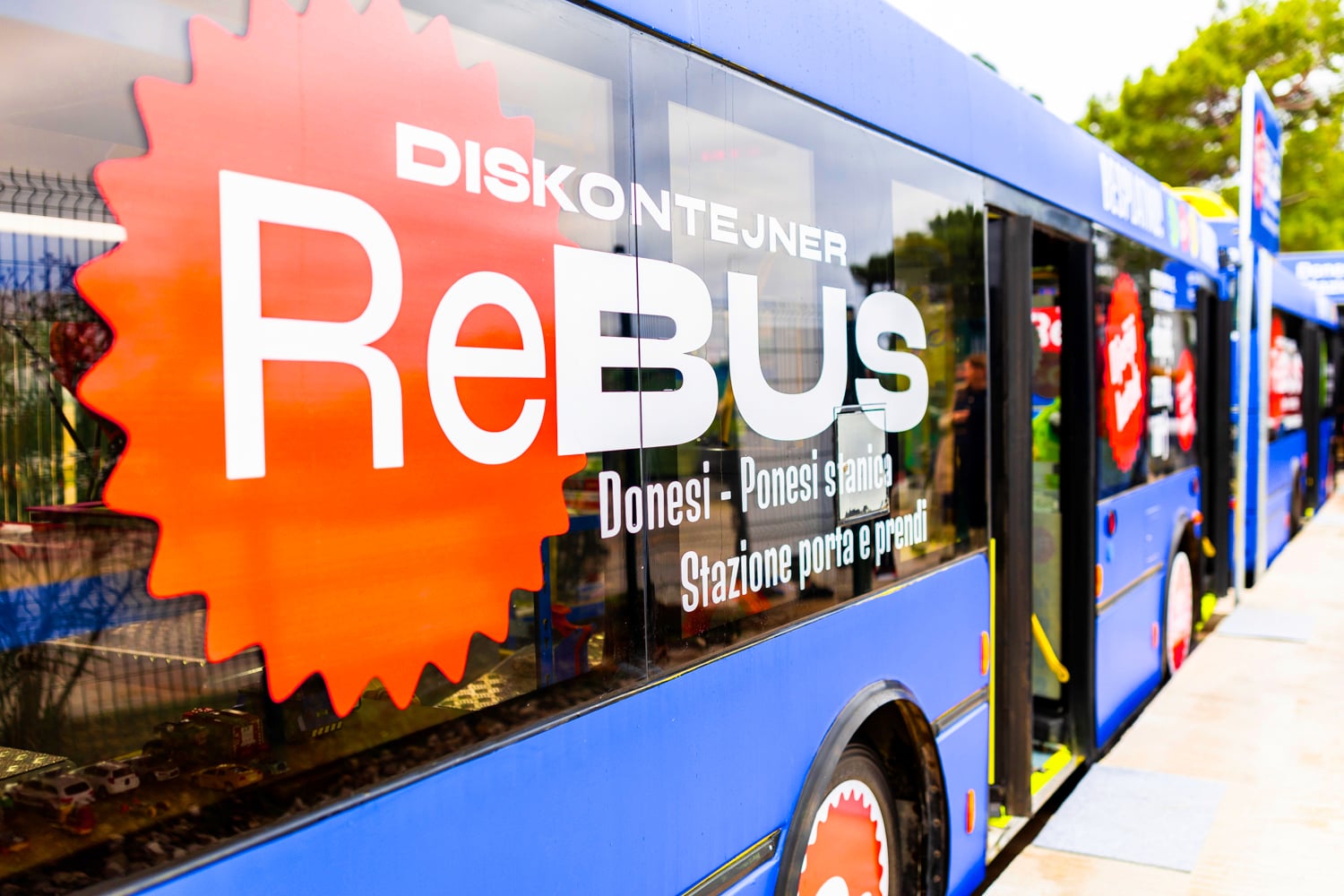
A dinner conversation about waste separation ended with a statistic that opened an important question for the creative team: who are initiatives like this actually speaking to? More than half of people do not recycle, while those who already do will probably find their own way to a recycling center. ReBus therefore looked for a way to reach an audience for whom reuse and sustainability are not yet part of everyday habits.
The inspiration came from a place where people might least expect it: the world of discount stores. Large prices, bright colors, promotional leaflets, and messages promising a good bargain took on an entirely new role. Instead of inviting people to buy, they offered a simple exchange: bring what you no longer need, find something you do need, and take it without paying.
“Permanently low price,” “It can’t get any cheaper,” and “€0” took on an entirely different meaning in ReBus. Here, there is no product behind them that needs to be sold, but an item that someone no longer needs and someone else can take without paying. What usually encourages purchasing thus became an invitation to look at what already exists before buying something new.
Students from the School of Applied Arts and Design Pula also took part in shaping ReBus, while students from the Industrial and Crafts School carried out the technical work. The slogans and messages were developed through workshops, and their directness and freedom from the rules of professional communication became part of the project’s identity.
In the first month alone, 126 cubic meters of items were saved through ReBus, while since the beginning of the project, 40 tons of waste have been prevented from being generated. Alongside the exchange of things, something also emerged that could not be reduced to numbers: conversations about objects, repair advice, and a space where people began exchanging more than what they had brought with them.
We spoke with Jelena Fiškuš and Sean Poropat, creative directors and co-owners of Studio Sonda, about the project that won golds at IdejaX in the Miscellaneous, Branding, and Nature categories, about how they brought ReBus closer to people for whom sustainability is not necessarily an important topic, why they turned to the aesthetics of discount stores, and what they learned once the idea reached citizens.
ReBus deliberately did not speak only to people who were already environmentally conscious. How do you design a sustainable initiative for an audience that may not be interested in sustainability at all?
If we want to achieve real, tangible changes in society, we have to stop communicating only within our own eco-bubble. Recently, we were sitting at a dinner and the conversation turned to waste separation, and it turned out that more than 50% of people do not recycle waste, which shocked us because, as an individual, such a situation simply seems unimaginable, but apparently that is the reality. It made us think seriously. People who already recycle and care about the environment will come to the recycling center anyway. Our goal was to reach the other extreme, the audience that browses retail chain leaflets every day looking for the cheapest products, without realizing at all that there is a very good alternative to throwing things away and buying them again.
To reach them, we could not use the classic educational, somewhat patronizing language of sustainability, the kind that actually puts them off. We therefore designed the initiative using absolutely all the triggers from the world of discount stores and promotions: strong colors, massive typography, “promotional” stickers and messages, sale aesthetics… We took over the mechanisms of fast consumption they are bombarded with every day and used them as “bait” for something completely opposite, education about the circular economy. Instead of forcing them to learn the language of sustainability, we “packaged” sustainability in the language they use and understand.
How did you turn familiar slogans such as “Permanently low price” and “It can’t get any cheaper” into the identity of a public service, without the idea remaining just a witty joke?
As always, the key is that there is a real, grounded truth behind the communication messages, rather than just a copywriting trick. When a classic discount store says “Permanently low price,” it is still selling you something, taking your money, and quite often pushing a low-quality product on you.
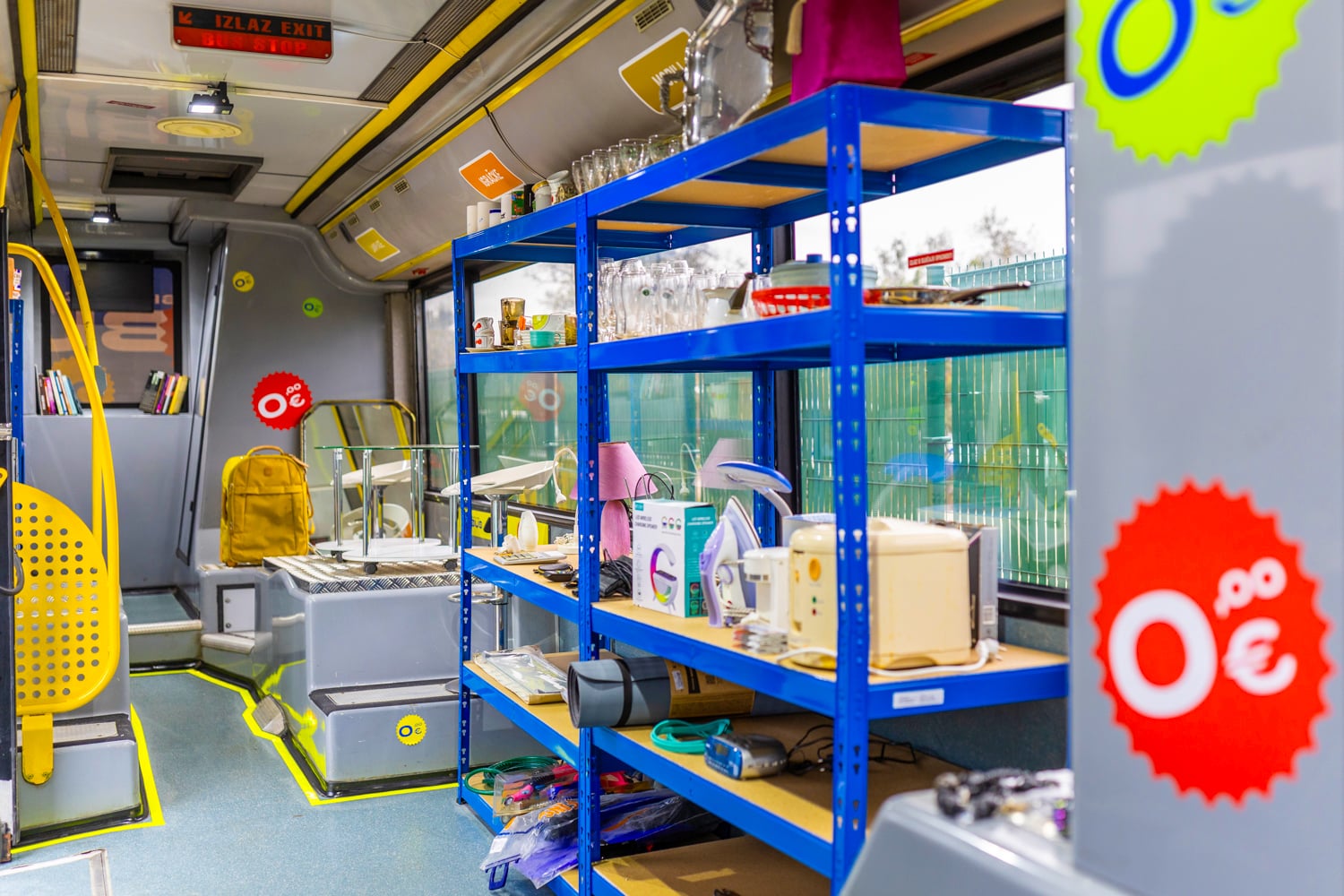
When we say “It can’t get any cheaper” or “€0” in ReBus, we mean it quite literally. There is no checkout, no receipt. We turned familiar, hyper-commercial slogans into very literal instructions for using a public, free service. Those slogans attracted attention because people recognize them, but they did not remain just a joke because behind them there is solid infrastructure and repurposed buses into which you can actually bring an item you do not need and take one you do need completely free of charge. A joke becomes an identity the moment you can physically fulfill the promise from the slogan in the space.
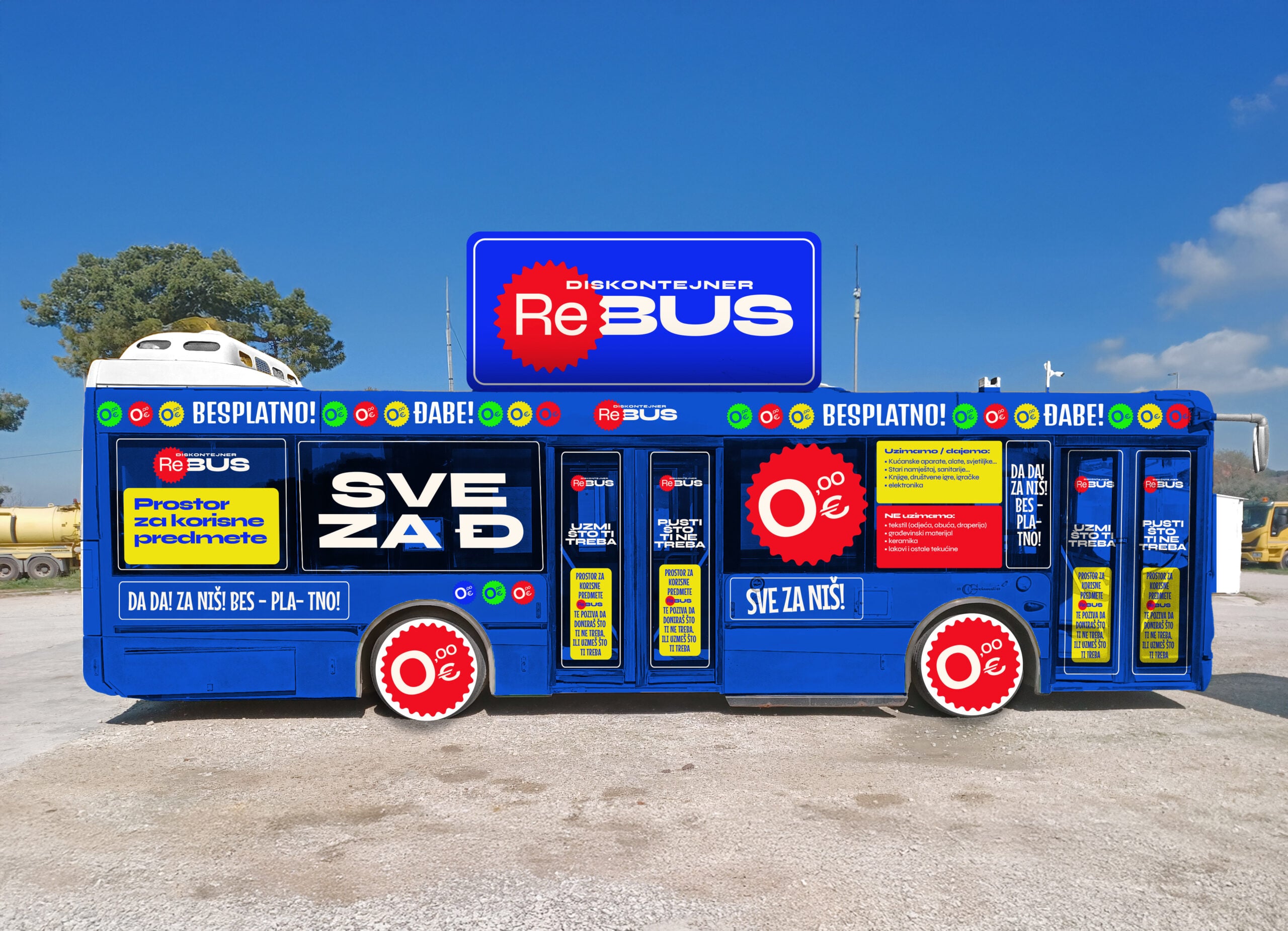
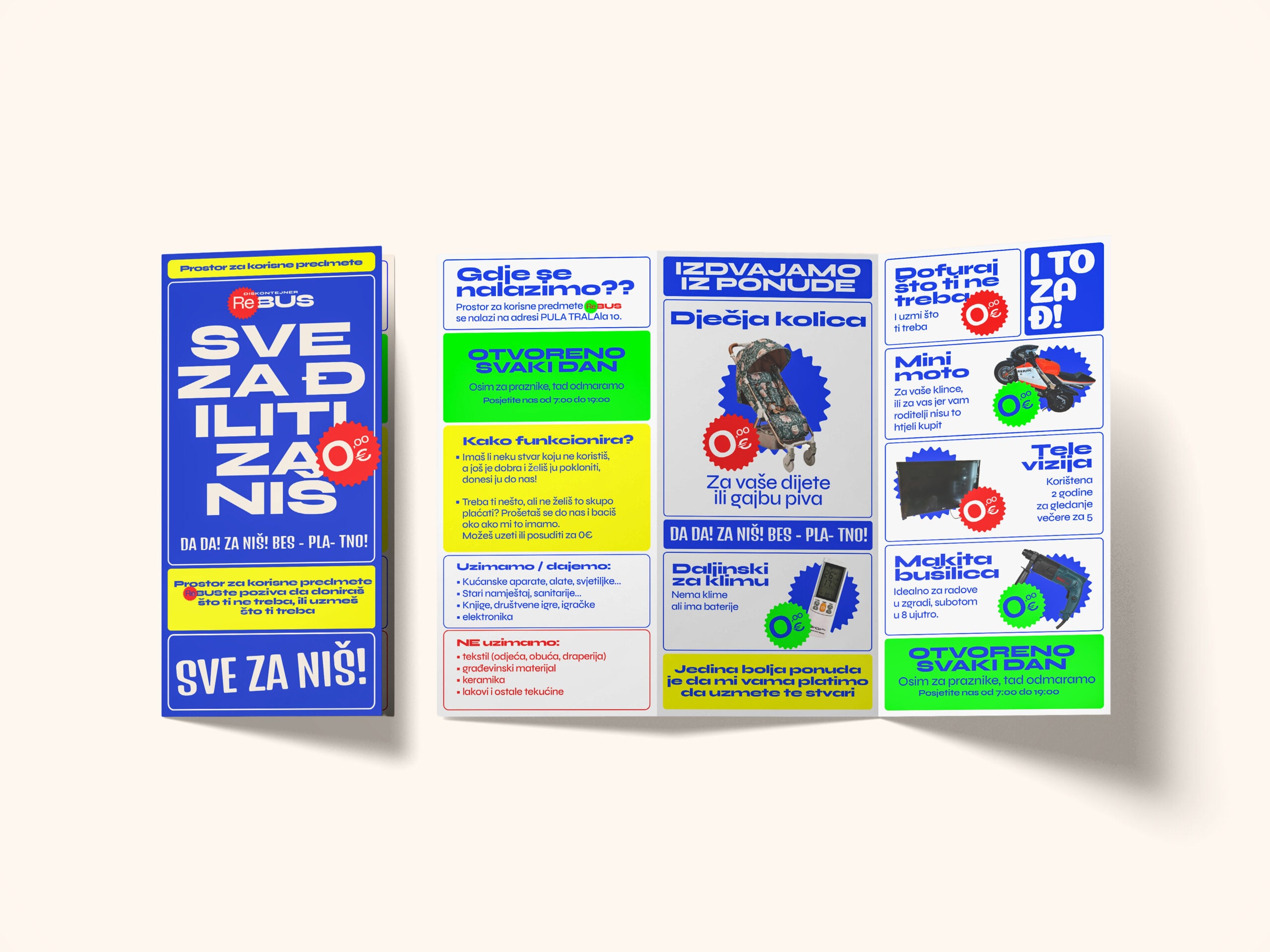
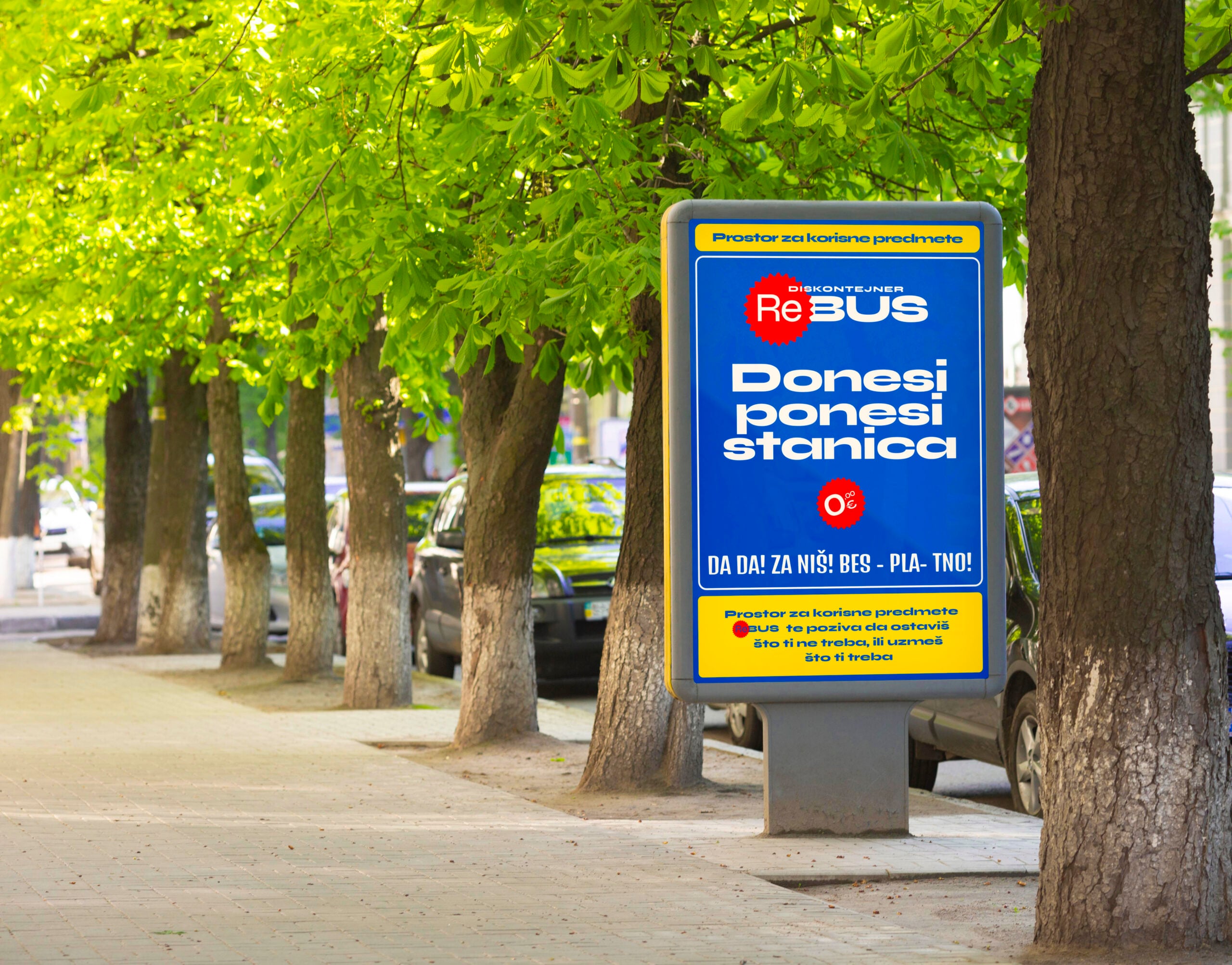
The final design and slogans were created through workshops with students from the School of Applied Arts and Design Pula. What did their perspective bring to the ReBus creative system?
Working with young people from ŠPUD and the Industrial and Crafts School (who carried out the technical work) brought an incredible amount of authenticity and boldness into the entire process. As professionals, we are sometimes constrained by the rules of design and communication that we have learned over the years, but students do not carry that burden.
They understood the “discount” approach instinctively and, through the workshops, created slogans and messages that were uninhibited, direct, and witty. Their perspective brought that specific local and youthful energy, but it also showed something much more important: that younger generations, when given an opportunity and a concrete framework, are more than capable of articulating complex topics such as sustainability. In that way, the project is not just passive learning, but active practice in which students understand that their design can solve concrete municipal problems in the city.
ReBus saved 126 cubic meters of items in its first month alone, while the project has prevented 40 tons of waste from being generated since its launch. What surprised you most about the citizens’ response?
Honestly, what surprised us most was how quickly and naturally that change in habit happened. Very often, people simply do not want to pollute, so if they are educated and offered simple, accessible infrastructure, behavior changes. By implementing ReBus, we gave the public an adequate space and clearly communicated the rules of the game in a language they understand. The results from just the first month of operation are data that prove there is a significant and unmet need among citizens for similar activations. We were also delighted by the ease with which the “bring-and-take” concept was accepted. The buses did not become “dumping grounds for old things,” but spaces for encounters, exchange, and genuine human solidarity, while the creation of the project itself was also a strong example of cooperation between the public, private, and educational sectors. We would like to see more collaborations like this because they are a model that gets things moving!
Is there anything you would add to ReBus’s creative system today, now that you know how the community has embraced it?
It has had a great start, and we can only wish it a long and fulfilling life and that it becomes a permanent bring-and-take station. And for society in general, even more actions like this, especially now that we know how powerful that sense of community can be. ReBus is no longer just a place for leaving items, but a place where people communicate, exchange stories about those items and repair advice, and in the future we would like to design tools that further encourage this.

