

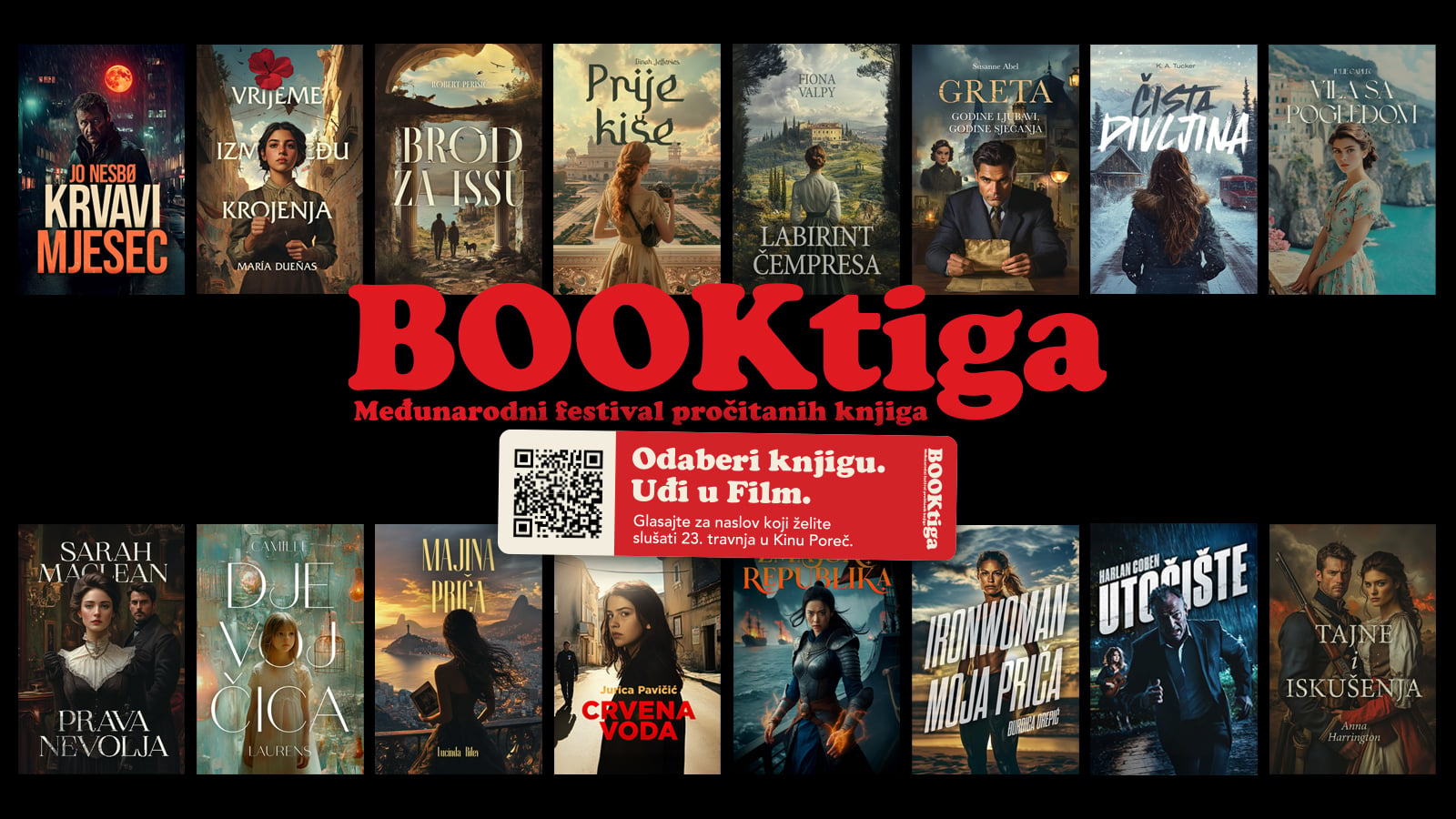
We can change the platform, format, screen and length of the content that holds our attention, but one need remains rather stubborn: we still love good stories. We need them to connect us, to recognize ourselves or someone else in them, to pass on experiences and values through them. The problem for books, then, is not that audiences have lost interest in stories, but that they have become accustomed to finding them somewhere else.
Studio Sonda decided to go exactly there for the Poreč City Library. Instead of yet another call to read, BOOKtiga adopted the visual and communication language of the content that captures the attention of that same audience every day. Books were given the look of movie blockbusters, descriptions resembling trailers, the web logic of a streaming platform, while city posters became places where a story first attracts attention and only then reveals that behind it is not a new series, but a book.
Digital language served as an entry point into the world of books. Artificial intelligence enabled the production of visuals and texts for more than a hundred titles, algorithmic logic helped audiences discover content, while streaming aesthetics gave the campaign a familiar rhythm. Technology opened the door, but the story remained the reason to walk through it. This is where Studio Sonda drew the line between the tool and what makes a book worth reading.
That is why the ending of BOOKtiga is almost the complete opposite of its beginning. Slučaj vlastite pogibelji by Kristian Novak, the book that received the most audience votes, was given no digital adaptation at all. It was performed in a cinema by Judita Franković Brdar, without the technological spectacle that had preceded that moment. After the screens, algorithms and generated visuals, what remained were the voice, the text, the audience and the reason the campaign was created in the first place: the human need for stories. This combination of digital language and a return to an analogue experience brought BOOKtiga two gold awards at BalCannes, in the categories Tourism, Culture and Leisure and Community & Culture, as well as the highest recognition, Best in Show, at the MIXX Awards Croatia.
We spoke with Jelena Fiškuš and Sean Poropat, creative directors and co-owners of Studio Sonda, about why they decided to speak the language of books’ biggest competitors, what they absolutely did not want to leave to artificial intelligence and why the most digital part of the campaign had to end in a completely human way.
Books today compete for attention with streaming platforms. Why did you decide to adopt the language of their biggest competitor?
It is important to demystify one thing right at the beginning: with this campaign, we were not speaking to an audience that already reads, although we tried to make the campaign interesting to them as well. Our primary target was that part of the audience that does not read, but still immensely loves and seeks out strong, powerful stories.
It is clear that books are not actually competing only with streaming services; they are fighting absolutely everything that distracts us today. Formats are becoming shorter and faster, while algorithms are conditioning us to want everything immediately, which in turn increasingly weakens our ability to concentrate deeply. But one thing in human nature does not change: we still love, and need, good stories, stories that connect us and through which we pass on values… We found that audience, hungry for a good plot but distracted by the countless pieces of content they encounter throughout the day, exactly where they spend their time today: on streaming platforms.
Almost two decades of working for the Poreč City Library have taught us that there is no point in moralizing from posters about how little people read today. That battle is lost in advance. So we decided to take over the tools and language of those who are taking readers away from us. We “hacked” the visual code, used the trailer format and the recognizable streaming aesthetic that this audience consumes, all in order to lure them back to the most advanced medium ever created: their own imagination.
Artificial intelligence was involved in creating cinematic visuals and book descriptions. What did you not want to leave to technology in that process?
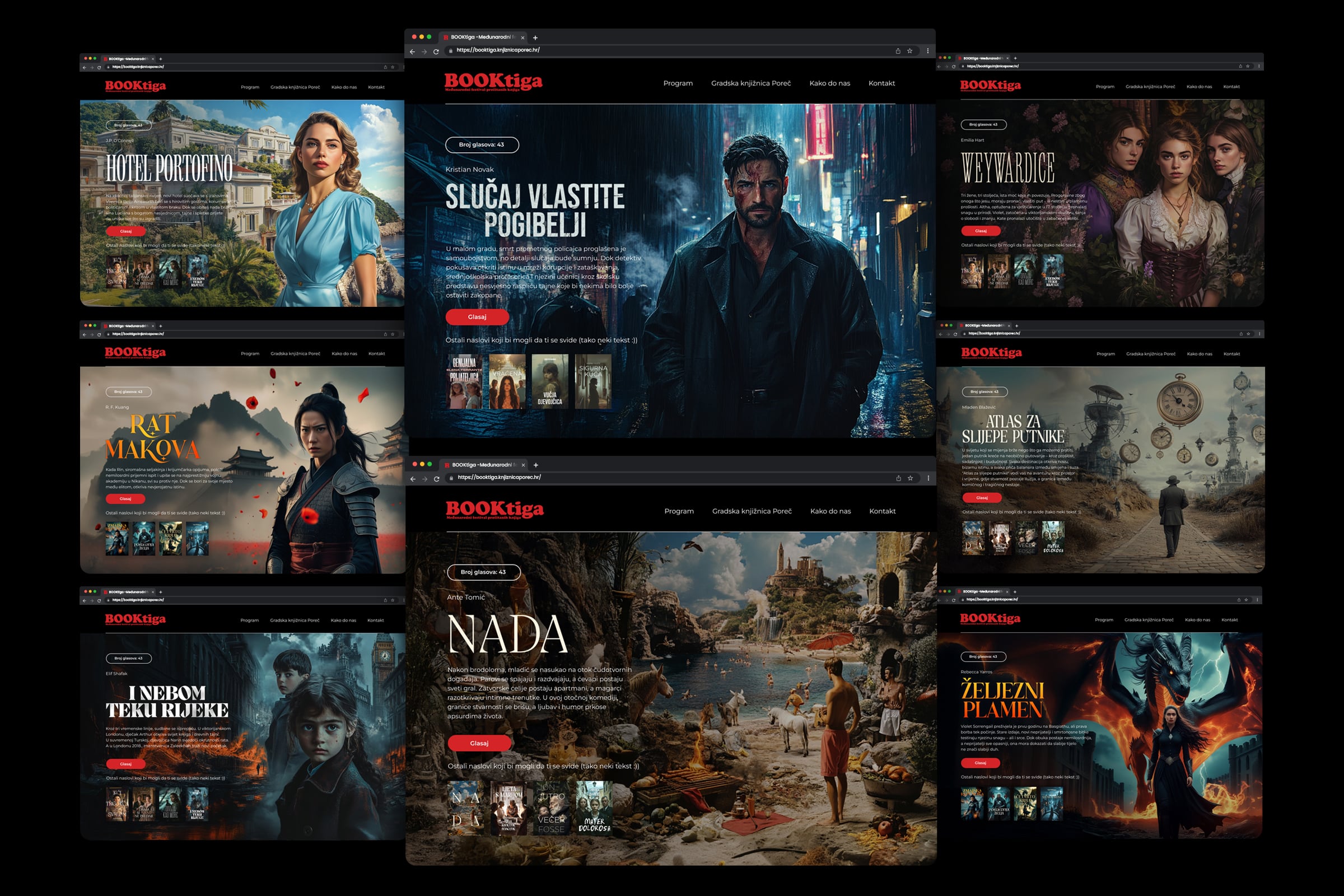
Artificial intelligence served as a great tool for rapid production because it allowed us, in a very short period of time, to create visuals that looked like movie posters for more than 100 selected titles, as well as write texts in the style of blockbuster announcements. Had we done this in the traditional way, the process would have taken months, and no library has a sufficient budget for something like that anyway. It is worth emphasizing that artificial intelligence was deliberately used transparently, even deliberately somewhat simplistically, and exclusively for the purpose of entering the sphere of streaming services. In no way did we want to suggest that it should replace the human hand in writing and illustrating the works themselves.
Additionally, we did not want to leave the most important thing to AI: human emotion. The selection and curation of the books themselves were done by people, because an algorithm cannot understand the true value and message carried by a particular title. And what was important to us from the very beginning was that this entire campaign, which initially relies heavily on digital technology and artificial intelligence, had to end with an exclusively analogue, human epilogue.
That is why the winning book that received the most audience votes (“Slučaj vlastite pogibelji” by Kristian Novak) was given no technological adaptation whatsoever. Instead, we brought it to life in a real cinema through a public, emotional interpretation by the brilliant actress Judita Franković Brdar. We wanted to show that at the end of all that digital content, when the cinema lights go out, there are no more screens, no artificial intelligence. All that remains is the human voice, a good text and imagination. That is the key moment of intimacy that we absolutely did not want to leave to technology.
How important is it to have a client willing to temporarily turn a cultural event into an experience that, at first glance, does not look like a library at all?
It is absolutely crucial. Without such a client, ideas like this remain nothing more than attractive presentations sitting in an agency drawer.
Cultural institutions sometimes play it safe. There is a certain deeply rooted fear that they will lose seriousness or authority if their communication does not look exactly the way one expects a cultural institution to look: classic, strictly educational. That is why the Poreč City Library played a key role here. Having a client who allows you to turn their entire website into an interface reminiscent of Netflix, while putting up posters around the city that look like announcements for summer blockbusters rather than invitations to a book fair, requires an enormous amount of courage and trust.
They understood the key point: not looking like a library, in this case, was not disrespectful to the library, but a tactical move. It was the tool we used to reach the people we talked about at the beginning, an audience that would otherwise not even pay attention to a standard advertisement for a literary festival.
When a client is willing to step outside their comfort zone and allow culture to be packaged in a fun, unexpected and modern way that feels close to a contemporary user, the results follow. Book sales and a packed cinema at the end of the campaign proved that culture can be extremely attractive without losing even the slightest bit of its true value.
Was BOOKtiga’s breakthrough the fact that the library did not merely present books, but directed the way audiences discovered them?
Exactly. That may actually be the most important breakthrough of this campaign. The traditional approach of institutions is often passive: books are arranged on shelves, whether physical or digital, and users are expected to come on their own, browse them and find something for themselves. We completely reversed that process. The library stepped outside its building, took on an active role and became the “director” of the entire user journey.
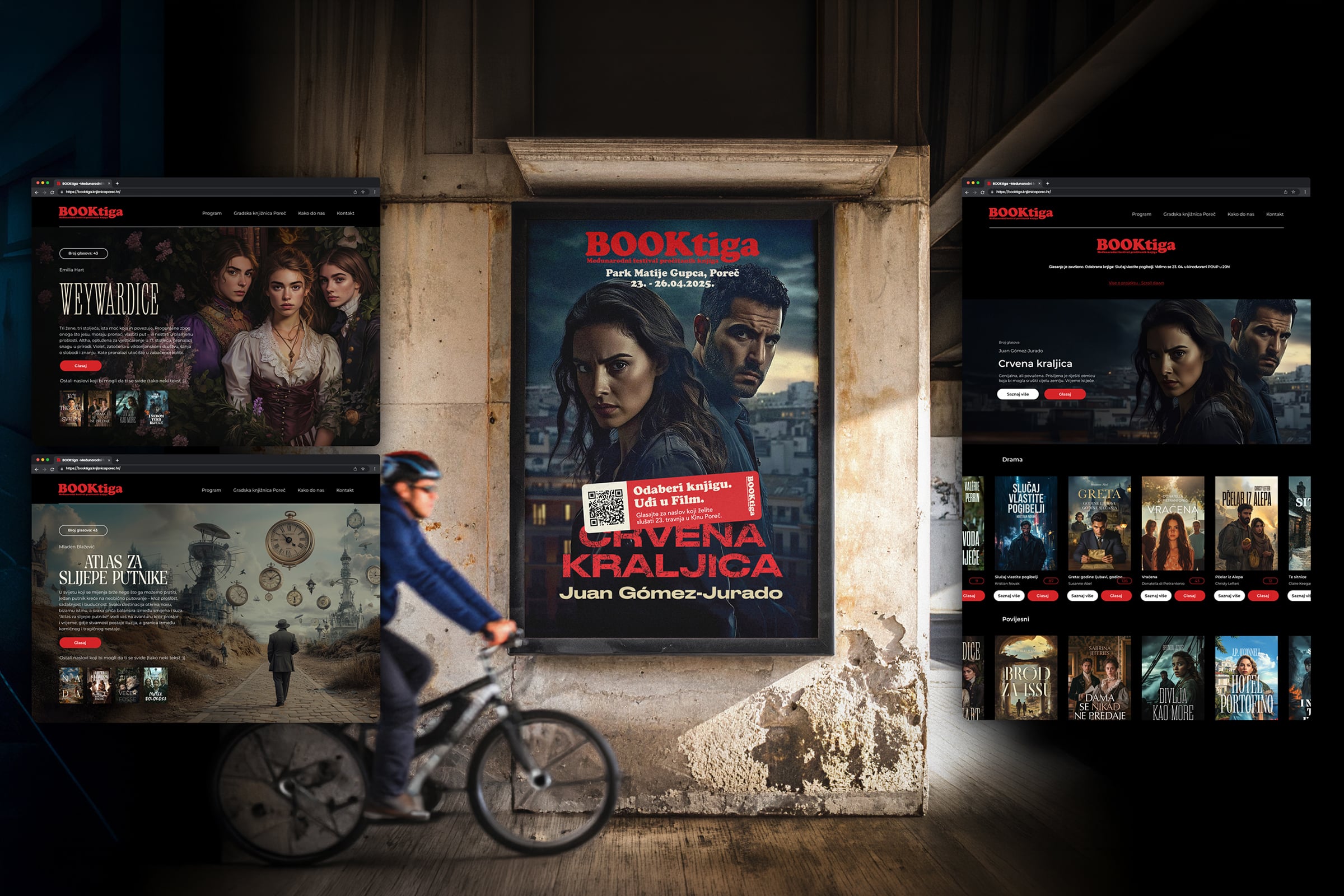
We decided to direct the discovery process exactly as it is done on streaming platforms, only in the real, physical world and on the web. And so we turned the streets of our city into a kind of open-air streaming platform. Every poster in the city was not merely a static festival advertisement, but a “screening point”, a place where a story catches you by surprise and pulls you into the plot.
When users moved from the posters to the redesigned website, we did not offer them a dry list of literature. The website guided them through categories, hooked them with suspenseful descriptions, suggested similar content and encouraged interaction by allowing them to vote for the book they wanted to “watch” in the cinema.
So, we did not merely change the “packaging” of the books; we completely changed the psychology of discovering them. The library was no longer merely a guardian of its collection; it became an active curator creating excitement and anticipation around a good book, exactly like the hype generated ahead of the premiere of a major movie hit.
Juries approached BOOKtiga from different angles, but each found a reason to reward it. Which aspect of the project do you consider the most important, and perhaps the least obvious?
Our favorite aspect of the project is its paradox. On the surface, the campaign screams; it has everything: artificial intelligence, streaming aesthetics, digital screens, a web platform that imitates algorithms… it is all there! We used the tools of the modern age that normally steal our attention and time. But the true value lies in the fact that all that flashy digital noise was used exclusively as bait to ultimately pull people away from screens. The goal of that entire technological spectacle was a return to the quietest, most intimate and purest human experience: reading and creating one’s own projection in the world of imagination.
For us, that is BOOKtiga’s most important message. We showed that the digital and analogue worlds do not necessarily have to be enemies. Digital technology does not only have to steal our attention away from books and shorten our concentration spans; if directed the right way and combined with a good idea, it can become their strongest ally.

