


Images source: Agency Forge.Coop
Author: Nermin Nino Kasupović
This autumn Bosnia and Herzegovina is expecting general elections. If we rely on past experience, we can already assume what they will look like: mutual accusations, empty phrases, generic slogans and visuals that resemble administrative notices more than a call to political action. Election campaigns in BiH, unfortunately, for years have not been a space of ideas, but a space of inertia. And what is even more discouraging, they are rarely a space of good design in its full, strategic sense.
When politics dictates visual identity
Political parties, large and small, have offered their voters nothing worth remembering. But the responsibility does not lie only with politicians. Part of the blame also belongs to agency professionals who have reduced pre-election campaigns to budget lines and media buys, rather than a platform for articulating new ideas, values and visual identity. When communication/design is reduced to decoration of political power, it ceases to be relevant.
Let us recall how eighteen years ago Barack Obama’s campaign made a radical shift. The 2008 presidential election showed how design, typography and a visual system can shape the perception of a political movement in the era of digital media. The campaign was consistent, clear and ideologically precise. Shortly afterward the book Designing Obama appeared, written by Scott Thomas, then design director of the Obama for America campaign. The book is not a manual nor a portfolio of nice posters, but a document of a system in which design, message and communication formed an inseparable whole. Unfortunately, in Bosnia and Herzegovina we learned nothing from that lesson.
Today, almost two decades later, we are witnessing a new example of political communication that understands the spirit of the times. The campaign of Zohran Mamdani, the newly elected mayor of New York, showed what a contemporary, ideologically clear and design-bold political strategy looks like. Mamdani appeared as an outsider within an already established political system, but not as a rebel without structure. His campaign was low-budget, grassroots, communication-precise and visually consistent until the very last day.
Design that communicates, not decorates
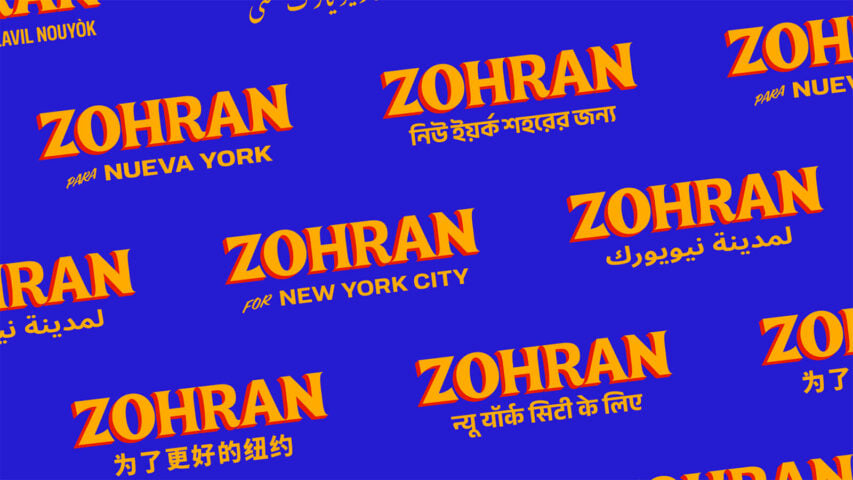
The visual identity of Mamdani’s campaign consciously rejects the aesthetics of institutional politics. Bold typography, high contrasts and a limited color palette create the feeling of a political poster rather than a marketing advertisement. The photographs do not idealize the candidate; he is not portrayed as a figure of power, but as an equal member of the community. The design does not aim to impress the voter, but to mobilize them. Which in our country, you will admit, very few election campaigns have managed to achieve.

The campaign colors were intense blue combined with fiery orange and sunny yellow, and it was quite clear they were taken from the everyday iconography of the city: bodegas, MetroCard cards, street food, storefronts of small businesses. The visuals felt like an organic part of New York’s urban reality, not an imposed political message. The typographic and illustrative language relied on pulp aesthetics, thick contours of vintage comics and hand-painted elements reminiscent of retro Bollywood posters, a sensibility that further emphasized Mamdani’s personal identity and origin. Posters looked like everyday objects: ones we find on refrigerators, pharmacy windows, balconies and neighborhood notice boards.
Multilingualism was at the very heart of the design. Materials appeared in English, Spanish, Urdu, Hindi and other languages. Of course this was not political correctness, but recognition of the communities the campaign addressed. By speaking the language of people, the campaign enabled voters to experience themselves as part of a movement, not merely as an electorate.
Lessons that BiH persistently ignores
The strategic strength of Mamdani’s campaign lies in the complete consistency between what the politician says, how he looks and how he acts when addressing voters/citizens. Design here is not neutral. It is ideologically clear. The campaign deliberately chooses an anti-branding approach: no polish, no universal likability, no adaptation to the system. Precisely that rigidity creates authenticity.


In Bosnia and Herzegovina, political communication still behaves as if the world has not changed. The same visual patterns, the same empty messages, the same patronizing tone. Voters are told what to think, but never why they should believe what they are told.
Particularly problematic is the complete ignoring of Gen Z, the new generation of voters. These are young people voting for the first time this year. They grew up in a digital environment, recognize insincerity in a second and do not seek perfect politicians, but authentic positions. Cheap political slogans do not interest them. They want to know whether someone sees them, hears them and understands them. Gen Z does not experience politics through billboards and TV news. For them design is part of the message, not decoration. A campaign that does not understand this loses their trust in advance.
The lesson of contemporary campaigns is not aesthetic, but philosophical. Designing Obama and Mamdani’s campaign show the same thing: political identity is not built by one slogan or one spot, but by consistency between what is said and what is lived. Campaigns that try to be “neutral” to appeal to everyone, in reality speak to no one.
What can and must be done already today
If a conclusion must be drawn from all of this, then it is not aesthetic but professional and ethical. Political communication in Bosnia and Herzegovina will not change on its own. It can change only if those who shape it, designers, strategists, copywriters, producers decide to stop being passive executors of tasks and become authors again.
The first thing that can be done is rejecting false neutrality. Neutral design in politics does not exist. Every color, every typography, every frame and every sentence already carries a value position. When campaigns insist on “safe,” “moderate” and “universally appealing” language, they are actually communicating fear of taking a stance. Contemporary voters, especially younger ones, read that fear faster than ever. Design must stop hiding ideological emptiness and begin clearly articulating a position.
Second, the leader-centric narrative must be abandoned. Campaigns in BiH still build visuals in which politicians are elevated above people, retouched, stiff, isolated. That is not only an aesthetic problem, it is a communication failure. The era of political messianism has passed. Campaigns that have a chance in the future must visually and narratively show the process of community-building and participation within it. The candidate is not a product, they are only one element of a broader value system.
Third, it is possible and necessary to start talking with Gen Z, not “about” them. This implies a radical change of language, channels and formats. Gen Z does not seek perfectly polished messages, they seek clarity, purpose and the possibility of action. That implies shorter messages, but more precise ones. Fewer slogans, more concrete calls to action. Design that looks like it belongs to real digital space, not advertisements from 2004.
Fourth, design must regain its strategic role. In most domestic campaigns the visual language comes last, when messages are already exhausted and strategy nonexistent. Contemporary campaigns show the opposite: design is a tool for structuring the message, not decorating it. This requires courage on both the political and agency side, but without it there is no progress.
And finally, perhaps most importantly: creative agencies must take part of the responsibility. It is not possible to speak about creativity, ethics and social responsibility while agreeing to campaigns that underestimate voters. Professionalism is not only technical delivery, professionalism is also the ability to say “no” to bad communication, even when the budget suits you perfectly.
A lesson in visual-political responsibility
Examples such as Mamdani’s campaign do not offer ready-made templates to copy. They offer proof that political communication today functions only when it acknowledges the reality of people’s lives and invites them to be part of the solution, not mere consumers of promises. That is a lesson applicable in BiH but only if there is readiness to abandon the comfort of familiar patterns.
If political campaigns in Bosnia and Herzegovina want a future, they must stop “performing” security and start offering truth. They must step down from positions of power and enter dialogue. They must stop communicating TO citizens and instead begin communicating WITH them.
Because the new generation of voters does not seek leaders who promise they know all the answers. They seek politicians and expect campaigns that have the courage to tell them: “We do not know everything, but we know with whom we want and can solve it.”
If we do not understand this now, ahead of these autumn elections, the risk is not only another lost mandate. The risk is losing the trust of an entire generation. And that is a defeat that cannot be repaired in the next election cycle.

