

More and more of our working days come down to some form of optimization. How to do more in less time, how to shorten a process, how to remove an unnecessary step, how to produce yet another format from the same content, and how to get from idea to publication as quickly as possible. Technology has helped us greatly with this. At the same time, it has created a situation in which more messages, screens, notifications, videos and people are competing for the same attention than ever before.
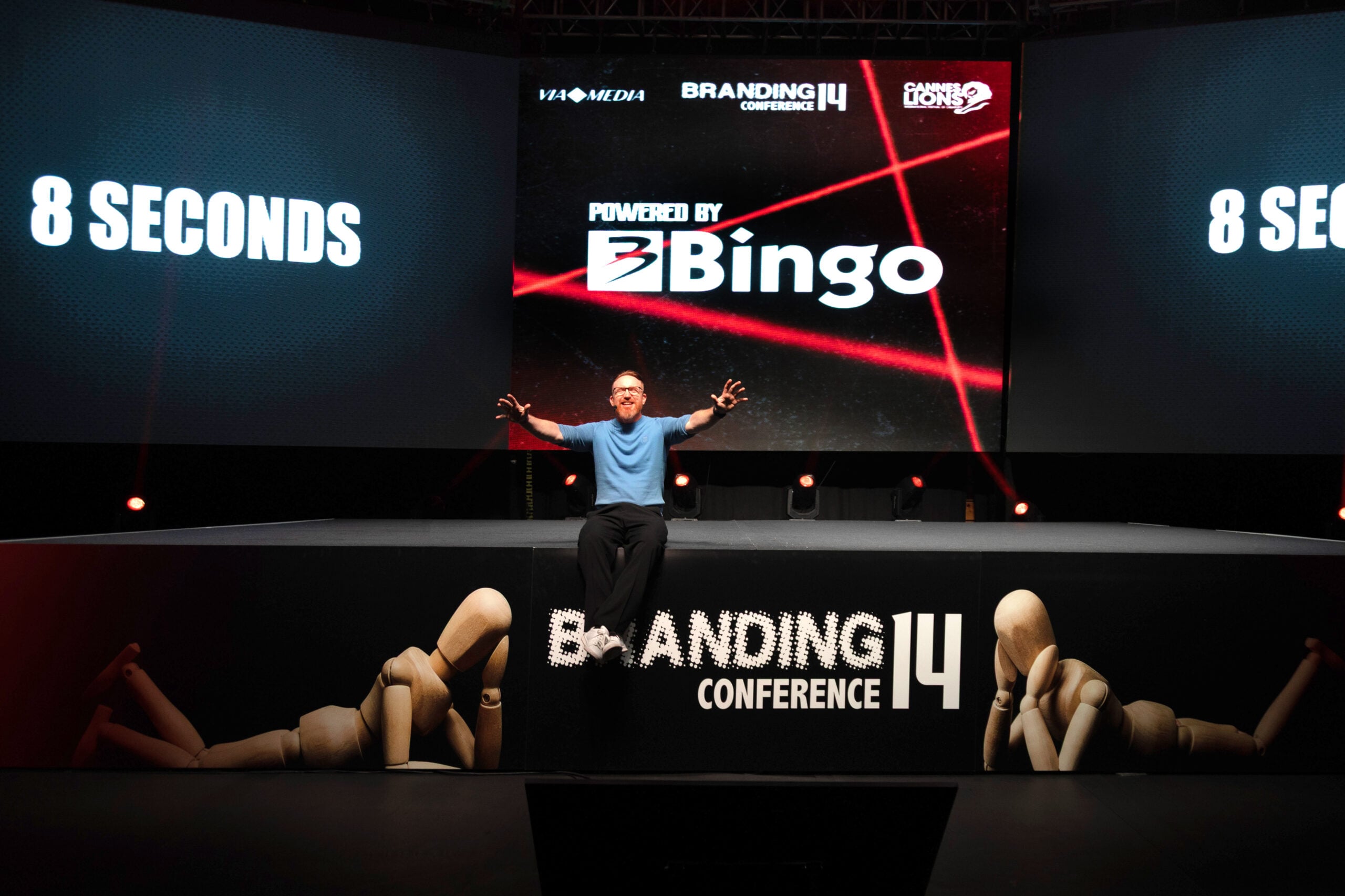
That is perhaps why it was entirely fitting that David JP Phillips took the stage at the 14th Branding Conference, an expert in communication, storytelling and presentation skills who has spent a large part of his career trying to understand one thing in particular: why we give someone our attention and, even more importantly, why we decide to keep giving it to them.
And, as you can probably guess, he won ours fairly quickly.
Phillips admitted right at the beginning that he is somewhat obsessed with attention. For years, he has analyzed the ways people communicate, broken them down into individual skills and tried to understand why one speaker can hold an entire room, while with another we will be looking at our phones after only a few minutes. That work eventually became a system of 110 communication skills, and today he also uses that knowledge in an internal AI tool trained, as he explained, to teach people to communicate better with other people.
But his story about attention did not begin with grand theories. It began with things that seem almost banal.
If you are filming a video, make a movement at the beginning. Our eyes register change. Wear something that creates a clear contrast because our gaze naturally moves toward the part of the image where contrast is strongest. Think about colors, because they also influence the way we experience a stimulus. Phillips even suggested a small experiment to the audience: turn off the colors on your phone screen for seven days and observe how suddenly the device becomes less appealing. And finally, light your face clearly enough so that the person on the other side does not have to search for what should be the center of communication.
Movement. Contrast. Color. Light. Four small ways of telling our brain: look here.
But attracting someone’s gaze and keeping a person with you are two different things. This is where Phillips shifted his talk from the realm of presentation skills toward what happens inside us while we watch, listen or create. He spoke about the role of dopamine and oxytocin, about motivation, creativity, connection and the way we gradually become emotionally attached to the people and content we are exposed to.
That is why, for example, the ending of a series we have watched for months can sometimes leave us with an unusually empty feeling. We were not simply following the plot. We spent time with those characters, learned their habits and began expecting their return. A connection was created.
At this point, Phillips’s talk returned to the optimization we mentioned at the beginning. The more processes we automate, the less patience remains for attempts, mistakes and versions that will never make it into the final work. And yet it is often through that effort that our connection with what we create is built. Time, attempts and small victories become part of the value we assign to that work.
At a moment when AI can skip ten steps between the initial idea and the first version, that becomes a particularly interesting thought. Not because technology is a problem, nor because a slower process should automatically produce a better result. But because it is worth noticing what else gets lost when we remove all effort from the process.
Perhaps that is why Phillips’s four recommendations for content sound almost opposite to much of the advice we hear every day about social media. Make something of your own. Show the effort that went into it. Do not hide every obstacle and failed attempt. And make the story personal.
In other words, do not show the audience only a perfectly polished result. Show them that someone was there while it was being made.
That, of course, does not mean that every process should be turned into an emotional diary. But it does explain why we are sometimes much more drawn to a video in which we see someone try, fail and put things back together than to yet another flawless final shot. One shows us the product. The other gives us something we can connect with.
Change is equally important for attention. Phillips spoke about variation as one of the ways of maintaining interest: changing the rhythm, the way we say something, a visual element, the structure or the type of stimulus. In a presentation, that might mean following a statement with a question, then a metaphor or a story. In a video, it could be a change of shot, pace or energy. The brain reacts to novelty, while monotony very quickly gives it a reason to go somewhere else.
Still, even the best combination of movement, contrast, color, light and variation cannot replace a story.
One of the examples Phillips used to demonstrate this was Significant Objects, an experiment by Rob Walker and Joshua Glenn in which entirely ordinary, cheaply purchased objects were given something they had not had before: a story. Writers created fictional narratives for them, and the objects were then offered on eBay together with those stories.
The object did not change; what changed was what it meant and what it represented. Over the course of the project, objects purchased for just a few dollars generated a sales value of nearly $8,000.
We can talk about price, function, material and all the rational characteristics of a product, but people rarely live among characteristics alone. We live among the meanings we assign to them. We keep a concert ticket, an old keychain or some completely ordinary little object not because of its value, but because of what connects it to a particular person or moment.
For Phillips, storytelling is not an addition to communication, but the way we naturally understand and remember the world around us. That is perhaps why the most important lesson from his talk was a very simple one: before we film, write or present something, we need to know how we want the person to feel when we are finished.
If we want to communicate excitement, closeness or interest, that feeling has to be present in us while we are communicating. That is why Phillips advised the audience to first bring themselves into the emotional state they want to convey to others before recording. This is perhaps where the difference between content that briefly catches our eye and content we decide to stay with becomes clearest.
The first knows how to attract attention. The second gives us a reason to give it.

