
After a brief postponement, Sarajevo once again got its day reserved for the creative industry. For a few hours, the Zetra Olympic Hall became a place for ideas, conversations, lessons, some reconsideration of our own ways of working and, perhaps most importantly, an opportunity to finally hear live some of the people whose projects we have been following for months.
This is precisely where one of the greatest values of the Branding Conference lies. Year after year, it manages to bring a global perspective together on the same stage with people and stories created much closer to us. It does not treat the regional and global creative scenes as two separate worlds. Alongside major international names, space is also given to people from the region whose work has long belonged to the same conversation. Studio Sonda is one of the best examples.
If we are to admit a little editorial bias, the lecture by Jelena Fiškuš and Sean Poropat was among those we were especially looking forward to. Studio Sonda is one of the teams we follow at Media Marketing in such detail that a new award, project or idea from Vižinada rarely goes unnoticed. That is why the opportunity to finally hear directly from the stage the story we have been following for years through projects and recognitions had a special value.
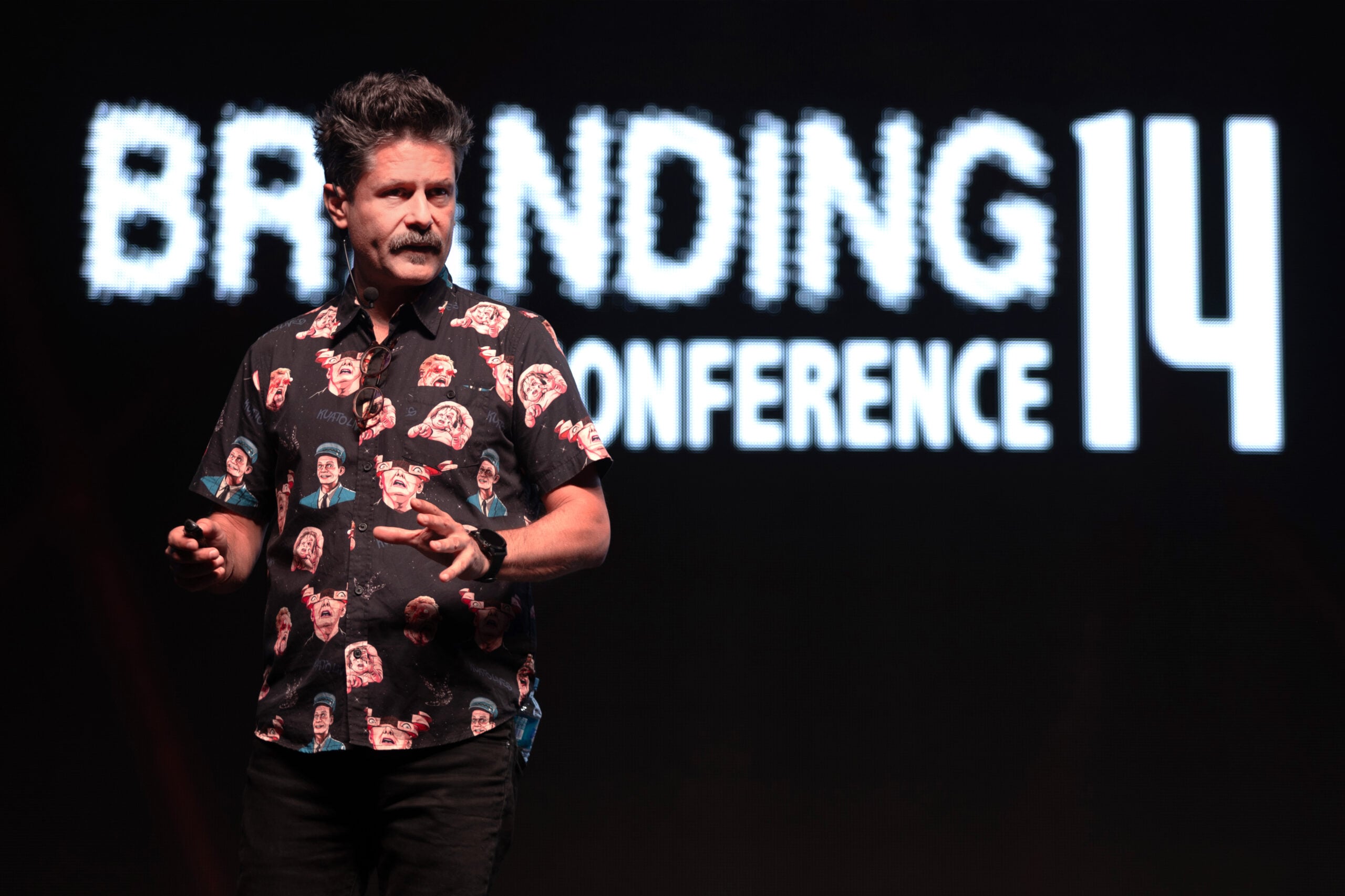
The plan, however, underwent a small change. Jelena was unable to join her colleague on stage due to health reasons, so Sean took over the lecture that was supposed to be their joint appearance. It could be said that this time the famous “break a leg” was taken a little too literally. And the lecture he brought to Sarajevo had, in a way, been in preparation for much longer than a few weeks or months. Its first outlines began to take shape back in 2004, when Sonda’s story began in Istria.
And perhaps that is precisely where their first glitch happened.
Starting your own publishing project without much experience in such a business, and then building a creative story far from the centres where industry logic would expect it to be, hardly belongs to the category of decisions that would pass a classic risk assessment without several serious warnings. Yet Sonda continued to grow precisely from such decisions. Today, it operates from Vižinada, has its own creative centre and projects that travel far beyond the borders within which they are created.
Poropat very quickly arrived at a question that concerns all of us. Why are we so obsessed with safety?
Part of the answer today can be found in technology. We like it because it can repeat much of what we do faster, more precisely and without our limitations. It does not get tired. It does not need weekends. It does not go on annual leave. It can process enormous amounts of information, recognise a pattern and offer the path with the fewest unknowns.
In other words, it is excellent at reducing risk, and all of this fits perfectly with the way we have been taught for years to make decisions.
We look for proven methodology, a familiar path and as little room for error as possible. From childhood, we are often directed towards the safe choice, an education that will secure a job, a stable career and decisions whose outcome we can at least approximately predict. There is no ill intent behind this. On the contrary, the desire for safety comes precisely from care.
It is just that creativity is not exactly known for functioning best when all the unknowns have been removed in advance, and that is where the problem begins.
Here Poropat drew the line between what technology enables us to do today and what we risk losing if we hand over too many decisions to it. We have more and more tools, more and more data and increasingly precise models telling us what we should do. At the same time, those same possibilities are available to a growing number of people.
The democratisation of tools has brought a great deal of good. But if we all use similar systems to find the safest answer, we can very easily end up with similar results as well. And then we become a little bit the same. And a little bit boring.
Perfectly summed up in: “Perfect code creates perfect boredom.”
Perhaps that is precisely why the question is no longer who has access to the best tool. More and more people do. The question is what we will do with it once we stop following only what it suggests as the most logical next step.
This brings us to the paradox Poropat spoke about during the lecture. We build systems designed to remove uncertainty, while some of our most valuable human qualities are tied precisely to the ability to enter uncertainty anyway. Curiosity pushes us to look beyond what is familiar. Courage allows us to go there even when we have no guarantee of the outcome. Commitment keeps us there long enough that we might turn something uncertain into something valuable.
Technology can process the information we have given it. But feelings, values, relationships between people and the context in which something acquires meaning are much harder to reduce to a neat average and a predictable formula.
He turned the whole idea into an image that is difficult to forget: walls.
Each of us has them. Inside them are information, experience, methodologies and everything we have learned so far that works. That is our safe space. We know the terrain, we know the rules and we can predict fairly well what will happen if we follow them. But major change rarely happens within those walls.
Stepping outside them does not mean rejecting everything we know. Quite the opposite. One of the most important messages of the lecture was that we should research as much as we can, gather information, understand the problem and use all the tools available to us. And then, based on all of that, be the person who will sometimes take a step the model would not recommend.
This brings us back to Sonda.
Because when you look at their story from that perspective, it is difficult not to notice how many times it developed precisely by crossing some imagined line. They launched a magazine even though they did not have all the answers about how such a business should be run. They built a creative studio in a small community and proved that an address does not have to determine the reach of an idea. Later, they built their own creative centre, opened it to education, the community and experiments, and continued testing ways of creating.
And they did not remove technology from that equation. On the contrary, Poropat spoke about how actively they follow new tools and possibilities for their application. The team even has a person whose job is to research every day what has appeared and how it might be incorporated into their work. The point, therefore, is not to defend human creativity by pretending technology does not exist. A much more interesting question is whether we can understand it well enough to know at what moment we should stop following its logic.
One of the projects that demonstrates this philosophy particularly well is Piquentum. In that case, nature did not remain merely an inspiration on a moodboard. Natural processes and data became part of the creative solution. There was no complete certainty that the idea would succeed, but there was a willingness to explore it in enough detail for the risk to become worth taking. Once again, they crossed the line, and perhaps that is precisely why projects known by the global industry now come from Vižinada.
The same idea is perhaps shown even more clearly by Sonda Designed by People. The programme introduces into the creative process people who do not necessarily have previous design experience, nor do they come from the industry. What they bring is their own experience, perspective and way of looking at a problem. In this way, Sonda practically tests one of the theses Poropat presented in Sarajevo: design is not just packaging or the final visual we eventually hold in our hands.
Design can become a way for people to connect, spend time together, learn something from one another and bring into the process experiences that professional routine sometimes no longer even notices. If we constantly raise our own walls, we also close ourselves off from the possibility that someone from outside might show us what we no longer see.
Perhaps that is why the expression glitch in the algorithm describes much more than the title of a single lecture so well.
Being a glitch does not mean rejecting the system. It describes what happens when, into a system that naturally strives for safety and predictability, we introduce a decision that cannot be fully calculated. It means understanding it well enough to know when we need to step outside it. Using data, but not reducing the decision to data alone. Using technology, but not allowing it to define the limits of our imagination. Seeking safety where we need it, but leaving room for decisions whose result we cannot yet fully calculate.
Sean Poropat and Jelena Fiškuš did exactly that long before we began talking daily about algorithms and artificial intelligence. And perhaps that is why the story of Vižinada fits so well into the entire lecture. They started locally, but they never accepted local as a boundary.
That is probably also what is especially worth hearing when the example comes from our own region. Not so that we can prove once again that “we can do it too”, but because the distance between a local beginning and globally relevant work suddenly looks much more concrete. We see people who stepped outside their walls, made mistakes, learned, continued and built a system that today allows them to keep asking new questions. And we will need more and more of those questions.
The industry is almost obsessed with the question of whether AI will replace us, but Sean brought the conversation back to a more important place: what can we bring to the process precisely because we are not machines? We cannot beat them at tirelessness, and probably not at speed either. But perhaps that was never the game we should be playing. As technology becomes increasingly better at finding the optimal path, it remains up to us to sometimes step outside familiar parameters and see what exists beyond the walls.
Because perfect code may be able to produce a perfect solution. The only question is whether we want all those solutions to start looking the same.

