

Water is one of the most difficult categories in advertising. There is not much mystery in a bottle of water. It is clean, cold, healthy, needed by everyone and, precisely because of that, almost always condemned to the same visual repertoire: droplets on plastic, a body in motion, sun, an athlete, a mountain, advice to drink more fluids. Everything is in its place. And almost nothing is remembered.
Ten years ago, Imago did something completely different with Jana. Water was not water then, but pure love. At the center of the campaign Wing of Love were Malena and Klepetan, a stork that returns and a man who cares for them without calculation and without spectacle, out of a habit that over time turned into a story the entire region followed as its own. That campaign brought Croatia its first Cannes Lion in 2016. The bronze then looked like a big full stop on one story, but also like the opening of a door that domestic agencies did not often walk through.
Ten years later, Imago returns to Cannes with another bronze for water. Only this time, water was not love, nor nature, nor purity. It was thirst, the ordinary, summer, everyday kind, spoken without thinking in one sentence we all know: “Oh, I’m going to die of thirst.” Somewhere in that sentence, between exaggeration and real discomfort, the professional mourners were waiting.
For the campaign A Cry for Hydration for Studena, Imago Ogilvy won a bronze lion in the Social & Creator Lions category. The campaign took the topic of hydration out of the safe shelter of advertising and pushed it straight into a local cultural nerve. Three professional mourners, voices traditionally associated with loss and grief, began mourning over those who do not drink enough water.
“So you don’t die of thirst, take a GUC GUC.”
The entire logic of the work was contained in one sentence. The deadly serious topic of hydration was given an equally serious, yet completely unexpected form. Not to shock at any cost, but because one more pleasant, well-intentioned message about the importance of water simply would not have had enough strength to break through the noise of the day.
Studena is a challenger brand. That means it does not have the luxury of speaking quietly and waiting for the audience to find it. It has to find a way to reach people who are not looking for it, it has to be precise, unusual and distinctive enough to be remembered even after the screen goes off. At Imago, as Darko Bosnar, Chief Creative Officer of the agency, explains, that path usually begins with permission for the idea to go too far.
“At Imago, we have one unwritten rule, and that is that during brainstorming we allow ideas to go beyond every possible boundary, to overturn every rational assumption and, at least in that initial phase without limits, to show what they could do. The starting point of every idea is the saying: ‘Hey, imagine if this actually went through.’”
That is a sentence advertising often says, but rarely follows through to the end. Many ideas are born as a joke in the room, and even more die as soon as the PowerPoint, the budget, the fear of the client or the question of whether someone somewhere will be offended is opened. The professional mourners clearly survived all those stages. Bosnar does not romanticize that process. He describes it as a turbulent journey in which the idea has to be presented to the team, to the client, to production and finally to the audience, and each of those points can change it, narrow it or shut it down completely.
“We are very passionate in the process. We defend our ideas, we fight for them, we convince both ourselves and the team that this particular direction is the right one. I often say that in the process we literally pull each other’s hair out and make peace. We argue like hell and then kiss and make up. All of that shows how much fire and emotion go into our campaigns.”
Perhaps that is exactly the difference between an idea that remains a charming joke and one that turns into a campaign. The professional mourners were not used as a folkloric ornament. They were not there to give the campaign a local flavor, the way embroidery, an old object or an accent is placed on a visual and then everything is declared authentic, but were the real mechanism of the idea.
Studena did what many campaigns promise and rarely achieve: it found its own format of behavior within culture. It did not explain why professional mourners matter. It did not translate the joke for someone on the outside. It did not try to erase local edges in order to be understandable to everyone. It remained Balkan. And precisely there, in that decision not to polish away everything specific, its breadth emerged. Cannes does not reward localness because it is exotic. It rewards it when the local becomes precise enough to carry a universal emotion, when you know exactly where you are speaking from and therefore do not have to sound like everyone else.
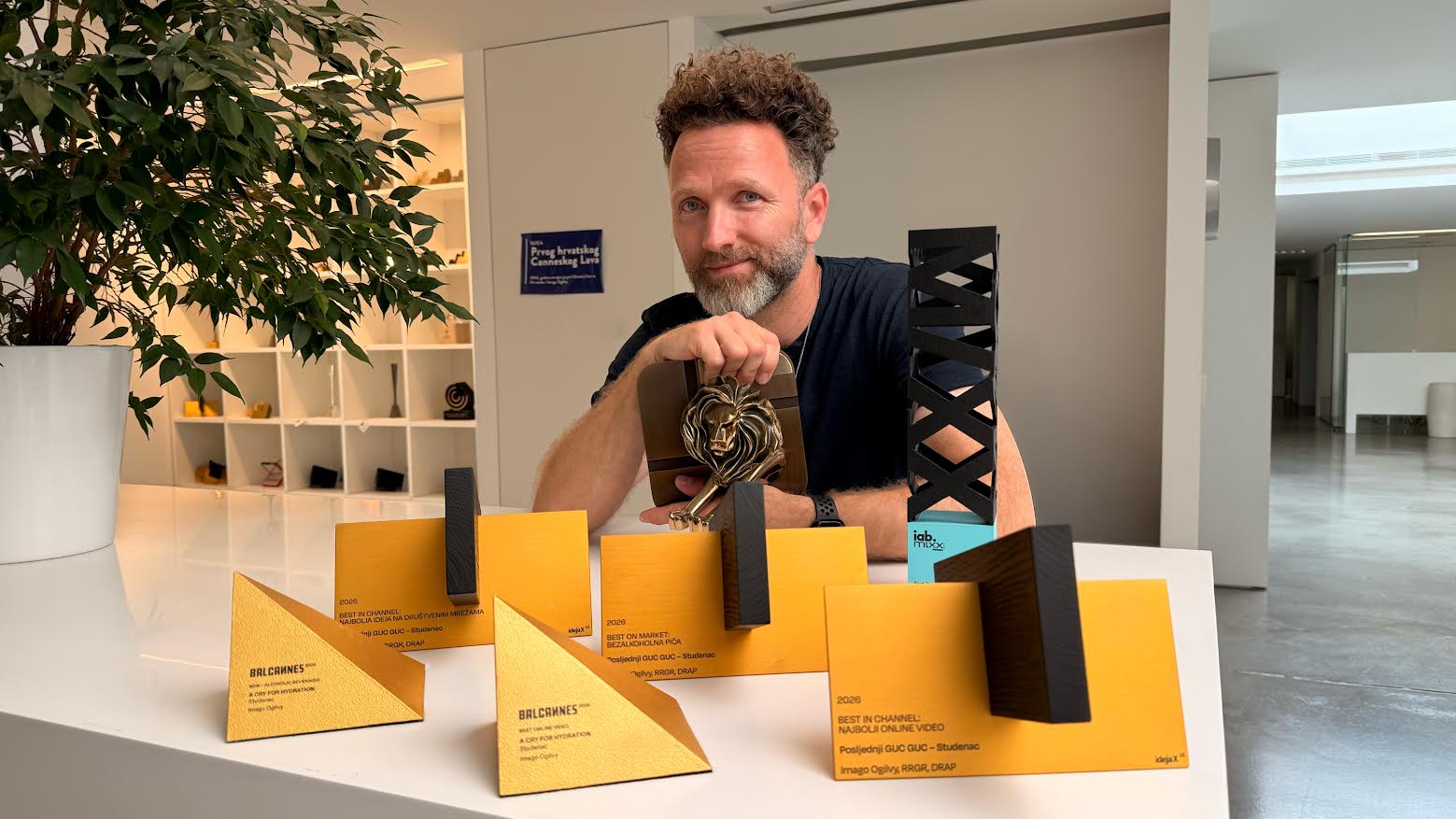
The campaign began building its road to Cannes much earlier. At BalCannes, it won two golds, in the Non-Alcohol Beverages and Best Online Video categories, as well as silver for Best Social Media Idea. At the IdejaX festival, it won three golds, in the Non-Alcoholic Beverages, Online Video and Digital, Social Media categories. This was followed by MIXX for Best Branded Content and SEMPL Gold for Best Social Media Campaign.
Awards are important, but here they speak more about something else. They show that the same idea managed to survive different juries, different criteria and different definitions of creative excellence, without losing what made it exist in the first place. It remained slightly uncomfortable, slightly funny, very local and fully aware of its own drama.
When looking at the decade between Imago’s two bronze lions, an interesting pattern emerges. Two campaigns for water, two completely different worlds. Jana started from the love the audience already felt for Malena and Klepetan. Studena started from a sentence the audience says almost automatically, then returned it to people in a form that could no longer be overlooked.
“The only pattern we see is that we create campaigns that do not look like marketing campaigns, but like some form of branded entertainment or content,” says Bosnar.
That may be the most precise explanation of both the first and the second lion. Imago tried to create a story people would follow even if they did not know who paid for it to be made.
The second Cannes Lion does not change the agency overnight. It does not erase ten years of work between two bronze statues, nor does it guarantee that every next idea will take the same path. But it removes one doubt that always remained after the first major recognition: was that an exception, or was it a capacity?
Bosnar’s answer is simple: “In essence, it changes nothing, it only confirms that the first one did not happen by accident.”
Ten years, two campaigns for water, two bronze lions. Neither began with water.


