

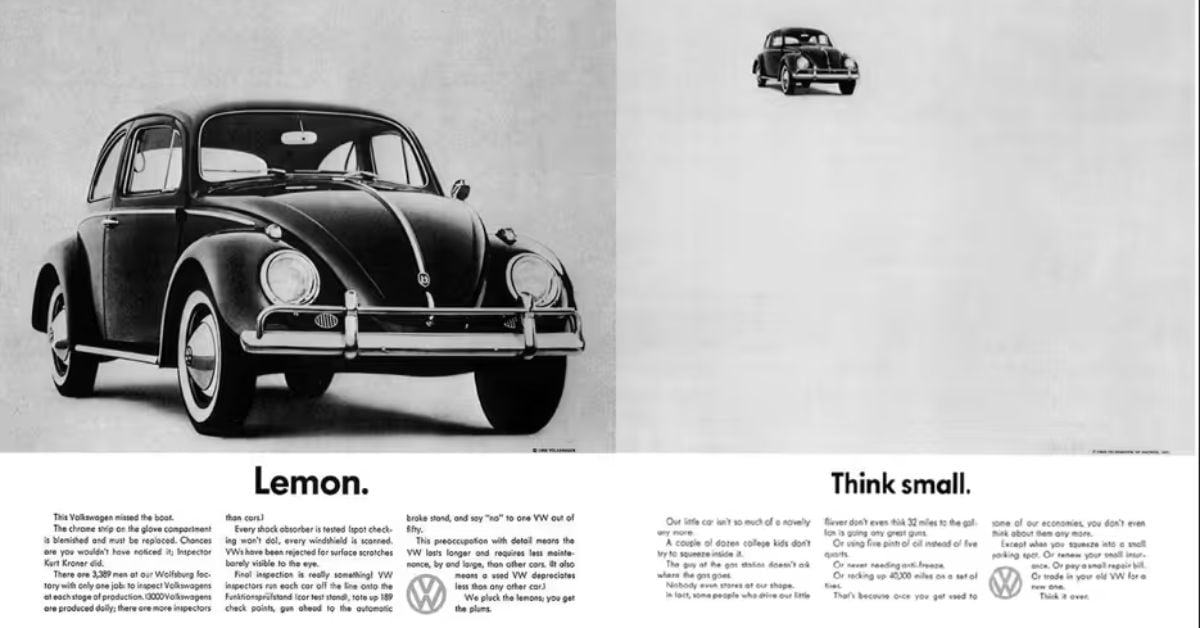
If you walked into a museum, you could probably identify a number of artworks from across the room. You don’t need to be an expert to spot a Picasso. In the same way, even if you’re not a car aficionado, I bet you’d recognize the Volkswagen “Think Small” advertisement. I’d argue it’s the most well-known automotive ad of all time.
Yes, I’m referring to a mass-produced magazine page as a work of art in the same way people think about a priceless Picasso painting. Why? Because both have a unique design language unlike anything that came before. Just like a Picasso has unmistakable shapes, figures, and Cubist aesthetic, “Think Small” has a similarly striking design. While they diverge when it comes to their mediums, they converge when you consider their avant-gardeness. They are one and the same in my book.
The creation of this Volkswagen ad for the American market represented a change in the way advertising would be done; it’s not a stretch to say “Think Small” put the wheels in motion of a fundamental shift in print advertising. And the adman—the Picasso—behind this renaissance in advertising was Bill Bernbach.
Bernbach was forward-thinking and certainly had the courage of his convictions. When it came to advertising, he firmly believed in unconventional ideas that ended up attracting many equally talented men and women to his new wave agency, Doyle Dane Bernbach. Among the many schools of thought Bernbach helped promote was using good design—art—as a means to sell. Playing with graphics and layout was a signature of DDB’s effective print ads.
And Bernbach’s boldness permeated everywhere in the office. For instance, instead of separating people into departments like most ad agencies of the day, DDB placed the copywriter and art director in the same room – which is how Julian Koenig and Helmut Krone ultimately came up with this masterpiece. It’s also been reported the office lacked showy accoutrements, instead allowing the agency’s work to be the focal point, including decorating the walls with ads. (It’s my new life’s mission to find photographic proof of this!)
Hopefully you’re getting the sense that DDB was hell-bent on breaking just about every rule of advertising. And Volkswagen was its muse to redefine what great advertising was and could be.
So how did “Think Small” come to be, in the late 1950s, in that cutting-edge office, led by Bernbach and humming with obsessive, creative talent?
The chassis of DDB ads, especially its work for Volkswagen, was a realness that Bernbach and his team felt was the only way to speak to an audience. DDB felt a disconnect with many of the ads of the day, which created a false sense of how to achieve happiness, had the underlying theme that “bigger is better,” and put pressure on people to “keep up with the Joneses.” Much like today, it could be said there was an unhealthy relationship between consumers and products in the 1950s.
The Volkswagen Beetle – how it looked, how it was built, what it cost – seemed the antithesis of automotive offerings and the glamorous lifestyle many ads glorified. It was an antidote that DDB could get behind, a cure for what was plaguing advertising of the day.
When it came to crafting “Think Small,” DDB played up the simple, pedestrian attributes of the Beetle, not making it more than it was. Honesty was DDB’s style. Krone made the intentional choice to depict the car small – his layout was a way to align with Koenig’s message and stay truthful. The Beetle was a very compact car, bug-like in relation to the size of many cars of the day, and the severe contrast against the mostly blank page made readers pause on the page.
The copy starts with that famous “Think Small” headline. It’s another example of DDB leaning into design; “small” isn’t capitalized, which was a very deliberate choice to emphasize the car’s size. Koenig’s words in fine print present the facts in a frankly written way. There isn’t any “used car salesman” talk because DDB had faith in the reader. Of course, the words together are meant to nudge would-be consumers to literally consider owning this small, weird-looking car. Despite the car’s origins, going back to the 1930s and having a checkered past to say the least, times had changed and the essence of “the people’s car” still remained.
“Think Small” could also be interpreted as a mantra of sorts: Those two words planted a hope in Americans’ subconscious that, with this car, they could be granted a freedom they’ve been craving, a release from a never-satisfied feeling that comes with trying to live large.
Reportedly, the ad was such a point of conversation that people bought copies of Life magazine strictly for the ad. Some even cut it out and hung it up on their walls. It’s amazing how, approaching 65 years old, it can still hit home today. I don’t think I’m going out on a limb when I say we all could use a dose of “Think Small” and what it embodies in our lives today.
Although the Beetle is not a fast car, “Think Small” pulls away from the pack; it laps the field when compared to the gridlock of all auto ads ever created. Like the Beetle, it may not be the sexiest, most provocative ad, but that’s not where its beauty lies – it lies in the artists who composed it, its message, its timelessness. There’s so much richness to discover if you approach it with an open mind – like people did in the early 1960s when they embraced a small German car.
And “Think Small” doesn’t require you to have any connection to the Beetle to appreciate the ad. If you love good design, that’s reason enough. It’s clean, modern, and well thought out: Even the parts that are out of balance – the car being off-center, the asymmetrical body text – end up achieving harmony in the end. Its styling is reminiscent of the Case Study Houses of the ’40s, ’50s, and ’60s, which were atypical but quickly caught on and have become architectural monuments today.
Like those mid-century marvels, “Think Small” has come to symbolize the very best of design principles. Its effectiveness is no longer in its ability to sell a car model; it’s retired from that duty, but it continues to work in emeritus status due to its legacy.

