

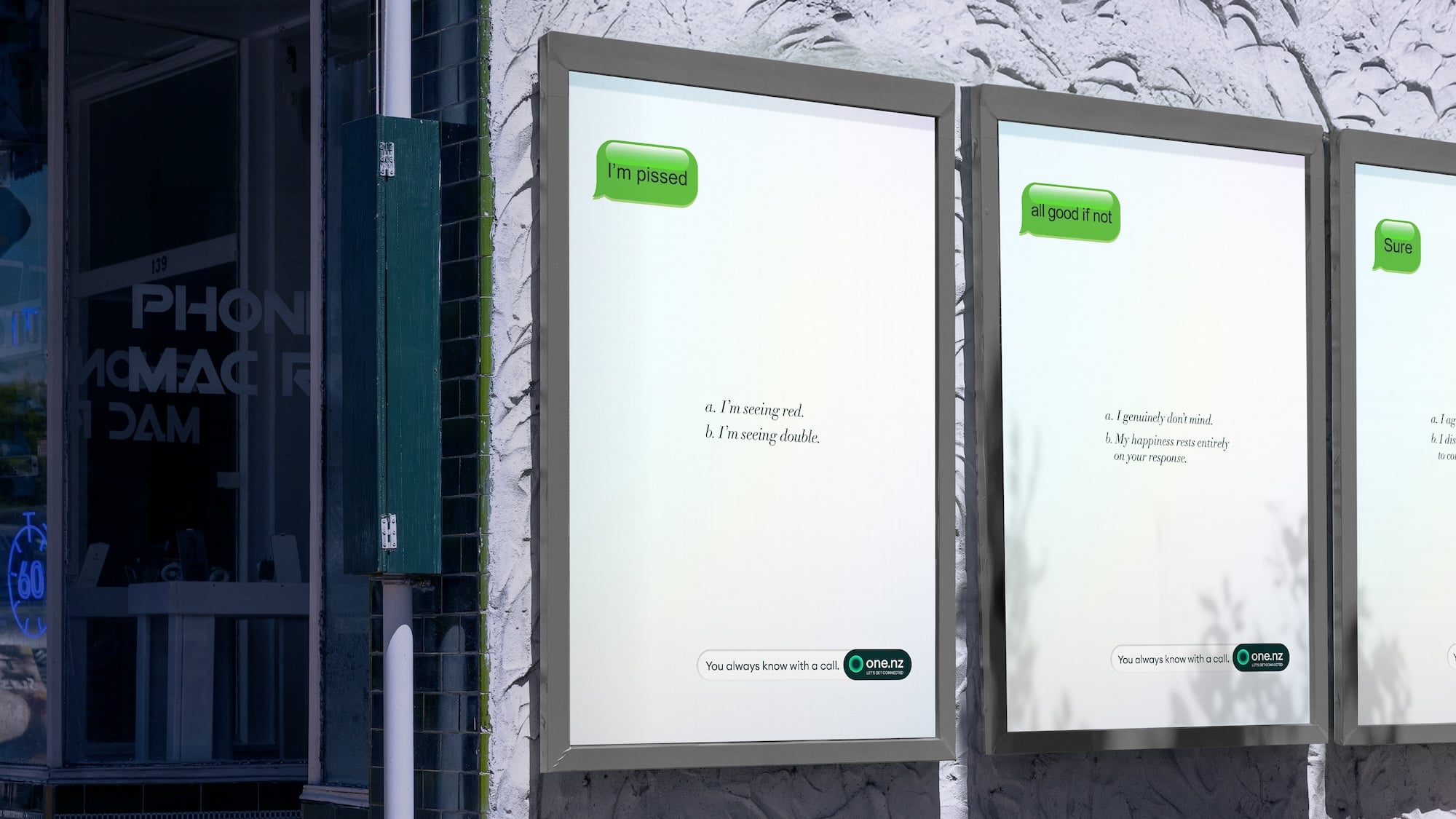
“Haha” can be genuine laughter, a polite reaction or a sign that the conversation should end. “K” can be perfectly sufficient or sound like the beginning of an argument. A thumbs-up can mean confirmation to one generation, while to another it can come across as cold, passive-aggressive or simply uncomfortable.
It is precisely this space between what the sender writes and what the recipient reads that became the basis of the new campaign by One New Zealand and McCann New Zealand.
Called Misinterpreted, the campaign starts from a simple problem of digital communication: text conveys words, but has a much harder time conveying tone, intention and context. Instead of trying to solve that uncertainty with yet another digital tool, the telecom proposes a rather old solution. Call the person.
The creative idea is therefore reduced almost to a minimum. Outdoor and print ads take expressions that appear in everyday messages and place different possible interpretations alongside them. These include “dying”, “sure”, “I’m pissed”, “all good if not”, a simple “k”, as well as the thumbs-up emoji.
With the expression “dying”, for example, the person on the other end might conclude that you have just had a great laugh. Or that you need emergency medical assistance.
That simplicity allows the campaign to rely on an experience almost everyone already knows. A misinterpreted message does not have to create a major conflict. Sometimes, a few minutes spent analysing punctuation, a short reply or an emoji are enough to make communication considerably more complicated than it needed to be.
The campaign also arrives at a time when the phone call itself has lost some of its former place in everyday communication, particularly among younger users. Research cited by the agency shows that a quarter of people aged 18 to 34 do not answer phone calls at all, while 70 percent prefer communicating by text. Other data also points to pronounced discomfort associated with making calls.
For One New Zealand, this change in habits creates an opportunity to bring its own product back into the conversation through its most basic function.
Alan Jones and Angelo An, Group Creative Directors at McCann New Zealand, explain that the strength of the idea comes precisely from the fact that almost everyone has their own examples of messages they have misread. We have thought someone was angry when they were not, thought someone was completely calm when they were not, while the meaning of even the most ordinary emoji can change depending on who receives it.
Instead of explaining the technological characteristics of the network, the campaign talks about what connection should make possible: for two people to actually understand each other.
This is also connected to the brand’s broader Let’s Get Connected platform.
Georgia Mahaffie, General Manager Brand & Marketing at One New Zealand, says that the simplicity of the work is precisely its greatest strength. The campaign takes a situation everyone recognizes, treats it without excessive seriousness and then directly connects it to the brand’s idea of bringing people together.
Sometimes, despite all the other possibilities we have on our screens, all it still takes is pressing the call button.

