

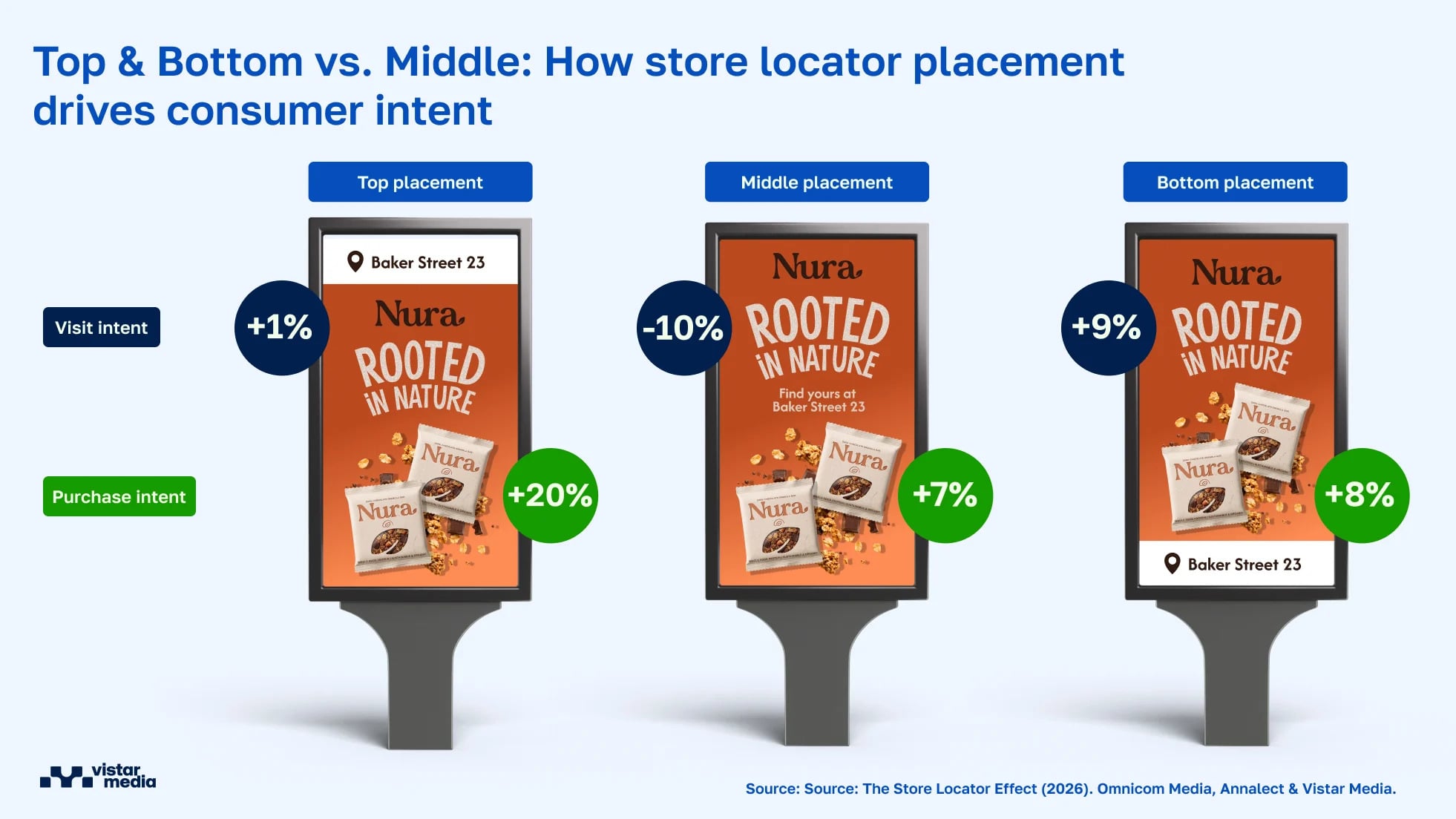
Information about where to buy chocolate can increase interest in purchasing it, but its position within the ad changes the result. In a study of digital out-of-home advertising, purchase intent for sweets and chocolate was more than twice as high when store information appeared at the top or bottom of the creative than when the ad contained no such information. Placing the same information in the middle proved less successful, as it had to compete for attention with the main message and image.
This is one of the findings of The store locator effect: How store information moves audiences from screen to store, published by Vistar Media in partnership with Omnicom Media and Annalect. The study examined how store location information, known as store locators, influences visit or purchase intent and what difference its placement and design make. In programmatic DOOH, these elements can automatically adapt to the screen’s location and direct audiences to the nearest store, restaurant or other point of sale.
The largest increase was recorded for products purchased impulsively. For sweets and chocolate, purchase intent rose by 116% when store information appeared at the bottom of the ad and by 110% when it appeared at the top, compared with the version without that information. Results for the overall consumer packaged goods category, or CPG, were more moderate: the strongest increase was 20%, with top placement. This distinction matters when interpreting the study, because the figure of over 110% describes impulse-buy products rather than the entire category.
For retail and quick-service restaurants, the study tracked visit intent. In the separate retail results, information at the bottom of the ad increased it by 35%, while the increase for quick-service restaurants was 24%. The authors explain the advantage of the top and bottom of the creative through the clearer separation of location information from the other elements of the ad. In the middle, it was easier to overlook.
The way the location was presented also had a measurable effect. Using a recognisable location marker, or pin, delivered a 16% increase in visit intent, while strong contrast between store information and the rest of the creative was associated with a 10% increase in visit or purchase intent, depending on the category.
Martine Hammink, VP, Creative Studio & Creative Solutions at Vistar Media, emphasised that the research gives creative teams a more concrete basis for decisions about out-of-home advertising. “It’s not a one-size-fits-all approach, but we hope this study gives brands and creative teams real evidence to make their creative outdoor advertising decisions more intentional and impactful.”
Adding a point of sale can, however, also create a brand recognition issue. When an ad prominently featured another brand alongside the product brand, such as a supermarket or retailer, attention was divided between them. In some cases, recognition of the advertised brand declined even though visit or purchase intent remained strong. For new brands that still need to build recognition, this is an additional decision to consider when designing the ad.
The research was conducted between February and April 2026 among 7,200 respondents in the Netherlands, aged 18 to 59. They were randomly shown images of an outdoor environment featuring a vertical digital screen measuring 1080 × 1920 pixels. Depending on the group, the ad contained store information at the top, middle or bottom, while the control version contained none. Alongside visit and purchase intent, the study tracked brand recognition and ratings of the brand and ad.
The study therefore measured responses after exposure to the ads, rather than actual store visits or sales. The authors also note that the findings apply to the screen format and creative executions tested. When adapting to other DOOH formats, the size, visibility and relationship of location information to the rest of the ad need to be reassessed.

