

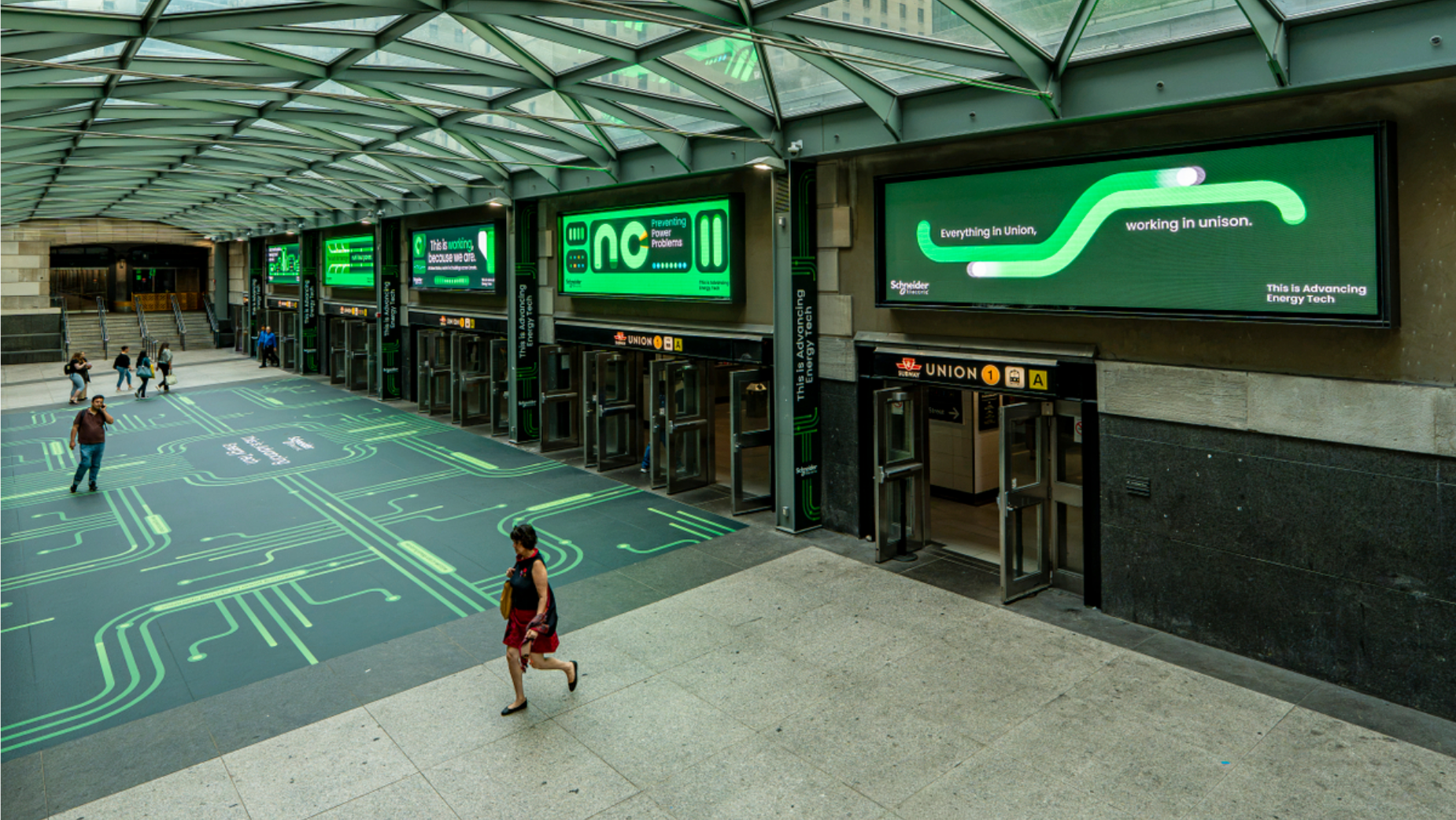
A digital screen at one end of a station usually has little connection with one at the other. At Toronto’s Union Station, they are now parts of the same image. The animation continues across different surfaces, connecting them into a system that resembles the movement of energy through urban infrastructure.
This is what Living Energy Dashboard looks like, a new activation by Schneider Electric Canada, developed by McCann Canada and creative studio BUCK. The station’s entire digital inventory is treated as a single surface, so the message does not end when an individual advertisement disappears from a screen, but continues through the space used by commuters every day.
The visual system consists of animated flows that move between displays and change in response to different conditions. They illustrate how intelligent energy systems respond to change and support the operation of buildings, transport networks and critical infrastructure. Sound is incorporated into the installation so that the sense of connection continues beyond the boundaries of the individual screens.
Union Station was not chosen solely as a way to secure a high volume of audience traffic. Schneider Electric’s technology already supports operations in environments like this one, but much of its work remains out of sight of the people who use them. The station has therefore become a practical example of a system that depends on reliable energy management, rather than a neutral location where a technology campaign has been placed.
For a company whose products and software are most often found behind walls, inside control systems and technical rooms, the main communication problem is not a lack of presence, but a lack of visibility. By connecting the station into a unified media system, McCann Canada addresses that problem without a traditional product demonstration. The screens themselves begin to behave like the network they are describing.
The subject takes on additional importance due to changes in Canada’s energy sector. The development of artificial intelligence and data centres, the expansion of electrification and the modernisation of the electricity grid are increasing the need for systems that can monitor consumption and adapt to change. The activation does not translate these processes into statistics and technical specifications, but into movement that can be followed while passing through the station.
Union Station is the centrepiece of a broader campaign that includes outdoor, digital video, social media and LinkedIn. The physical installation therefore remains its most extensive format, while the same visual principle continues across channels available to audiences outside Toronto.
McCann Canada led the creative concept, strategy and media planning. OCX was responsible for creative production, BUCK for visual design and animation, and Grayson Music Group for sound design. Outdoor execution at the station was supported by Branded Cities. The campaign is being extended across social and video channels with support from Meta and LinkedIn, while Golin Canada is leading public relations, executive communications and the earned media strategy.
The connected screens here are not merely carriers of a message about connected infrastructure. They are organised according to the same principle Schneider Electric is seeking to present: separate elements become more useful when they begin exchanging information and operating as a single system.

