

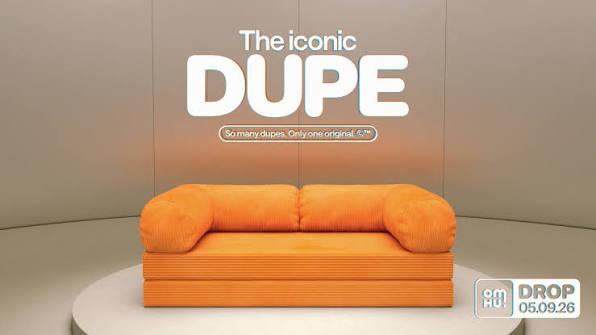
A deliberately misspelled name is usually not a recommendation when buying designer furniture. In OMHU’s campaign, it was part of the sales plan: the TEDDY model became TEDY, received a bright orange cover and appeared on Temu, Etsy and Dupe.com. Its price of $799.99 brought it closer to the imitations, while the original model cost $1,995 in the US.
Behind that listing was the same manufacturer, using the same materials and production methods. The Danish furniture brand carried out The Iconic Dupe campaign, conceived by its in-house creative team, by offering its own product alongside the cheaper versions that had become its competition. The intention was to attract precisely those shoppers who recognise the sofa’s shape but may not know who designed it.
The move followed market research that OMHU conducted after TEDDY went viral in 2022. It showed that the brand’s biggest competitors were not other recognisable furniture companies, but numerous imitations on online marketplaces. For a product whose appearance is already circulating on social media, this is an awkward marketing problem: audiences may know the design well without associating its creator with the purchase at all.
The limited TEDY edition gave the brand a way to enter that search for a more affordable alternative. The missing letter and lower price mimicked the way copies are presented, while the product’s origins led to an explanation of the original’s value. On the campaign page, OMHU therefore discussed production, materials, certifications and customer support, information that shoppers can hardly glean from a photograph of a sofa. The edition has since sold out.
Christine Smith, the brand’s creative director, explained that they wanted to raise awareness of what shoppers are actually paying for when choosing an imitation. In her statement, the lower price raised questions about working conditions, materials and environmental impact. This was the argument OMHU used to defend its own price, while the campaign’s humour allowed it to reach audiences without a lecture on what they should buy.
Celebrity lookalikes, dubbed “dupefluencers”, were recruited for the promotion, their online recognition already built on their resemblance to someone else. Among them was Miles Mitchell, winner of the Timothée Chalamet lookalike contest. The same idea was applied to outdoor advertising in New York, where the campaign included both real billboards and digitally created versions of them.
A collaboration with Office Magazine also offered an opportunity to test claims about the differences between the products by sitting on them. At New York’s LUME Studios, the orange TEDY was placed alongside five imitations purchased online, without labels that would reveal their manufacturers. Visitors inspected seams, compared fabrics and comfort, and voted for the sofa they believed was the original. According to a recap the brand published on 8 October, most identified it correctly, although the responses were not unanimous.
That comparison gave the campaign a more convincing continuation than another advertisement about quality. Shoppers had an opportunity to assess differences that easily disappear on a screen, and the brand gained a reason to talk about its product again. Selling the cheaper TEDY served as an entry point into a conversation about the more expensive TEDDY, in the places where people were already looking for its replacement.

