

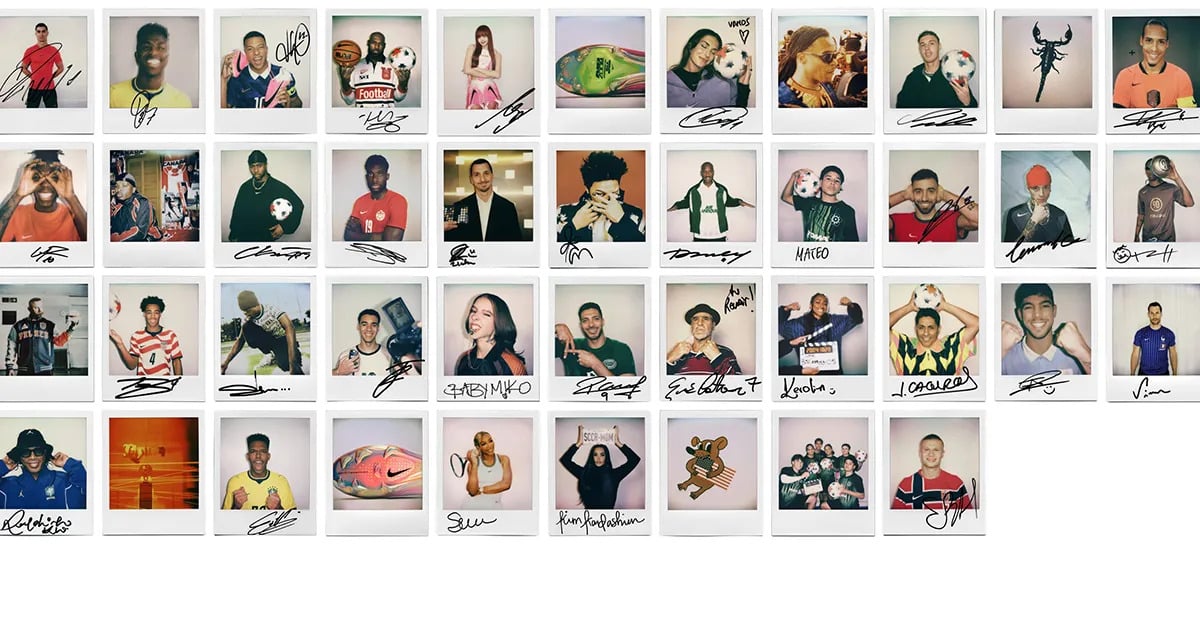
Unlike previous World Cup cycles, in which global sports brands built attention around one major advertising film, Nike has this time chosen to completely fragment its communication and transform it into a multi-month digital ecosystem of content, collaborations, and community-driven moments.
At the center of the new strategy is the “12 Weeks of Football” platform, designed as a continuous flow of content that will run throughout the summer leading up to the 2026 World Cup.
The campaign did not begin with a traditional cinematic spot, but with a series of 42 Polaroid photographs distributed across social media platforms. The images are intentionally raw, spontaneous, and almost chaotic – feeling more like an internet dump or a pop culture group chat than a traditional global sports campaign.
That aesthetic approach reveals the broader logic behind the entire project. Nike is clearly no longer trying to create one dominant advertising moment capable of controlling audience attention for a few days. Instead, the focus shifts toward constant presence within feeds, social media culture, and the crossover space between sport, fashion, music, and entertainment.
The photographs feature Cristiano Ronaldo, Erling Haaland, Kylian Mbappé, and Ronaldinho, alongside Kim Kardashian, Travis Scott, Serena Williams, Central Cee, Young Miko, and BLACKPINK star Lisa.
That combination of names is far from accidental. The campaign clearly demonstrates that Nike no longer treats football solely as a sporting event, but as a global lifestyle phenomenon that operates equally through streetwear, music, celebrity culture, and online communities.
An important role within the strategy is also played by NIKE TOMA (“Take the Game”), a platform focused on street football and content created by younger communities and local players. Through this, the company further emphasizes a community-driven approach while moving away from the traditional model of mass broadcast communication.
The Polaroid series also acts as a teaser for a number of fashion and streetwear collaborations tied to the tournament, including Jacquemus x France, Palace x England, NOCTA x Canada, Patta x Netherlands, and G-Dragon x South Korea.
Particular attention was drawn to a photograph of designer Simon Porte Jacquemus wearing a special-edition France jersey, effectively confirming rumors about major federation collections that Nike plans to release throughout the summer.
The new strategy simultaneously highlights how much the logic of sports advertising has changed. Instead of relying on one large “hero” film dominating television and YouTube, brands are now trying to build attention through a constant rhythm of smaller cultural moments capable of living for weeks across social platforms.
The contrast is especially visible in relation to rival Adidas, which continues to build its World Cup narrative around a more traditional large-scale cinematic spot featuring Timothée Chalamet, Lionel Messi, and Bad Bunny.
Nike is choosing a completely different direction – less about one spectacle, and far more about creating the feeling that the campaign is constantly unfolding across the internet.

