

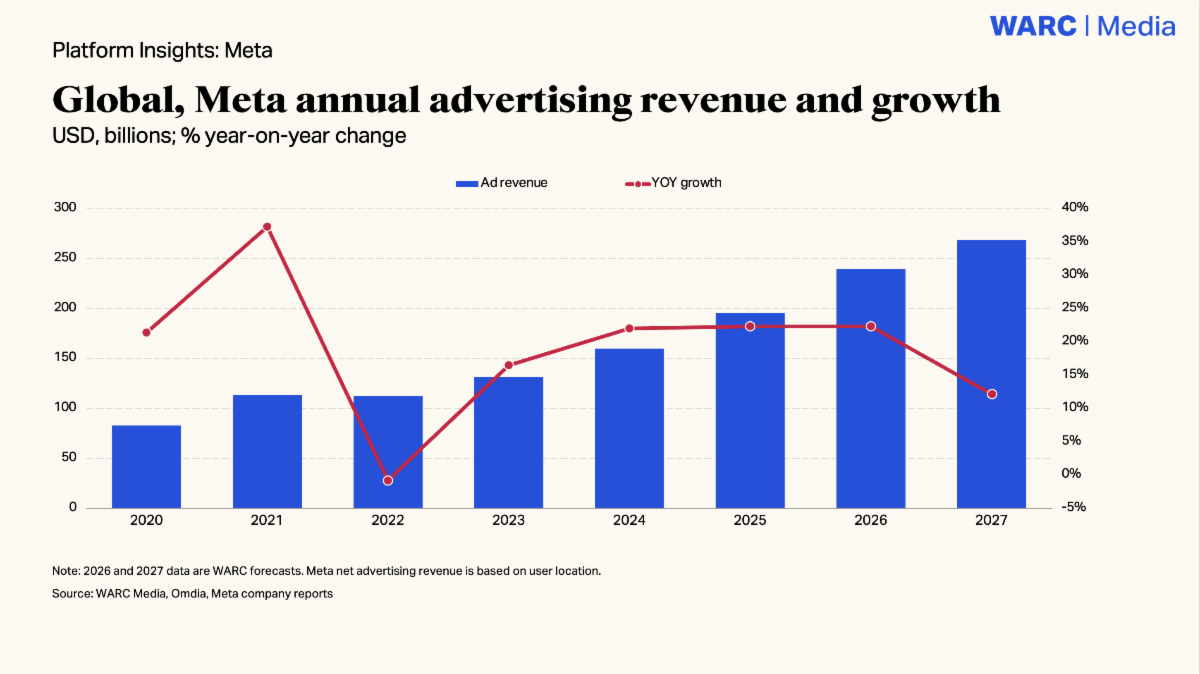
Meta is expected to surpass $240bn in advertising revenue this year, with the company’s growth becoming increasingly tied to artificial intelligence, campaign automation, and efforts to monetise existing audiences more efficiently than ever before. That is the key conclusion of the new WARC Media report “Platform Insights: Meta”, which examines how Meta’s business model is evolving and why investors simultaneously see both major potential and growing risk.
Over the past few years, Meta has significantly changed the way it sells advertising. The focus is no longer simply on increasing the number of ads across its apps, but on AI systems designed to improve campaign performance without damaging the user experience. Facebook and Instagram now operate as part of a unified AI infrastructure that optimises targeting, attribution, and campaign automation almost in real time.
According to WARC Media forecasts, Meta’s advertising business grew 22% during 2025, reaching $196bn in revenue, while a further 22.3% increase is projected for 2026, bringing total ad revenue to $240bn. Growth is expected to slow in 2027, though it is still forecast to remain strong at 12.1%.
The report argues that AI development has become central to Meta’s business strategy. In the years following the pandemic, the company dramatically increased investment in artificial intelligence and is now attempting to prove that automation can simultaneously improve campaign efficiency and platform revenues.
“Meta’s growth engine is moving faster than ever before. AI automation is transforming the way brands connect with audiences and driving strong growth in investment across Facebook and Instagram. That is enabling the company to make record investments in AI innovation,” said Alex Brownsell, Head of Content at WARC Media and co-author of the report.
At the same time, that same model is becoming a growing source of investor concern. During its latest earnings call, Meta announced an increase in annual AI-related capital expenditure to between $125bn and $145bn, with its business model still relying almost entirely on advertising revenue. Unlike companies such as Google or Amazon, Meta has far less diversified revenue streams, contributing to an approximately 10% drop in its share price following the announcement.
WARC expects Facebook to remain the largest contributor to Meta’s advertising revenue. In 2026, Facebook is forecast to generate around 60% of the company’s total ad business, while Instagram is expected to account for the remaining 40%.
At the same time, marketing industry interest continues shifting toward Instagram. According to WARC’s annual Voice of the Marketer survey, more than 55% of global marketers plan to increase investment in Instagram this year, while only 25% intend to increase spending on Facebook.
Meta says that more than 3.5 billion people worldwide use at least one of its apps every day. However, the report warns that user growth is beginning to slow, while restrictions in Russia and Iran during the first quarter of this year contributed to the company’s first-ever decline in total daily active users.
A significant portion of Meta’s future growth strategy is now focused on more efficient monetisation of existing users, particularly in markets outside North America and Europe. Latin America and Sub-Saharan Africa currently show high engagement levels on Facebook and Instagram, but generate significantly lower revenue per user. That is why Meta is rapidly expanding advertising across platforms such as Threads, which has already begun rolling out ads in Brazil.
The report also highlights how content consumption habits are changing across Meta’s ecosystem. Short-form video is increasingly becoming the default content format. Reels now accounts for 45% of all engagement on Instagram and 29% on Facebook, while time spent watching video content on Facebook globally increased 8% quarter-on-quarter.
At the same time, Meta continues investing heavily in large language models (LLMs) in order to develop what the company describes as a “deeper intuition about user interests” and improve ad targeting.
The report places particular emphasis on campaign performance and AI optimisation. Meta says that the rollout of its AI models during Q4 2025 drove a 24% increase in incremental conversions through more accurate attribution. Analysis by Fospha also found that cost-per-purchase improved by 4.5% year-on-year.
Brands using Advantage+ campaigns achieved 41% higher blended ROAS and 17% lower new customer acquisition costs compared with manually managed campaigns.
Partnership Ads formats, which combine influencer marketing with Meta’s performance tools, are also becoming increasingly important. According to the report, 71% of consumers make purchases within days of seeing creator content across Meta apps.
Analysis by Kantar found that the average campaign currently allocates around 4% of budget to Instagram and 5% to Facebook, yet both platforms continue delivering above-average results in terms of brand awareness, brand association, and purchase motivation.
Instagram is now ranked as the second most preferred media brand among global marketers after YouTube, while more than 40% of marketers believe that Instagram is among the four platforms delivering the highest levels of audience attention.
WARC concludes that Meta no longer operates simply as a social media company, but increasingly as an AI-driven advertising system in which algorithms, automation, and performance models are becoming the primary drivers of future growth. Because of that, the key question for the industry is no longer only how much Meta will grow, but how long the market will remain willing to finance such an aggressive AI transformation through advertising revenue.

