

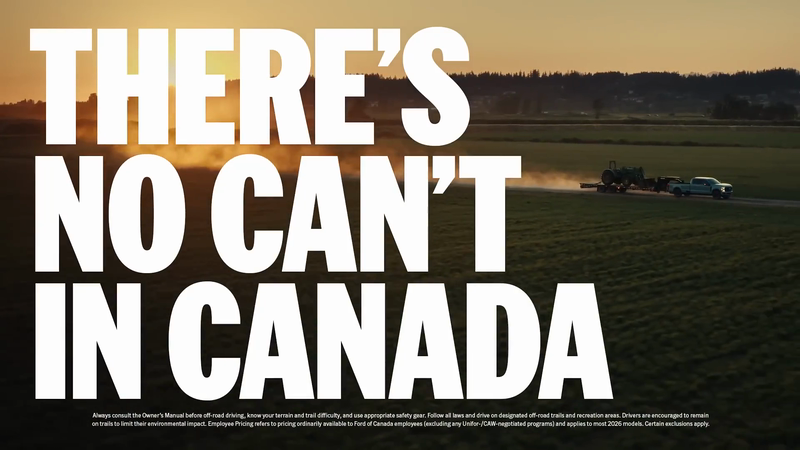
At a time when Canada’s automotive industry is facing trade tensions, shifting electrification plans and rising costs, Ford is choosing to prove its belonging to the country through plants, jobs and new investments. The new There’s No Can’t in Canada platform, developed by Wieden+Kennedy Toronto, relies on a play on words hidden in the country’s name, but does not look to the slogan for its main argument.
Ford has been present in Canada for 122 years and is now preparing to open its retooled Oakville Assembly Complex. It is investing more than five billion Canadian dollars in its transformation, a new stamping plant and preparations for the production of the Super Duty. These are accompanied by investments and operations in Windsor, Waterloo, Ottawa and Markham, cities the brand cites as more concrete evidence of its local connection than national symbols placed in an ad.
The campaign is accompanied by an open letter from Bev Goodman, President and CEO of Ford Motor Company of Canada. In it, she does not conceal the company’s American origins but argues that decades of manufacturing and employment have changed the nature of its relationship with Canada.
“We’re an American company, and I won’t pretend otherwise. But we’ve been living here long enough, building here long enough, that I think of us as a citizen of this country as much as a visiting one,” Goodman wrote.
This approach also shapes the way Wieden+Kennedy Toronto developed the creative idea. Canadians are at the centre of the story, while Ford presents itself as a partner to the people who keep the country moving. Instead of creating a new connection with the market, the campaign draws on one the company can trace through several generations of vehicle owners, employees and communities gathered around its facilities and more than 430 dealerships.
Paul Roy, Vice President of Marketing at Ford Canada, explains that national research shows Canadians remain optimistic despite the current difficulties. However, the company primarily ties its confidence in the market to the decisions it is already implementing.
“We didn’t need to manufacture a connection to Canada. It’s a relationship we’ve built over generations, and we’re proud to be a trusted, proven partner woven into the fabric of Canadian communities,” Roy said.
There’s No Can’t in Canada continues Ford’s shift this year towards real owners, employees and the ways its vehicles are used. The company cites truck owner stories, its appearance at Formula 1 in Montreal and a Canadian team’s participation in the Dakar Rally as experiences from which it learned that audiences respond better to recognisable situations than to polished automotive scenes with no clear connection to customers’ lives.
Alongside its reputational message, the platform also has a sales component. Ford has made the prices normally offered to its employees available to all customers in Canada. The national Ford Employee Pricing offer, presented with the message You Pay What We Pay, runs until September 30, meaning the campaign and its sales activities are still ongoing. In this way, the brand has connected its response to vehicle affordability with the same idea it uses to speak about its future in the country.
The campaign is also already present on the main Ford Canada website, where There’s No Can’t in Canada functions as a broader communications platform for different vehicle families. The open letter ends with a much more grounded image than those usually offered by corporate investment statements: Ford intends to prove its promise “one plant, one truck, and one customer at a time.”

