

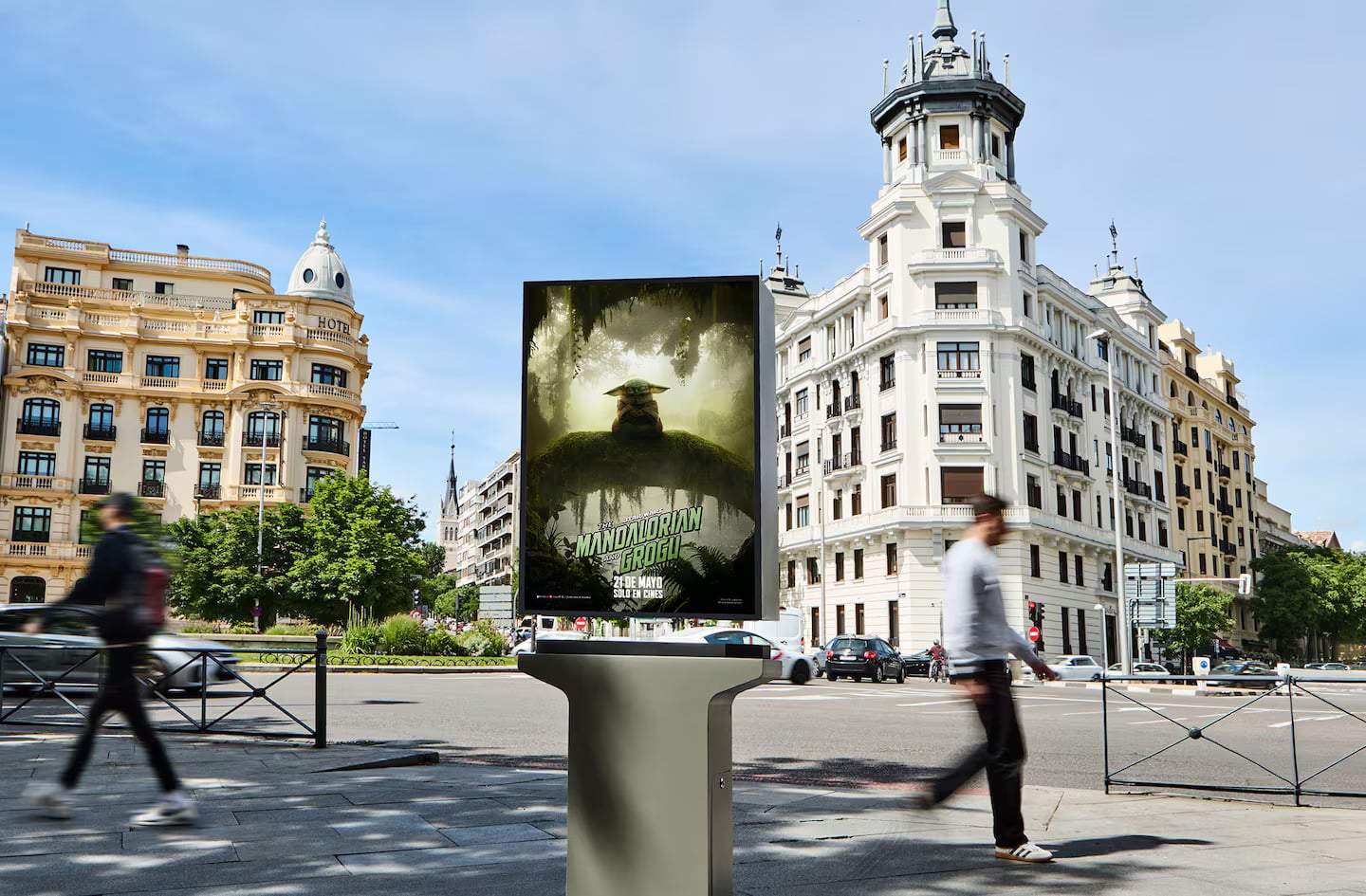
Disney, in collaboration with Havas Creative, launched a campaign in Madrid in which billboards literally float above the streets, directly referencing the “Force” powers from the Star Wars universe and Grogu’s ability to move objects without physical contact.
The activation was installed across several of Madrid’s busiest locations, including Cibeles, Calle Alcalá, Alonso Martínez and Fuencarral, just ahead of the theatrical release of The Mandalorian and Grogu, the first Star Wars cinema release in seven years.
Unlike many contemporary OOH campaigns that build their effect through CGI content designed primarily for social media, this project attempts to create the same level of spectacle in real physical space. The billboards did not rely on digital tricks or post-production, but were actually lifted above their bases thanks to a complex magnetic levitation system developed by Andtonic.
The visual effect of the campaign directly imitates the way Grogu uses the Force in the Star Wars world to lift and move objects. That idea became the central creative logic of the project – not simply to show a character from the film, but to physically transfer his power into the everyday urban environment.
As a result, the entire activation functioned more like a public installation or urban attraction than a standard advertising format. Passersby were not simply looking at a movie poster, but entering a situation that appeared to be part of the film franchise itself.
The technological side of the project represented a particular challenge because the system did not need to operate in controlled indoor conditions, but rather in open urban locations exposed to constant changes in weather, wind and vibrations caused by traffic and large numbers of people. According to information from the campaign, the magnetic system had to keep large structures stable in the air despite all outdoor conditions.
The campaign arrives at a moment when entertainment and streaming brands are increasingly trying to return physical experiences to the center of marketing strategies. After years dominated by digital content and social media, major studios and franchises are investing more heavily in activations that audiences can experience live, photograph and organically share online.
For Disney, this is also an attempt to make the return of the Star Wars franchise to cinemas feel like a major cultural event rather than just another movie premiere. Instead of a classic promotion focused on trailers and key art, the campaign tries to remind audiences that Star Wars has always functioned as an experience built around spectacle, technology and imagination.
In recent years, the outdoor industry has increasingly tried to move away from the static logic of billboards and transform urban space into an interactive medium. However, most of those attempts remain limited to screens, sensors or augmented reality effects that audiences only experience through mobile phones. What distinguishes this campaign is the fact that the effect exists physically and is visible to the naked eye, without the need for apps, filters or additional screens.
In that sense, the campaign simultaneously uses the nostalgia of the Star Wars universe and the contemporary audience desire for experiences that appear “impossible,” yet physically exist within the space of the city.

