

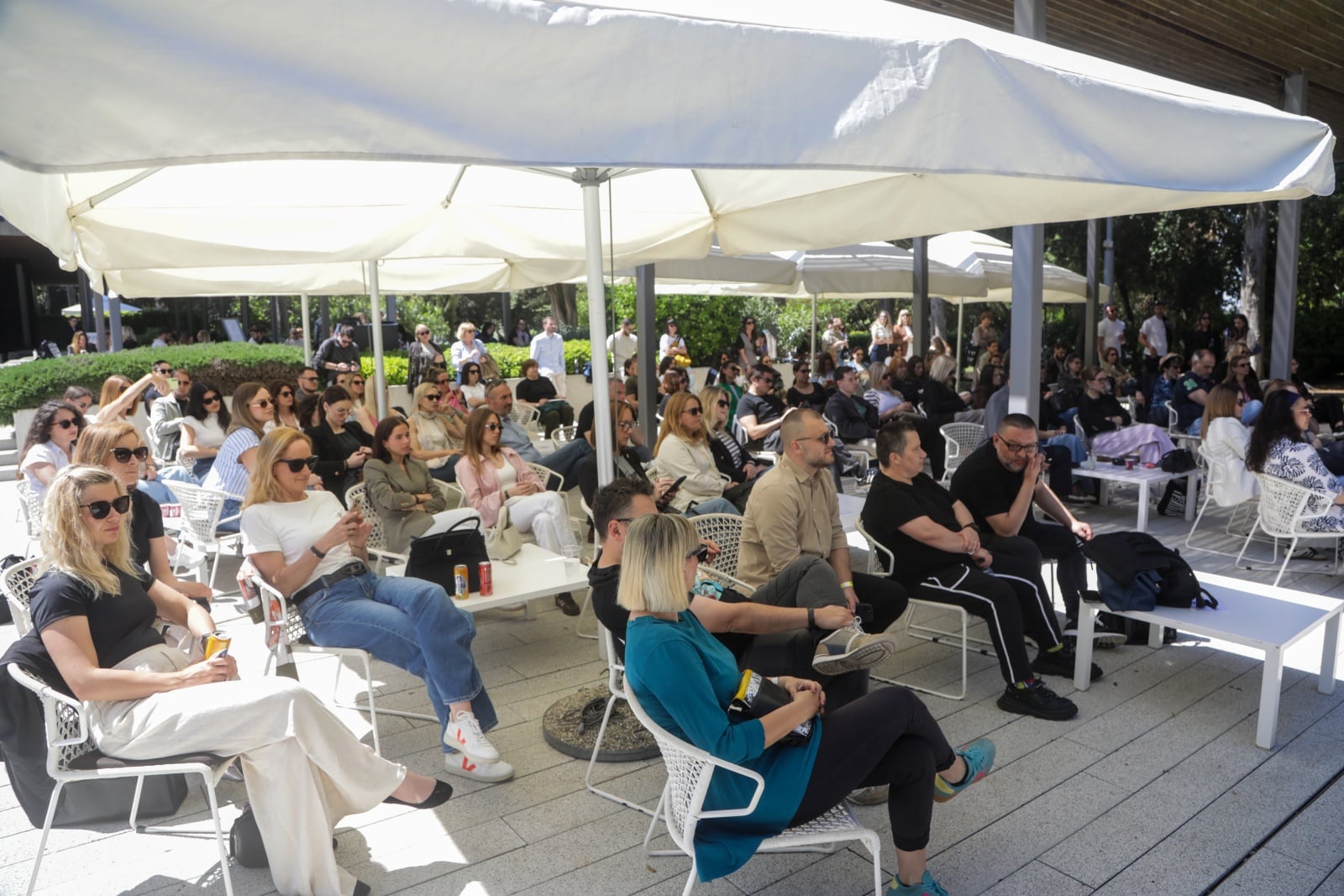
The closing day of the festival in Rovinj connected topics that at first seemed completely different, from the development of artificial intelligence and the psychology of AI systems to radio, film and long-term brand positioning, but the common thread of the programme quickly became clear. The focus was no longer on fascination with technology or big statements, but on how audiences react when communication reaches the right moment, context and channel.
The greatest attention was drawn by the lecture of Jürgen Schmidhuber, one of the key figures behind modern artificial intelligence, whose work has for decades been embedded into systems that today shape the way information is created, distributed and interpreted.
In the lecture Modern AI and the Future of the Universe, Schmidhuber did not speak about AI as a trend, but about the difference between what artificial intelligence actually is and what people today project onto it. Instead of simplified predictions and market hype, he focused on the long-term development of learning systems, their real limitations and the direction research is taking once the pressure of short-term market expectations is removed.
Such an approach shifts the AI discussion away from spectacle and back into the space of understanding, to the question of what technology actually does and what people want to see in it.
If Schmidhuber’s part of the programme opened the question of how systems function, the continuation of the day showed how people use those systems when they need to make decisions with long-term consequences.
Taking the stage was Julie Supan, the brand strategist behind the early positioning of YouTube and someone who helped shape brands such as Airbnb, Dropbox, Reddit and Discord at the moment they were still defining what they actually were.
Her lecture was not motivational, but deeply structural. She spoke about what it looks like when a brand has a clearly defined role, what it means to make decisions that still make sense when market conditions change, and why most communication problems are not caused by a lack of ideas, but by a lack of clarity.
Through concrete examples, she demonstrated how meaning is built in a way that can survive growth, competition and shifts in channels without constantly having to re-explain what a brand stands for.
One of the most striking regional examples came through the project The Wedding That Beat Titanic: 2 Million Reasons to Talk About Svadba, presented by Igor Šeregi, director of the film Svadba, and Goran Turković, designer at Šesnić&Turković and member of HURA and IAB Croatia.
Through the development of the idea, creative risks and key production and communication decisions, they showed how content created from a local context can outgrow its own boundaries and reach millions of people across the region. It was precisely this combination of local emotion and audience-driven sharing that transformed the film into a phenomenon audiences did not simply watch, but actively spread further.
The topic of trust in systems most users do not truly understand was opened in the panel The Psychology of AI, where Boris Šurija, CEO of Lexi and member of IAB Croatia, together with Andrijana Mušura Gabor, psychologist and behavioural scientist, discussed psychological patterns increasingly appearing in AI-generated content.
Through practical examples, they showed how anchoring, confirmation bias and the need for “safe” answers directly influence the way AI generates content, but also why so much generated material today sounds predictable and generic.
Particular emphasis was placed on the fact that the quality of output often depends far more on the person using the tool than on the tool itself.
While much of the festival programme focused on technology, algorithms and shifts in audience behaviour, the closing part of the day returned attention to one of the oldest media formats.
As part of the discussion Did Video Really Kill the Radio Star?, organised by Radio Grupa and Radio Istra, participants included Boris Jokić, scientist and host of the programme Glazbeni kurikulum on Yammat FM, and Korado Korlević, educator, astronomer and long-time voice of the programme Znanstveni leksikon – Pod zvijezdama on Radio Istra, moderated by journalist and radio host Damir Jurjević.
The conversation opened the question of why radio, despite the dominance of visual platforms, still remains deeply rooted in people’s daily routines, local communities and habits that other channels struggle to replace.
The final day of Dani komunikacija did not close the questions currently defining the communications industry, but it clearly showed the difference between communication that only appears convincing and communication that truly changes audience behaviour.
More information is available at Dani komunikacija

