

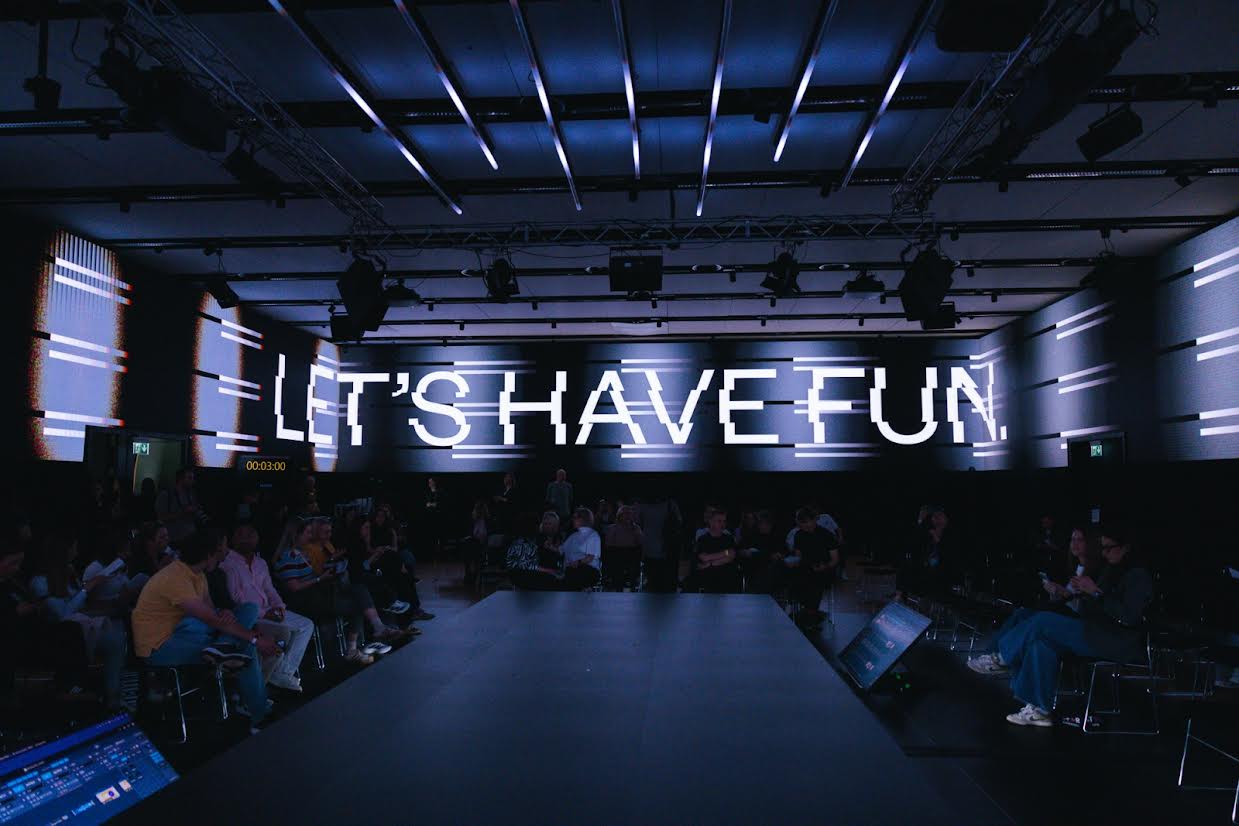
The second day of Dani komunikacija 2026 clearly showed that audiences today are no longer focused solely on inspirational case studies and big festival narratives, but on questions that directly impact the industry’s day-to-day reality: how communication decisions are made, who defines the value of creative work, where influence ends and responsibility begins, and what actually happens between an idea and its approval inside companies.
The programme in Rovinj shifted the focus away from broad industry overviews toward more concrete conversations about strategy, business, regulation and communication with a clear purpose. Instead of general conclusions, audiences were looking for ways of thinking that explain how the industry truly functions today.
Strategy as a Decision-Making Tool
One of the standout conversations of the day came from Mark Pollard, one of the world’s best-known strategists and author of Strategy Is Your Words, who works with global brands and, through the platform Sweathead, has built an international community of strategy professionals.
Speaking about the role of strategy in modern business, Pollard warned how often strategy is used as a form without any real business function behind it.
“If you can’t explain your strategy simply, you probably don’t understand it well enough.”
His talk positioned strategy as a tool for making decisions, rather than a document or presentation that exists for its own sake.
Creative Work as a Business Value Question
A similar theme from another perspective was explored by Chris Do, founder of The Futur, Emmy Award-winning designer and one of the most influential educators in design and creative business.
Rather than focusing on creative execution itself, he shifted attention to the way creatives define their value, negotiate and position their work in the market.
“Some people run toward change, while others run away from it. Figure out which group you belong to.”
His session opened a question the industry has increasingly been trying to address in recent years: how pricing, positioning and confidence in creative work ultimately shape the market itself.
Marketing That Comes From Business, Not Theory
The conversation A Story (Finally) Told: The Marketing Playbook also drew significant attention, bringing together Mate Rimac, founder of Rimac Automobili and Rimac Technology, and Damir Sabol, founder of Photomath, moderated by Davor Bruketa.
The discussion was not focused on classic marketing formulas, but on the experiences of people behind companies and products that have become internationally relevant.
Through their own experiences, they discussed the relationship between product development, market positioning and communication, long-term thinking, and where marketing truly has a meaningful role within business.
“If you do something interesting and have an internet connection, the whole world will talk about it,” concluded Bruketa, co-founder and creative director of Bruketa&Žinić&Grey.
Where Influence Ends and Responsibility Begins
One of the most current topics of the second day was opened through the panel Regulating Influence: Do We Need New Rules for the Creator Economy?, organised with the support of the European Commission Representation in Croatia.
The panel brought together representatives of regulatory institutions, media and industry: Damir Habijan, Minister of Justice, Public Administration and Digital Transformation, Kamilo Antolović, court expert for market communications and member of the IAB self-regulation working group, Robert Tomljenović, Deputy President of the Council for Electronic Media, and Andrea Čović Vidović, Head of Media and Deputy Head of the European Commission Representation in Croatia, moderated by Bojana Božanić Ivanović, director of Lider Media and member of IAB Croatia.
The discussion raised questions about the limits of influence in a space where the interests of creators, brands and platforms increasingly overlap, with a particular focus on transparency, sponsored content disclosure and responsibility for communication with real social impact.
In the context of the growth of the creator economy and initiatives such as IAB Croatia’s It’s Important to Know When It’s Paid For, the panel highlighted the need for clearer rules and a more aligned approach among all market participants.
What Actually Gets a “Yes”
Strong interest was also generated by the panel What Actually Gets Approved: The ‘Yes’ Formula, which focused on the part of the process that rarely becomes visible outside companies -how ideas actually move from presentation to approval.
The discussion featured Tomislav Ćorić, Deputy Prime Minister and Minister of Finance, Kristian Buhin, Head of Revenue Management in Marketing and Sales at Maistra, Bruno Krčelić, Director of Corporate Communications and Marketing at ENNA, and Daniel Hrupek, Marketing Director for Coca-Cola Adria, moderated by Ema Huskić, Marketing Lead for Mastercard Croatia.
Rather than offering a universal formula for approval, the panel opened a broader discussion about how decisions depend on context, risk, budgets, business goals and reputational implications that often remain invisible from the outside.
The second day of the festival ultimately showed that the communications industry today is looking less for motivational messaging and more for conversations that explain how the system works from the inside – from strategy and business to regulation, responsibility and decision-making itself.

