

The ads do not present a single claim that the audience is expected to accept. Instead, they offer several possible answers, shaped like the suggestions an online search engine provides while a user is still typing a question. One view goes in one direction, another opposes it, and between them remains space for everyone who does not fully identify with either.
This is what the outdoor advertising developed for The National Conversation looks like, as part of a national project seeking to establish how people across the United Kingdom experience community, belonging and their relationships with those around them today.
The research was launched in May, while the advertising campaign that further invited the public to participate was presented in June. The project is led by the Independent Commission on Community and Cohesion, while The /Together Coalition and M+C Saatchi Group UK turned its research ambition into a film, outdoor advertising and social media content.
Until the end of August, participants can complete a survey prepared by researchers from Nuffield College at the University of Oxford, leave a 60-second voice note or organise a conversation within their own community. The collected responses will also be analysed using AI models, and the findings should show what divides people, where common ground still exists and which ideas could bring them closer together again. The final report is scheduled for publication later this year.
Rather than presenting the project as another conventional survey, M+C Saatchi Group sought to give it the weight of a national moment. The central film was written by British playwright James Graham OBE, author of the play Dear England, while the text is voiced by Sir Ian McKellen.
His voice accompanies black-and-white photographs by 16 photographers, taken in different parts of the country and among people of different generations and backgrounds. The film focuses on questions of English identity, a sense of belonging and the stories that have shaped the country, but does not attempt to offer a definitive interpretation. Its role is to lead the audience towards the question of what kind of country they want to see and what role their own voice can play in shaping it.
The outdoor advertising translates that idea into a simpler system. Each ad begins with the words I feel, followed by three possible perspectives on safety, green spaces, diversity, religion and other themes taken directly from the questionnaire.
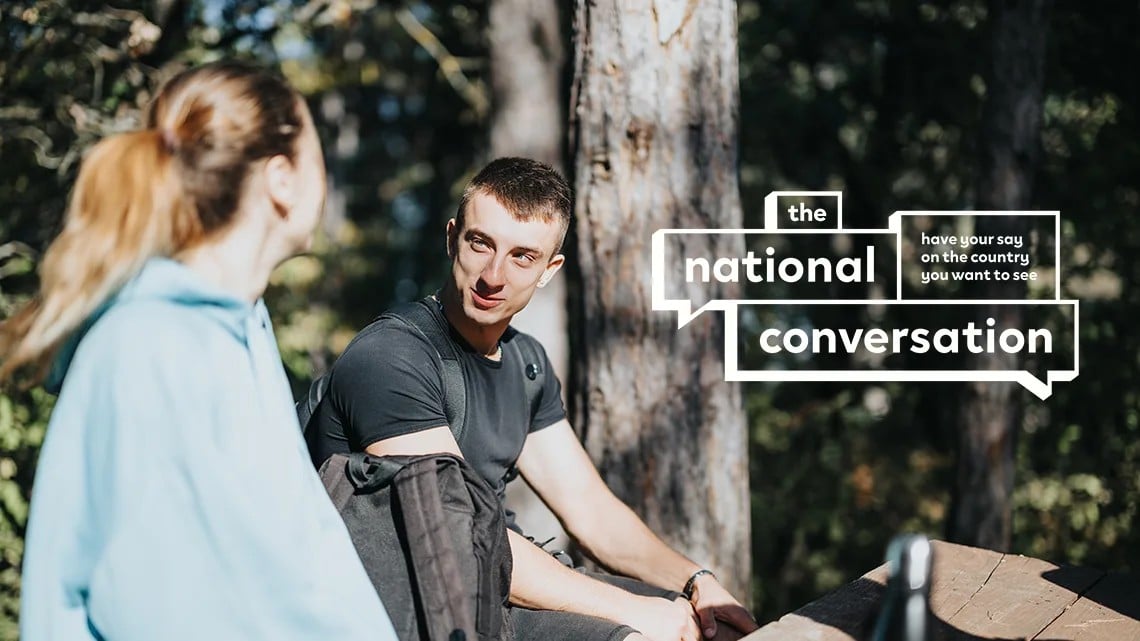
Rather than demanding immediate alignment, the ads show how differently the same place can appear when viewed through different personal experiences. That approach also extends to the visual identity, whose stylised text boxes evoke a conversation, while the black-and-white palette avoids political associations.
The project is supported by hundreds of organisations, including NHS, TikTok, UK Muslim Network, Scottish Council for Voluntary Organisations, Church Urban Fund, Countryside Alliance and the English Football League in the Community programme. Their involvement is intended to expand the conversation beyond the usual participants in public debate and bring it closer to local clubs, religious organisations, healthcare institutions, companies and smaller communities.
The National Conversation does not attempt to determine what Britain should think. Its aim is to establish whether, beneath different experiences and viewpoints, there is enough common language for a conversation about the country’s future.

