

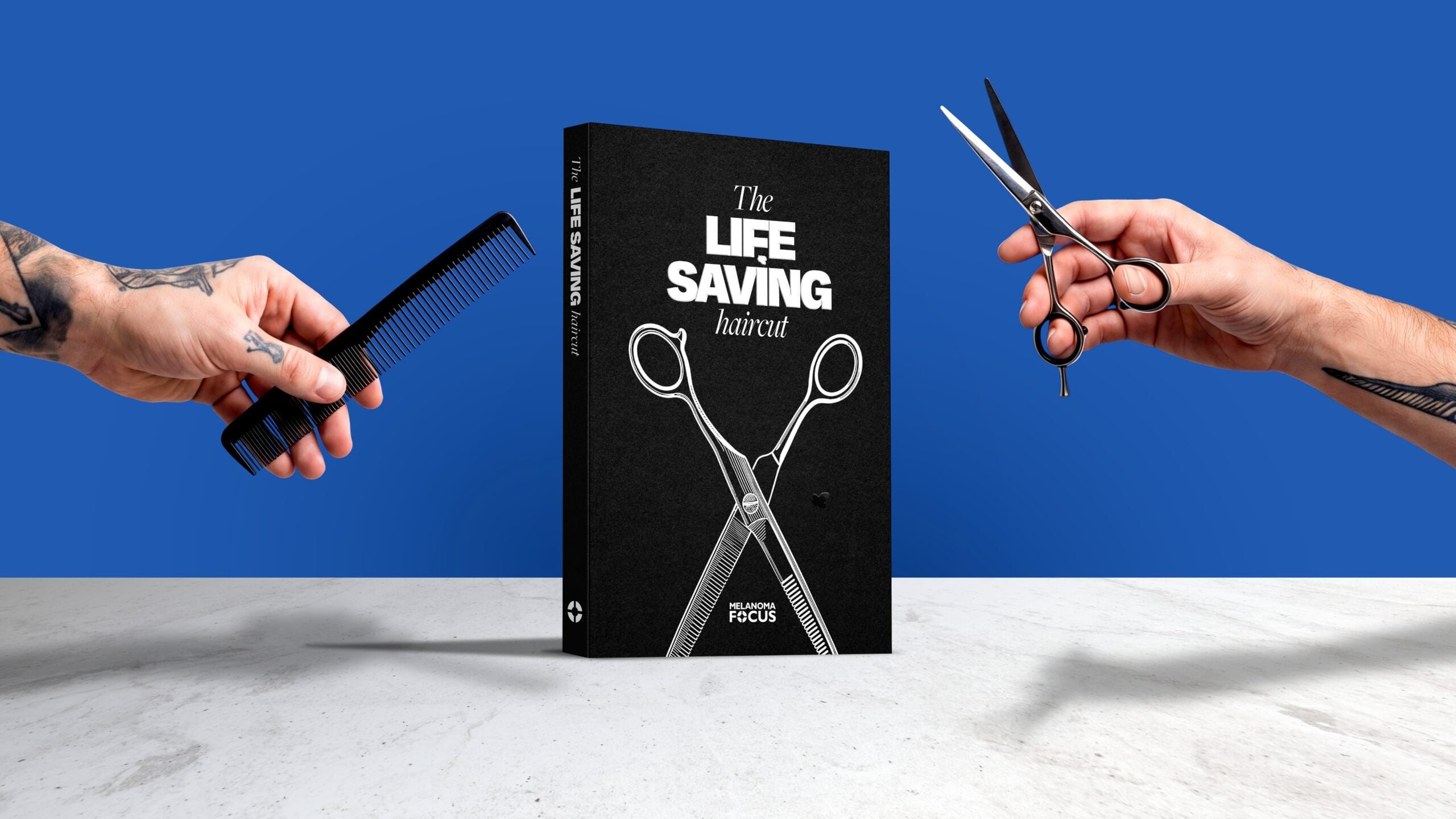
Most disease prevention initiatives aim to change public behaviour through education, warnings and calls for regular medical check-ups. UK charity Melanoma Focus chose a different route, bringing the issue of early melanoma detection into a place where few would expect it – barbershops.
The trigger for launching The Life Saving Haircut initiative was the fact that scalp melanomas are among the most difficult forms of the disease to detect, particularly in men. Because of where they develop, they often remain unnoticed longer than skin changes on other parts of the body, reducing the chances of timely treatment.
The idea was developed by creatives Michele Bona, Chiara Biondi and Michael De Piano, who, after learning about the specific challenges of detecting melanoma on the scalp, set out to identify a group of people who regularly see what most of us cannot. They found the answer among barbers.
According to data referenced by the project, more than 19,000 new cases of melanoma are diagnosed in the United Kingdom each year. A large proportion can be treated successfully if detected early enough. Research shows that approximately one in four melanoma cases in men appears in hard-to-see areas such as the scalp and neck.
Rather than creating a traditional awareness campaign, the organisation developed a practical tool for professionals who come into close contact with these parts of the body every day. The result is The Life Saving Haircut, a free handbook created with the support of melanoma experts that helps barbers recognise potentially suspicious skin changes and encourage clients to seek further medical advice.
One of the most interesting aspects of the initiative is that it does not attempt to position barbers as healthcare professionals. Their role remains simple – to notice a change that a client may never see themselves and start a conversation about it. That clearly defined boundary gives the initiative additional credibility.
Research cited within the project found that 92 percent of barbers are interested in acquiring basic knowledge that would help them recognise potential signs of skin cancer. This provided organisers with a strong argument for turning education into a tool capable of creating a tangible impact within local communities.
To launch the initiative, a promotional film was produced with the support of the Ruffians barbershop in London. During Skin Cancer Awareness Month, printed editions of the handbook will be distributed to barbershops and barber schools across the United Kingdom. A digital version is also available free of charge through the organisation’s website.
The Life Saving Haircut demonstrates that socially impactful communications do not always need to rely on mass media. Sometimes the greatest potential lies with people simply doing their jobs while having unique access to places that remain outside our field of vision. In this case, an ordinary trip to the barber takes on additional significance – becoming a possible first step towards the early detection of a serious disease.

