

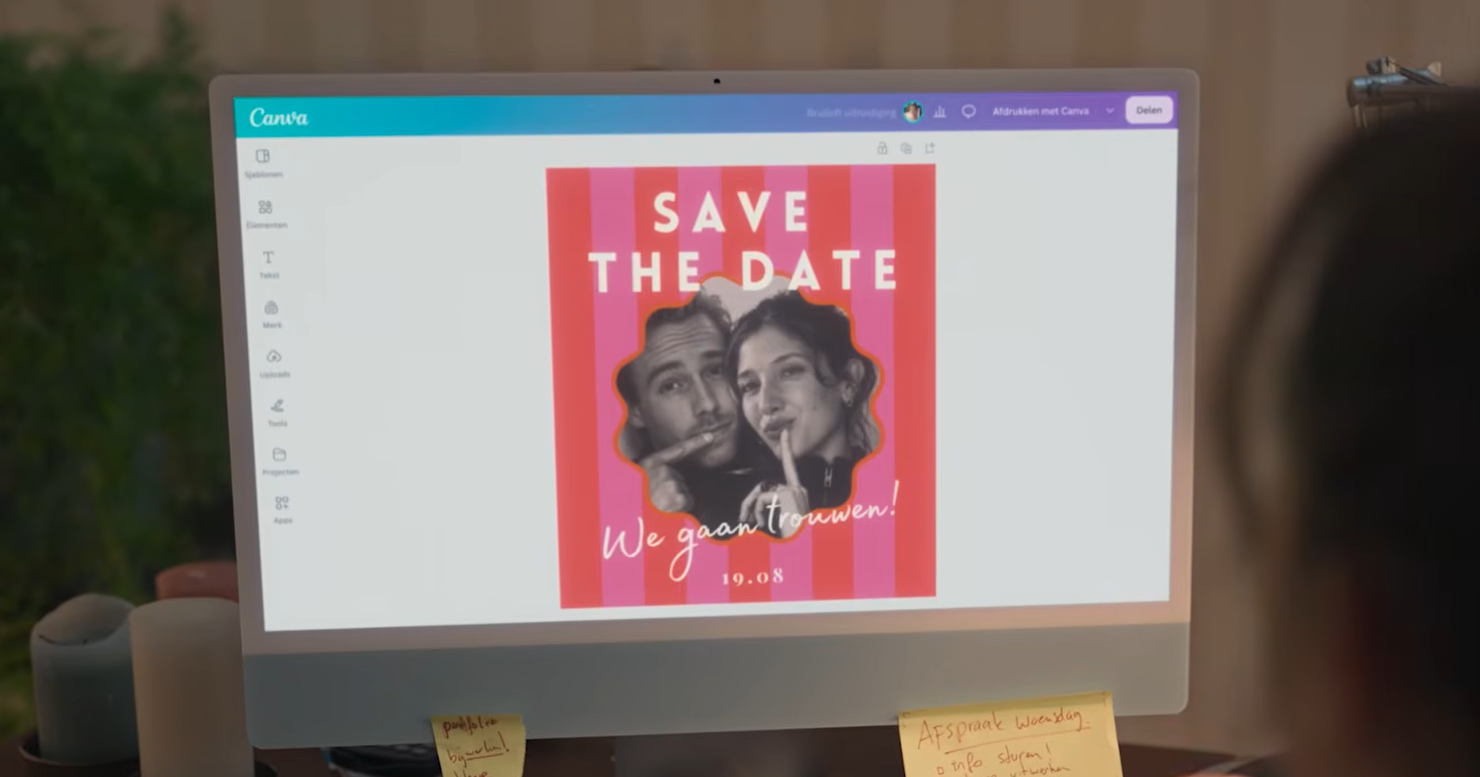
A wedding invitation featuring several mismatched fonts, a presentation with awkwardly inserted illustrations, and a social media post struggling to attract attention have been given the opportunity to express their dissatisfaction. In the first Dutch campaign for Canva, created by agency DEPT, these design disasters have become the main characters. Rather than mocking them, the campaign gives them a voice and one shared wish: to look like designs made in Canva.
The campaign Jaloersmakende Canva Designs (Envy-Inducing Canva Designs) draws on the song Ik wou dat ik jou was by Dutch duo Veldhuis & Kemper, with its lyrics adapted to tell a story of jealousy among poorly designed materials. The commercial features invitations with mismatched fonts, posts envying more successful versions of themselves, and a light bulb illustration from a presentation gazing at more visually polished designs. They are joined by badly cropped cat posters, a series of unusual internet visuals, and even a singing pigeon. Together, they perform a song addressed to the kind of design they all wish they could become.
The creative concept builds on the Dutch habit of preferring to make many things themselves, including invitations, presentations, and promotional materials. However, such creations often remain tied to old Word templates, outdated PowerPoint presentations, and visual solutions that have been repeated for years. Canva positions itself in the campaign as a way to maintain that independence while achieving a better final result. The campaign tagline is Je maakt het, met Canva (You make it, with Canva).
Pol Hoenderboom, Executive Creative Director at DEPT, explains that the agency wanted to highlight familiar design habits without directly criticizing the people who use them.
“The Dutch love creating things themselves, but they have been using the same Word templates and unattractive PowerPoint slides for years. Telling them that directly felt a little rude, so we decided to rewrite a Dutch classic and let the ugly designs sing for themselves. It turns out that creating something truly ugly requires an incredible amount of creative skill,” Hoenderboom said.
For Canva, the local approach was also important because of the way the platform has grown in the Dutch market so far. According to Andres Boot, General Manager of Canva Benelux, users have often discovered it through recommendations from colleagues, friends, and others in their circles. That is why the first national campaign needed to use a cultural reference familiar to the local audience.
“Canva exists to make design accessible to everyone, not just designers. In the Netherlands, it grew through people recommending it to one another: a colleague to a colleague, a student to a friend. We wanted our first campaign here to feel equally local, so we took a song every Dutch person knows and let the designs we have all made at some point sing it back to us,” Boot said.
The campaign is also the first major creative project DEPT has developed for Canva since being selected as the brand’s lead creative agency in the Netherlands in August 2026, following a competitive pitch. The partnership covers creative development, production, television advertising, social media, and influencer strategy.
The campaign was directed by Yousef Thami and produced by 100 prcnt. It is running on television, in cinemas, on social media, and across out-of-home advertising channels. The Dutch launch follows locally tailored Canva campaigns in Italy, France, the United States, the United Kingdom, and Thailand, while a second phase of the Dutch campaign is already in development.

