

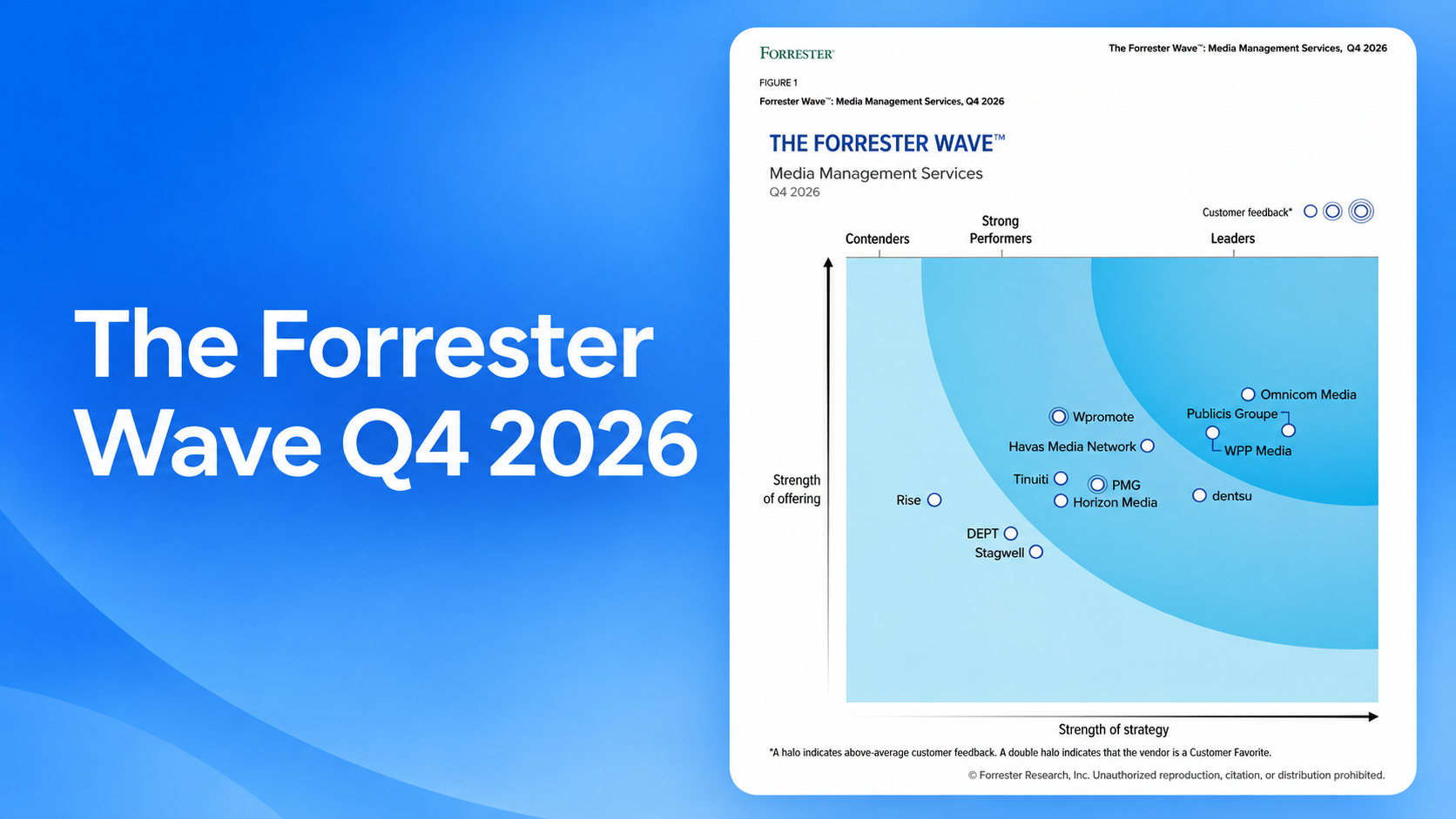
The price of media space remains important when selecting an agency, but the work advertisers entrust to it increasingly includes connecting customer data, implementing technology, supporting sales and managing change. It is this expanded remit that Forrester describes in its report The Forrester Wave: Media Management Services, Q4 2026.
The evaluation of 12 media services providers against 19 criteria placed Omnicom Media, Publicis Groupe and WPP Media in the Leaders category. Their assessed strengths show how closely the choice of a media agency is connected to other marketing decisions: where data will be processed, how media investment will be linked to sales and who will ensure that technology is actually implemented in day-to-day work.
Forrester states that, alongside buying and campaign execution, advertisers are seeking business strategy, innovation, better insights and support in managing change. Agencies are responding by investing in a deeper understanding of audiences and proprietary technology solutions. For marketing teams, the practical consequence of this development is a broader scope for assessing partners: favourable buying terms can be an important advantage, but on their own they do not indicate how successfully an agency will connect media with the rest of the business.
At Omnicom, that connection is particularly evident in commerce. The evaluation highlights the combination of Acxiom’s consumer identity data and the Flywheel Commerce Cloud platform, which connects data, SKU-level management and sales attribution linked to agency compensation. Forrester therefore identifies the group as a fit for large companies seeking to bring together media, commerce, consumer data and creative activities on a common technology foundation.
Such an offering creates the opportunity to make media decisions with more detailed insight into individual product sales. At the same time, linking attribution to compensation gives added weight to agreeing on how the contribution to sales is measured. For an advertiser considering this model, measurement methodology becomes part of assessing the agency relationship from the outset.
Publicis stands out for connecting media scale, data and technology, alongside strong buying and marketing analytics capabilities. Clients value data-driven personalisation, but some midsize clients report waiting for data resources.
For advertisers seeking to centralise media services, which Forrester identifies as a suitable reason to choose Publicis, access to specialists and the way resources are allocated therefore deserve as much attention as the technology offering. The value of personalisation also depends on whether it can be delivered when a campaign needs it.
The assessment of WPP Media emphasises technology and solutions implementation and communications strategy. The Systems of Influence framework identifies sources of growth, maps communities and cultural codes, and defines the role of media. The evaluation also highlights bespoke instances of the WPP Open platform and data collaboration through InfoSum.
For companies operating across multiple markets, the relevant capability here is connecting shared insights with local execution. Centralised infrastructure can support coordination, while an understanding of communities and cultural codes should help determine the role of individual channels and messages. Assessing an agency therefore also involves examining how global capabilities will become usable for a local marketing team.
Size, meanwhile, is not the only route to high scores in individual capabilities. Wpromote, placed in the Strong Performers category, received the highest possible scores for media planning, communications strategy, agentic media buying, search and answer engine optimisation, and vision. The evaluation recognises its Care Index, developed with Northwestern University, as a framework for connecting brand affinity with commercial performance.

