

If you have opened any reputable global trend reports this year, you have probably noticed that they are all talking about the same things. Artificial intelligence is expected to completely change how we plan campaigns, hyperpersonalisation is becoming the new standard, AI agents are taking over parts of the purchasing process, and brands, analysts claim, will increasingly create trends themselves rather than follow them.
Such predictions are nothing unusual. Every year brings a new list of technologies and approaches expected to define the following twelve months, and some of them genuinely do.
What is often overlooked is that markets do not develop at the same pace.
Solutions that are already delivering results in the world’s largest markets cannot always simply be replicated in Croatia. Budgets, the amount of available data, technological infrastructure, regulatory frameworks and user habits all differ. Instead of merely asking whether something is a global trend, it is much more useful to assess whether there are already enough reasons for it to become a local priority.
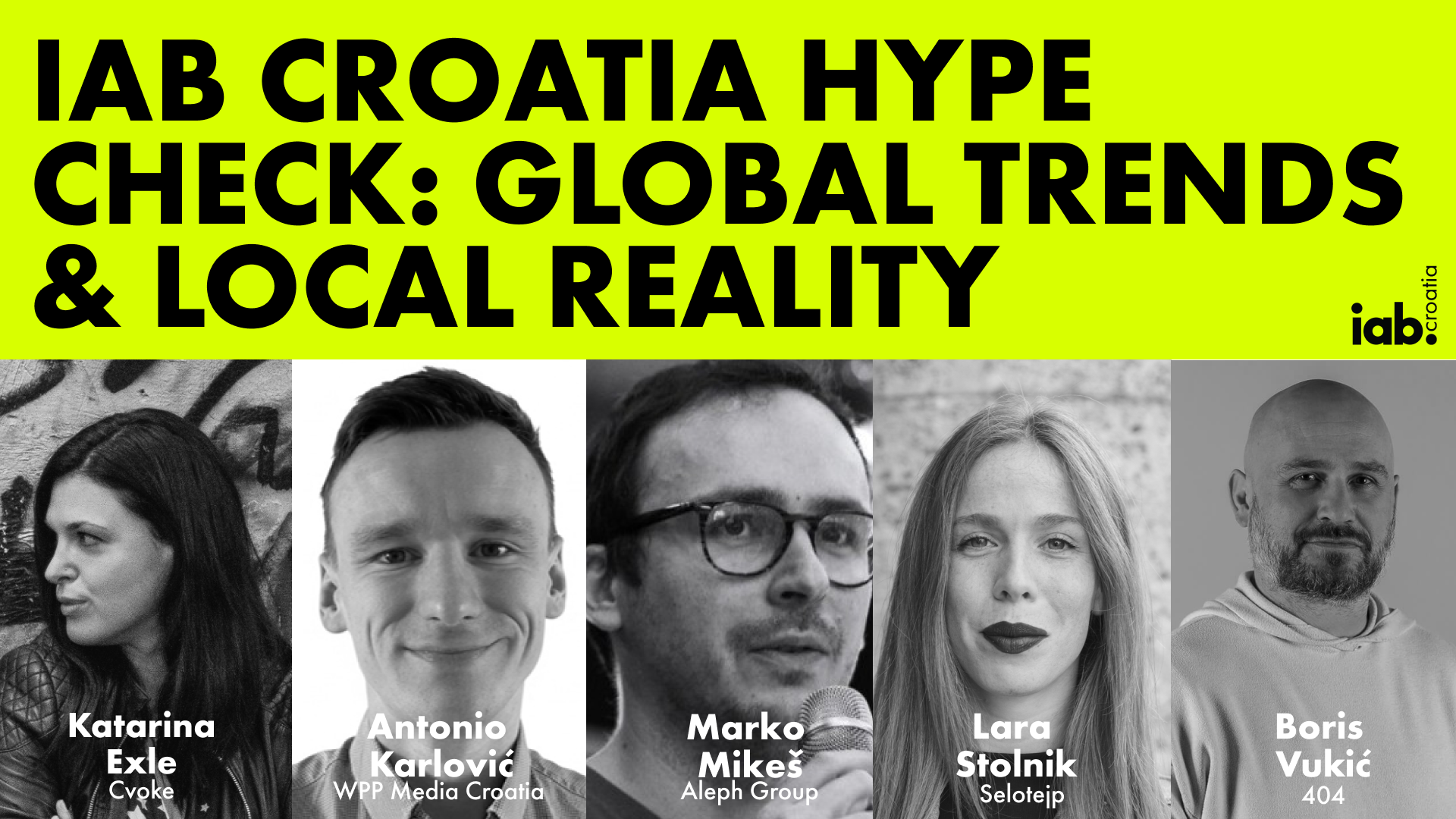
This is the starting point of the recently published document IAB Croatia Hype Check: Global Trends & Local Reality, released by IAB Croatia, the community of digital leaders. Rather than once again listing what awaits us in the future, halfway through the year, experts from IAB Croatia answered a question that is much more important for the domestic industry: which trends currently dominating global reports already have genuine potential in the Croatian market, and which have yet to develop it?
- The age of hyperpersonalisation is still to come: the technology exists, but the market is still building the prerequisites
Hyperpersonalisation is currently being presented as the new standard of digital communication. Artificial intelligence is expected to adapt messages to each user in real time, taking their behaviour, location and context into account.
However, when the trend is assessed according to criteria such as the breadth of adoption and its development potential in the local market, the picture looks different. Hyperpersonalisation is currently used mainly by individual companies in the telecommunications, banking and fintech sectors, while data infrastructure remains the biggest obstacle for most of the market. Without connected databases, data teams and significant investment, it is difficult to speak of broader adoption. IAB Croatia therefore concludes that this is a trend that is only beginning to lay the foundations for more substantial development.
- AI attribution still does not have enough data
AI attribution promises a more precise understanding of the entire customer journey and better decisions about budget allocation. The added value exists, particularly for large systems with high transaction volumes.
However, the breadth of adoption and the cost-effectiveness of implementation are precisely the criteria preventing this trend from passing the domestic market test for now. Most Croatian advertisers do not have a large enough volume of data for advanced models to demonstrate their full value, while existing solutions such as GA4 continue to meet market needs across a large number of business cases.
- Voice, AR and smart devices: not all new formats are equally ready
Global reports often place them in the same category, but the document shows that they cannot be evaluated according to the same criteria.
When considering the breadth of adoption and availability in the local market, voice assistants and smart devices still depend on limited support for the Croatian language and a small number of users. Augmented reality, on the other hand, is already demonstrating concrete value in industries such as cosmetics, fashion and furniture. The authors therefore conclude that this is not a trend that should be accepted or rejected in its entirety. A distinction must be made between technologies that are ready and those that are not.
- The end of trendjacking: a good idea needs context
A growing number of global analyses suggest that audiences are becoming less responsive to brands attempting to participate in every viral moment. Instead of speed, authenticity and a recognisable voice are gaining importance.
IAB Croatia does not dispute this direction but warns that its implementation requires a market that understands and accepts such an approach. The level of understanding is one of the criteria leading the authors to believe that the domestic market will continue developing its practices in this area for some time before this form of communication becomes dominant.
- Agentic shopping: the technology is ahead of the ecosystem
Shopping with the help of AI agents is no longer a futuristic idea. Technological developments indicate that such systems could soon take over some of the decisions currently made by consumers.
Nevertheless, criteria such as development potential and existing limitations show that the domestic market still lacks the prerequisites for broader adoption. The regulatory framework, user trust and retailers’ readiness will determine the extent to which this form of shopping takes hold in practice.
- Digital fatigue exists, but the market is not yet following its pace
We increasingly speak about users who want to spend less time in front of screens, but experts from IAB Croatia warn that this sentiment is still not reflected in market behaviour.
When considering the breadth of adoption and actual added value, digital channels continue to record growth, while offline experiences primarily complement existing communication activities rather than replace them. In other words, the trend exists, but it has not yet developed into a dominant practice.
- Superhuman creativity: the highest expectations and the most unanswered questions
Can artificial intelligence become more creative than humans? It is a question that has generated perhaps more industry debate than any other in recent years. This is why “Superhuman creativity” remains hype in 2026, although the signal behind it is real. AI-generated content is already increasing the value of the human touch, local relevance, imperfection and genuine authorship. The problem is that this signal can very easily be reduced to a stylistic trick.
IAB Croatia does not question AI’s ability to accelerate creative processes. Instead, through the criteria of added value and understanding, it demonstrates that the market still sees the greatest value in collaboration between people and technology.
What is hype, and what is a real opportunity?
This may be the document’s most valuable contribution. It does not attempt to prove that these trends are irrelevant, nor does it claim that they will not shape the future of the communications industry. On the contrary, many of them will probably become part of everyday practice in the coming years.
The question it asks is much more useful: are we ready for them this year?
The answers can be found in IAB Croatia Hype Check: Global Trends & Local Reality, which, alongside a detailed analysis of each of the seven trends, explains the methodology used to assess their breadth of adoption, development potential, added value, limitations and level of understanding in the Croatian market.
The document was developed by the IAB Croatia Predictions & Trends Hub working group, consisting of Katarina Exle (Cvoke), Antonio Karlović (WPP Media Croatia), Marko Mikeš (Aleph), Lara Stolnik (Selotejp) and Boris Vukić (404), with contributions from experts across the domestic industry. For anyone interested in distinguishing between a trend worth following and one that, for now, remains more of a promise than a business opportunity, this document is worth keeping close at hand.

