

Today, the banking sector operates under constant pressure for change – from digital transformation and regulatory requirements to growing public expectations around transparency, reputation, and social responsibility. In such an environment, corporate communications are no longer just business support, but a function that directly influences a company’s trust and credibility.
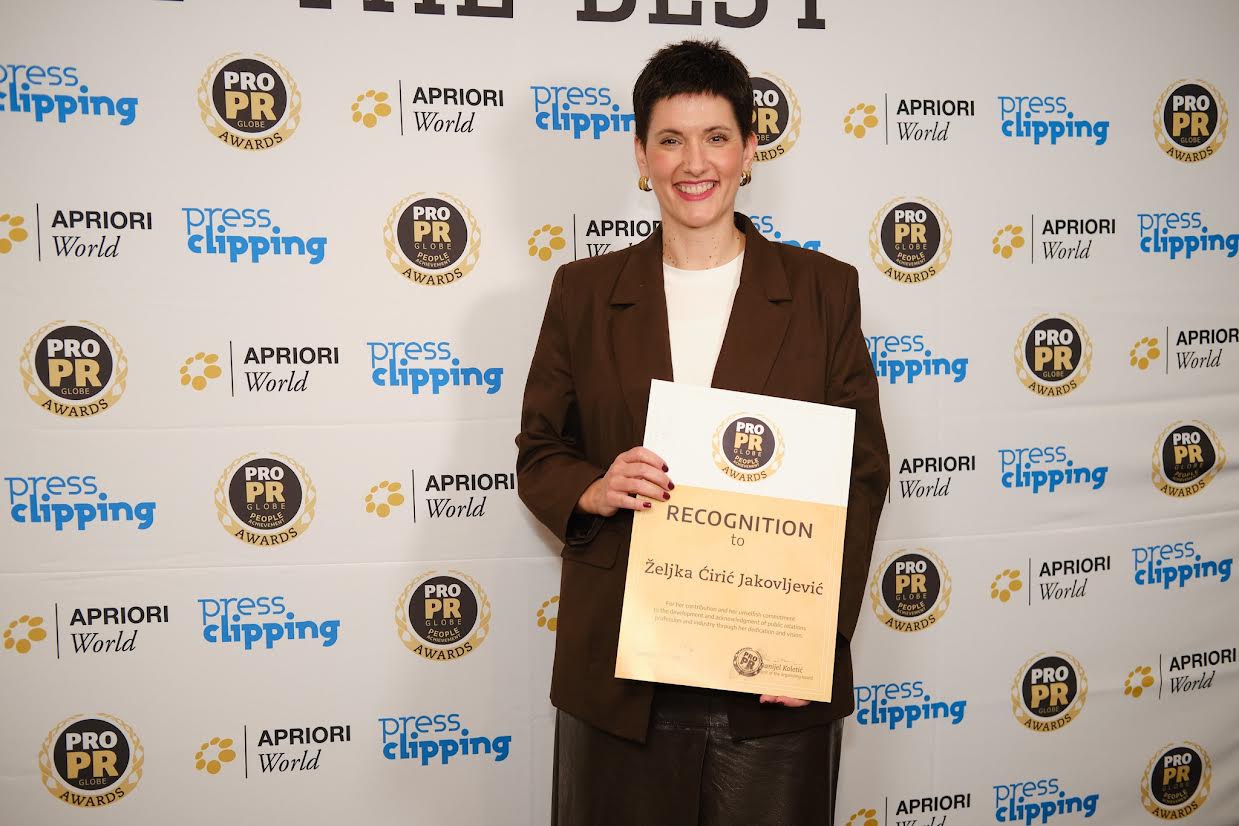
It is precisely at the intersection of communications, reputation management, and corporate social responsibility that Željka Ćirić Jakovljević has built her career. This year, she received the PRO PR Globe People Achievement Award, presented as part of the 23rd PRO PR Conference. Throughout her career, she has held leading communications positions at Eurobank, Banca Intesa, and today at UniCredit Bank Serbia, where she leads internal and external communications as well as CSR activities.
In an interview with Media Marketing, Željka Ćirić Jakovljević speaks about the challenges of communications in the banking sector, the media’s relationship toward socially responsible projects, the role of artificial intelligence in PR, and why reputation is still built primarily through trust and long-term relationships.
What do you see as the biggest challenges in the banking sector today, particularly in the area of public relations and corporate communications?
The banking sector operates in an environment of constant change, from regulatory requirements and digital transformation to shifting expectations from clients and the broader public. In such a context, the biggest challenge in communications is no longer just how to communicate something, but how to build and maintain trust.
Communications have become a strategic function. We are expected to be fast, transparent, and precise at the same time, while also explaining complex financial topics in a way that is understandable and relevant. A particular challenge is balancing reputational risk with the need to remain open and present in the public sphere.
In the era of digital channels and instant information, speed is no longer a competitive advantage, it is the standard. What truly makes the difference is credibility and consistency of messaging over time.
As someone who was among the first in Serbia to develop the concept of corporate social responsibility, how do the media view the values it brings today, and how recognised is it among the public?
Corporate social responsibility is no longer an additional activity today, it is an expectation. When we began developing these initiatives in Serbia more than fifteen years ago, it required much more explanation about their purpose. Today, the focus has shifted. The question is no longer whether companies should engage in it, but how authentic and long-term their commitment is.
The media have become significantly more sophisticated and critical, which is actually a positive development. Superficial or one-off initiatives are recognised very quickly. On the other hand, projects that demonstrate continuity, measurable impact, and a clear connection to business strategy receive attention and recognition.
There is also growing public awareness around the importance of ESG topics, alongside increasing expectations that large companies should act as active drivers of change, not only through donations, but through the way they operate overall.
Today, the media commercialise almost every piece of news. In your opinion, what should remain within the sphere of unpaid publicity when we talk about corporate communications, donations, sponsorships, and socially responsible projects?
I believe there are topics that should remain within the sphere of authentic, unpaid publicity, especially those that carry genuine social value.
Donations that have a concrete impact on communities, initiatives in education, inclusion, or support for young people, these are stories that should be shared because they matter, not because they are paid for. Once such topics move entirely into the commercial space, they lose their essence and credibility.
At the same time, the reality is that the media landscape has changed, and it is sometimes necessary to combine different approaches. What matters most is that the line between PR and marketing remains clear, and that public trust always stays the priority.
What is your view on artificial intelligence in public relations, especially within the banking sector? Based on your experience, what are its main advantages and potential challenges?
Artificial intelligence is already changing the way we work, both in communications and across banking as a whole. Its greatest advantage lies in speed, analytics, and the ability to personalise content. It enables us to better understand audiences, anticipate trends, and become more efficient in our daily work.
However, communications are, above all, about credibility and emotion. AI can significantly improve processes, but it cannot replace human judgement, context, and responsibility, especially in sensitive situations such as crisis communications.
The biggest challenge will be finding the right balance: how to use technology to improve our work without losing the authenticity and human element that are essential for reputation.
If you were not working in public relations, what would you most likely be doing in your professional career?
Communications have always been a natural choice for me because they combine strategy, creativity, and working with people, something I truly enjoy. However, if I were not in this field, I would probably be in a role closely connected to strategy and business development.
I am drawn to working on large systems and transformations, whether through marketing, strategic management, or the development of new business models. In essence, it is the same line of work: understanding markets and people, and making timely decisions that create meaningful impact.
Which moment in your career has left the strongest impression on you, apart from the awards and recognitions you have received?
Awards are a great encouragement, motivating you to push personal boundaries and strive toward something that will be recognised. However, the strongest impression on me has not come only from awards, but from moments when, as a team, we managed to create real change, whether through projects that had a tangible impact on the community or through situations in which we successfully protected the company’s reputation in challenging circumstances.
Moments when you realise that communication is not just support for the business, but an integral part of it, when it influences decision-making and shapes the direction a company takes, are especially important to me.
In the end, what stays with you the most are the people and teams you worked with, because reputation is not built through campaigns, but through relationships developed over time.

