

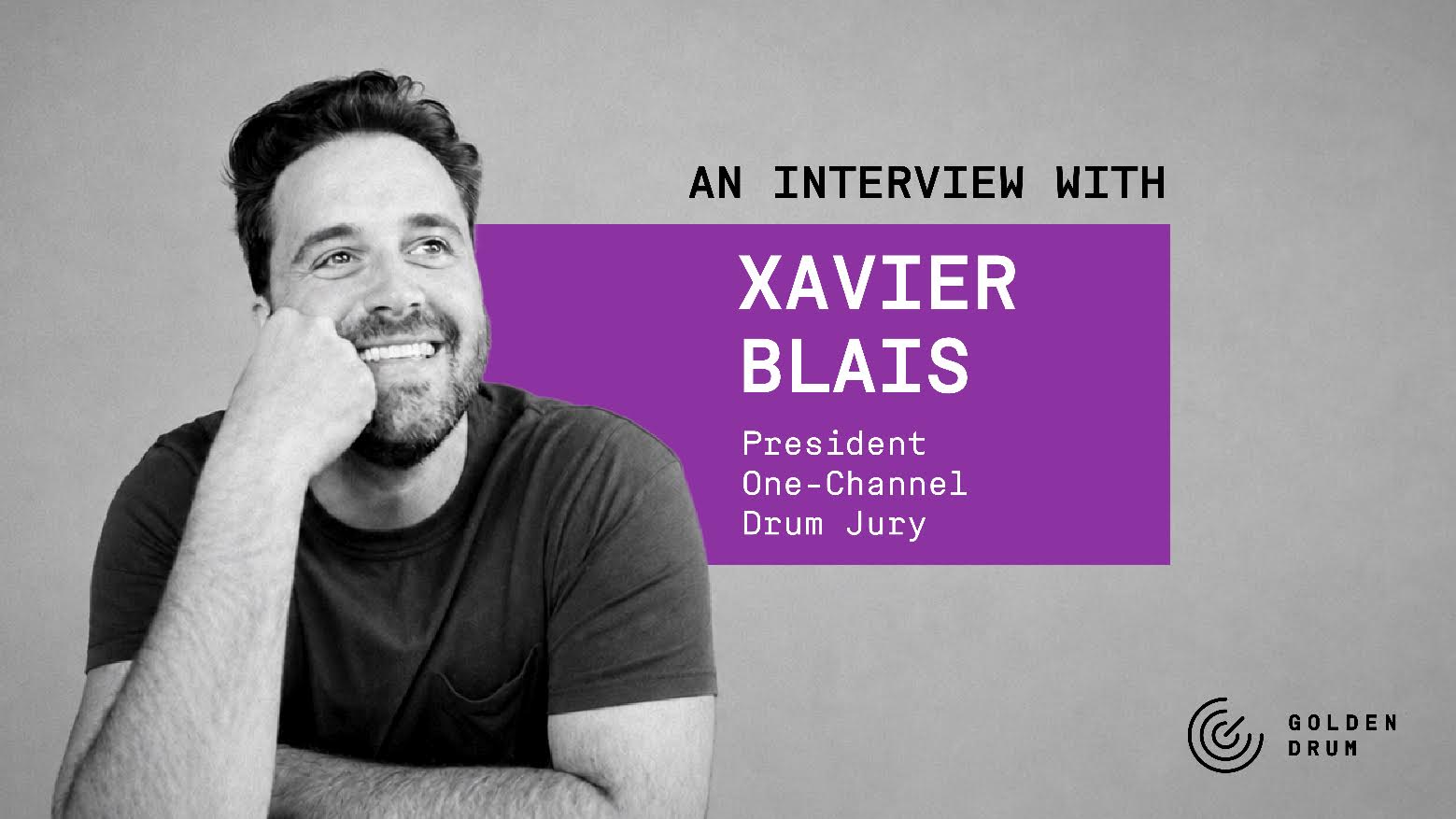
More channels, bigger ecosystems and increasingly sophisticated tools do not automatically lead to better ideas. For Xavier Blais, the real opportunity lies in focus – creating work that is true, distinctive and capable of solving a business problem without unnecessary complexity. It is an approach that has helped Rethink build a reputation for creativity that earns both attention and results.
As Partner and Chief Creative Officer at Rethink, President of the One-Channel Drum Jury and one of the featured speakers at this year’s Golden Drum Festival, Blais brings a perspective shaped by both creative ambition and commercial reality. In this exclusive interview, he reflects on why awards should be the result rather than the objective, what agencies and clients need to understand about each other to produce braver work, and why the next generation of creatives needs to spend less time theorising and more time making.
Many marketers believe that more channels automatically lead to greater impact. Do you think the industry sometimes underestimates the power of focus?
Absolutely. Coming from a smaller market with less budget, I’ve often seen us look up to big global ideas built across five or six channels. But complexity doesn’t make an idea better.
I’d rather have one channel nail an idea than artificially build an ecosystem around it. Focus forces you to clarify what the idea actually means, and sometimes one sharp, simple execution can have more impact than being everywhere.
As an independent agency operating at global scale, how do you balance the pressure to consistently produce award-winning, attention-grabbing work with the need to deliver sustained commercial results for clients?
For us, those things are connected. Award-winning, attention-grabbing and commercially effective work can be the same thing.
The important part is agreeing with the client upfront on what success looks like. If you solve the business problem in a breakthrough way, the award is a result of that, not the goal itself. It’s a game within the game.
After winning major awards and being named at the top of the Lions Talent Report, do you think the industry’s definition of creative excellence still aligns with what most clients actually need to grow their business?
Great work can absolutely win awards and produce business results. The danger is when awards become the objective rather than the proof.
If you focus on making work that is true, interesting and doesn’t feel like an ad, and that can actually move the business, awards tend to follow. But you can get sucked into chasing recognition and forget what the work is supposed to do.
We need awards as a barometer of success and to demonstrate a track record, but they can’t become the reason we’re doing the work.
In most client relationships, who do you think is more responsible for the “courage gap” in creative work today—the agency pushing safe thinking or the client rejecting bold ideas?
I don’t think it’s a bravery gap. It’s an understanding gap.
Usually, both sides want to do the best work. The problem is that they don’t always have the same definition of success. That’s why we use “relationship accelerators” with new clients — essentially a conversation about how we work, what we expect and what success looks like.
One client told us, “I want you to think about the money as if it were your money.” That’s a simple but powerful example of shared accountability. When both sides understand what they’re trying to achieve, it’s much easier to take risks together.
Everyone talks about “true partnership” between agencies and clients—what does that actually look like in practice when pressure mounts around timelines, budgets, and business performance?
Trust. Our longest relationships at Rethink have lasted because there’s enough trust to take risks together.
Audacious work usually comes from relationships where both sides are comfortable taking a few trust falls. Some of our best ideas have even been sold over text. That kind of proximity makes a huge difference.
But trust also means being honest. You have to be willing to tell a client when something isn’t working, and do it with empathy rather than avoiding the difficult conversation.
Do you think agencies and clients are aligned today on what “successful creativity” actually means—or are they still operating with fundamentally different definitions driven by awards versus business metrics?
Again, I think it’s an understanding gap. Agencies often think of themselves as partners, while clients can understandably see them as suppliers because this is ultimately a service business. The goal is to get out of that “us versus them” mentality.
You need to understand not just the feedback you’re getting, but the reason behind it. Once there’s enough trust to have that conversation honestly, you can start working toward the same definition of success.
What needs to change in the agency–client relationship so that creativity is evaluated as a long-term investment in growth, rather than a cost that must justify itself immediately?
Transparency. There is still some baggage from an era when agencies were seen as irresponsible – creatives showing up late, ignoring feedback, treating creativity as a kind of magic trick.
Some of that skepticism was earned. Agencies also contributed to the problem by working for free, producing spec work and undervaluing their own output.
We need to be transparent about costs, expectations and problems, and honest enough to have difficult conversations. If the work genuinely creates business value, then the investment becomes much easier to understand.
As creativity becomes more distributed across strategists, technologists, and AI tools, what new skills or mindsets will define the most valuable creative people in the next five years?
For me, it’s the actual act of making. AI makes it easy to imagine something, put it into a deck and convince yourself you’ve done the work. But having an idea isn’t the same as making something happen.
Making requires discipline, risk and the willingness to be wrong. That’s increasingly important in a world where we’re constantly consuming instead of creating.
That’s also what I’ll be talking about at Golden Drum: building a maker culture. We need to theorize less, make more and have the guts to put things into the world.
Submit your best work to the Golden Drum Competition before the 8 September 2026 entry deadline and give your creativity the stage it deserves.
Secure your delegate pass and join the creative minds shaping what’s next at Golden Drum 2026.

