

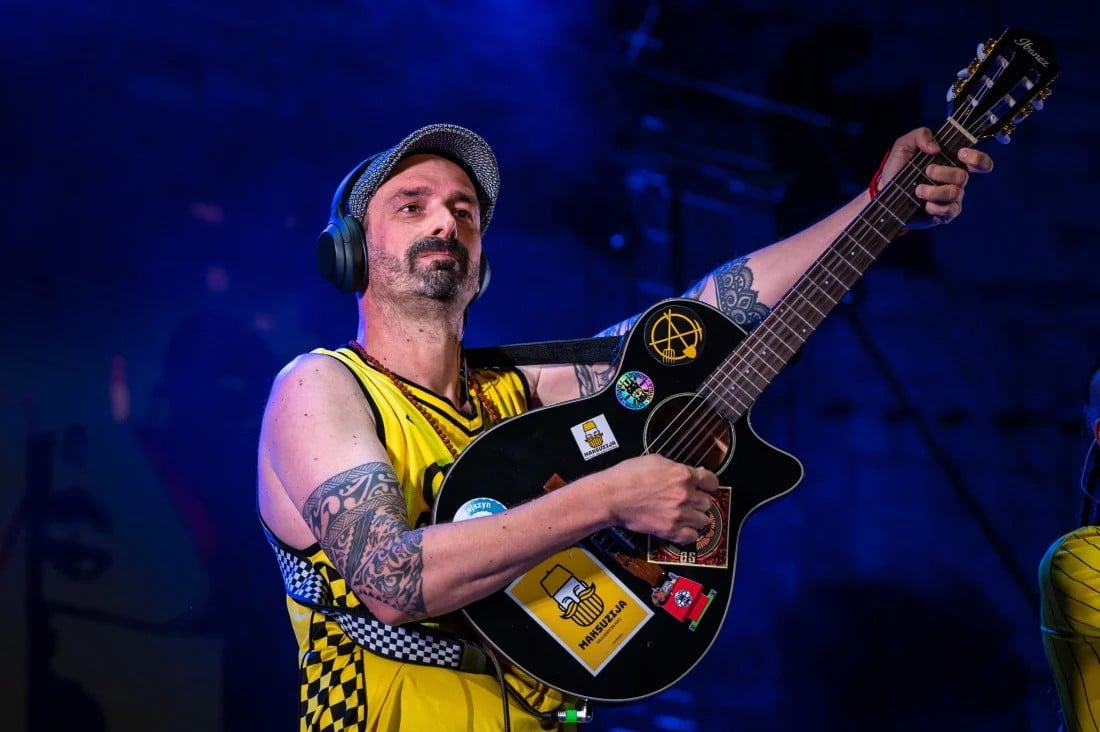
Brano doesn’t use the words marketing or advertising. He calls it communication, he refuses to use the word “audience”, shrugs when you compliment his “strategy” and then quietly fills concert halls, clubs across continents. That’s when I realised the most effective marketers are the ones who don’t think they’re marketers at all.
If you make lukewarm lemonade to satisfy the general taste of the neighbourhood, you are offering a thoroughly boring beverage because nobody remembers lukewarm. To make a drink that lingers on the tongue, you must pack it with sour lemon, sharp mint and the Igman mountain of ice. You must be willing to let the crowd turn their heads and look at you like you are completely mad.
To truly understand how to make a “drink” that powerful, you have to shut out the noise of the world and find the people who refuse to play by the corporate marketing or advertising playbook.
Shutting out the noise, Brano and I sat down at a sanctuary in a secluded, safe and peaceful corner of Goričko. In that relaxed, backyard atmosphere, surrounded by the laughter of our loved ones, Brano Jakubović took the most valuable thing he has, time, to dive into a deeply honest, unfiltered conversation.
We sat down to deconstruct the madness of mass modern marketing and extract the raw truth of how Brano and the Dubioza team “motaju, motaju and then smotaju” things that actually stick.
This deep dive was fuelled by questions brought to the table by some of the finest minds in the industry, Jasmin Alić, #1 LinkedIn Expert, Ines Markovčič, Marketing Manager at Mladina d.d. and Siniša Waldinger, Creative Director at Bruketa& and yours truly.
Part I: The lukewarm lemonade vs. the circus bike
Lenja: Let’s jump right into the deep end with a brilliant question by Jasmin Alić: “When you are creating, how do you decide what to keep and what to erase? Do you ever feel like certain words you write might be too strong for a broader audience and find yourself editing them down just to fit in?
Brano: (Smiles) It’s actually the opposite. The only things we actually edit out are the things that fit too well into the “general taste.” If it blends in, we throw it in the trash. We look for the things that are strong, raw or completely “too much” and that’s exactly what we leave in the songs. If you make lukewarm lemonade to please everyone, it’s just incredibly boring. It’s better to make it punchy, pack it with real lemon, sharp mint and throw a mountain of ice on top to keep it cold.
Lenja: That reminds me of the story you wrote about your father in your book “MOJE DUBIOZE”. Your dad always did things that made the entire neighbourhood turn their heads and stare and how wrong am I to think you “inherited” that exact trait?
Brano: That definitely came from him. He was a typical, stubborn Sarajevo guy who drove everything his own way, completely blind to what the surroundings thought. He had his opinions, and he voiced them. But the neighbourhood? To them, he was a circus. He didn’t know how to just go out and buy a normal family bicycle. He bought four ordinary bikes, took his into the shed and welded a homemade Harley-Davidson circus machine. It had rearview mirrors, three seats, handles pointing every which way, saddlebags big enough to hold an entire kitchen of sandwiches and a radio blasting music down the street. The 4 of us would ride ten kilometres to Ilidža in a line, with bikes blasting music. The neighbourhood stopped and stared. To a young boy, it was pure public embarrassment. I was ashamed that we always had to attract attention. But later, I realised: he never cared about attracting attention. He simply did what he enjoyed, completely detached from whether heads turned or what anyone had to say.
Also my parents weren’t typical parents: “You’re 20 now, you got a degree now get a real job!” was not in their vocabulary. They would actually come to concerts of my earlier bands and stood in the first row. My dad would later come to many Dubioza concerts and sit in his chair next to my brother, our sound technician, with his little cushion and dove into the concert, not needing or wanting to speak to anyone.
What he taught me is that the worst thing you can do is let your environment shape your mind, because then you turn into Play-doh. Anyone can mold you. When I was a kid, this “uniqueness”/ “madness” actually terrified me. I was deeply ashamed because my dad was so strange to everyone else. It took growing up to break through that and realise why it actually matters. Now, I apply it even more than he did.
Lenja: While you guys defied the old-guard music labels entirely, when you released an album for free, they laughed and called you mad? Tell me story behind that…
Brano: There was no plan. For the first seven years, every single record label rejected us. Nobody cared. When we finished our third album, Firma Ilegal. Our manager went door-to-door and they all told him to get lost. Finally, one record label in Slovenia agreed to print 1,000 physical CDs but they explicitly told us, “Here are your discs, now get out, we aren’t doing any marketing for you.” The very next month, we put our new album online for free and we hit 300,000 downloads from our website.
Suddenly, the director of that Slovene label drove all the way to Sarajevo, walked into our rehearsal space and begged for a meeting to officially release it. Why? We were already welcomed into 300,000 homes on our own! That year, it became the third best-selling physical CD in the region. The old music industry thought we were crazy to give it away.
Lenja: If I was the fly on the wall when you made that decision, what would I see?
Brano: It wasn’t a calculated digital strategy; it was an emotional reaction to the industry. We just wanted people to hear our music. But you gotta know that every time someone clicked “download,” it cost us real money in server fees. For 300,000 people, we paid out around 3,000 euros from our own pockets just so we could take our music to the people. We had a bone-deep belief that once people heard it, they would react and let us into their homes. And it paid off in the long run. I enjoy(ed) the alternative, chaotic route of reaching people. Social media was just starting; Facebook was brand new. We just put up a link and said, “The album is out.” Magic doesn’t live in a spreadsheet or in the perfect target audience; it lives in the wild. Paying 10,000 euros for a calculated corporate ad space where they guarantee your success will sit neatly between point A and point B is boring. When you do something wild, your success can go from zero to infinity, why would anyone put a limit to that?
Lenja: Let’s hear it from Siniša Waldinger: How do you find the balance between delivering a sharp, rebellious social critique of society while keeping the product appealing to the masses?
Brano: My opinion isn’t more important just because I have a guitar and a microphone! Standing on a pedestal with a guitar, acting like you possess some supreme knowledge and telling the masses how to live their lives, is a messianic syndrome. That’s why we use humor. Everything that passes for “high politics” in our region is ultimately a tragicomedy. It’s the perfect subject for mockery. We’ve written ten albums over twenty years and we are still singing about the exact same flaws.
Lenja: The word humor is the great segway to bring in a question from Ines Markovčič: When you put these messages out through raw humor, when did you realise that Dubioza Kolektiv was no longer just a band but a living cultural phenomenon?
Brano: We are just an ordinary band, that is all. The ultimate achievement of true communication happens when you lose control of what you made. When you create something and the people take it, strip it of your ownership and inject it with their own meaning. Look at what happened with our USA song. The biggest advertising agencies with a 100-million-dollar budget couldn’t buy what happened there. They couldn’t pay Zlatan Ibrahimović to sing our chorus on American television with Thierry Henry just because he felt the fire of it. Ask Pepsi how much 10 seconds of that airtime costs. We didn’t pay a cent. It happened completely out of our control. The biggest honour or happiness for me is when that song became the song of the people and stopped being our song.
Part II: The 30 Euro anthem
Lenja: Which songs end up being your most popular ones and what is the reason behind it?
Brano: The ones that write themselves in 2 minutes. The truth is, when you spend forever obsessing in the studio over a 80 Hz compressed bassline, you are really just pleasing yourself. Most people listening on a phone won’t ever notice or care about those technical details, only a few die-hard audiophiles will. As a producer, I’ve learned a golden rule: the less you interfere with a song and the more it just creates itself, the better it turns out. If I have to sweat and struggle over it for days, it’s usually a sign that it’s not the one.
Lenja: Tell us the behind the scenes story of the “I am from Bosnia, take me to America” world cup anthem”. How did a song from 2011 suddenly become the viral heartbeat of a football movement out of nowhere 15 years later?
Brano: It actually started 2 years prior on our tour in Mexico. A local football fan (originally from Bosnia) took us to a match where one of the teams wore bright yellow jerseys. Fast forward to the World Cup qualifiers in Cardiff, where Bosnia was playing Wales. That same fan was there with the BHFanaticos supporters group. He called our singer Almir right before kickoff and said, “Watch the game tonight, we have a surprise for you” and put the phone down.
Five minutes into the match, they pull out this massive, hand-painted banner that reads: “I’m from Bosnia, take me to America.” It was pure, self-deprecating Bosnian dark humor. We knew Wales was tough and Italy was next, meaning we had a 99% chance of failing. The banner was a joke: “We have no chance, so just take us to America already.” The broadcasting director caught a 3-second close-up of that banner. We literally recorded those 3 seconds off a TV screen with a mobile phone, matched it to our song from 2011 and threw the link onto social media as a joke.
Lenja: And it exploded.
Brano: Total euphoria. Within three days, the song spread so fast that fans were singing it in the streets. We were scheduled to go to Germany for a concert but we sent our technician and we chose to get to the concert a bit late. We drove straight to the stadium in Zenica to stand with the fans because they called us for support and got us the most valuable blue tickets ever.
I actually have this superstition where I believe I’m the “black omen” for our football team, meaning if I watch a football game live, we will lose. So right outside the stadium, we met a father who had traveled from Norway with his kid but only managed to get one ticket. The “boss” of the BHfanaticos gave his ticket to the kid, I gave the “boss” my ticket, walked back to my car and drove to Sarajevo. Halfway down the road, I turned on the radio, heard the score and immediately shut it off in panic. I sat in my bedroom in total silence, waiting to hear if my family would scream in joy or cry. When the screaming started, I knew we won the penalty drama.
Lenja: What did your next day look like?
Brano: We shot the new official music video for the song. We shot it in Mahala, a local concrete neighbourhood yard – for 30 euros. We used two hand-painted goals on a concrete wall, ten ćevapi on a plate and a neighbour hanging her laundry in the background. We made football human again, because football used to belong to the poor, not corporate sponsors.
Marketing, in our case, let’s not even call it marketing, it’s not even advertising, it’s a communication tool. In my opinion, timing is much more important than the budget when it comes to communication tools. The bigger your budget, the more time you waste. More and more people get involved, and they are just additional time-wasters. That’s why we like to do things ourselves from the very beginning. We just have a couple of collaborators, like someone handling the camera and Vedran, our bass player, who is actually a designer and does an amazing job editing and crushing it all. So we keep it in-house. For us, it’s much more important to do it quickly and on time. When the timing is right for something, it doesn’t allow for massive plans, scriptwriting, or any of that, you know? It’s simply a reaction to something in the moment. The fact that it’s overproduced, that it has the best post-production, or whatever, I think it’s all about the essence, both in the song and in the video. If you have the essence and you hit the right spot, you have something. Everything else is irrelevant.
Oh, and I remembered also that when we re-recorded the track to give it the football connotation, I realised I had lost the original digital master files because I’m terrible at saving data. I had to rebuild the entire song from scratch in the studio in a single day. But we’ve played it for so many years, so it was in our blood.
Lenja: The track and all your other tracks are injected with the “Balkan English.” I sense there is a story behind it?
Brano: Yes, people comment, “The song is great but your English is terrible, do something about it!” But they miss the point entirely. When you play a massive global stage like Glastonbury, you are just the 38th punk or rap band in line. If you try to blend in with perfect English, you sound uninteresting. You’re just trying to be someone else. Our “Tarzan English” is our identity. It’s simple, raw and everyone understands it, but it firmly establishes your background. Our songs lose all their weight and meaning if they are sung in a pristine British or American accent. We crossed over to the “Tarzan side” a long time ago. Most anthems are nationalistic “We are the strongest, we will crush you.” We went with the philosophy of a classic Bosnian joke: you make fun of yourself first, you keep it entirely human and you celebrate the beauty of a shared moment.
Lenja: You once said, “That’s not our audience, those are people, who care today but might not care tomorrow.” Watching your videos, listening to your interviews, seeing you create a women only mosh pit, bringing the fan who attended his 100th gig up on stage, joining the strikes and all other things.. it feels like empathy, genuinely caring for people who came to your show, is that the secret ingredient to your success? This deep human-to-human connection. Am I completely delusional here?
Brano: You’re quite spot on. Look, there are many parts to this job. Writing songs, finding inspiration, recording, the studio, the creative process, it’s all great and I love it. But at the end of the day, what matters most is stepping onto that stage, seeing living, breathing people out there and playing for them. That is everything to us. Critics often ask, “What’s the setlist? Are you going to play something that will surprise the crowd?” You know how some bands say, “I’m not playing those three hits, I’m bored of them, I can’t take it anymore.” I get it. But the person standing down there bought a ticket for those three songs. Maybe it’s their first time hearing them live. Sure, you’ve been playing that song for 20 years and you’re sick of it. But refusing to play what you know 100% of the crowd wants? To me, that’s selfish.
We always prioritise the people who didn’t just buy a ticket but chose to spend their time with us at that very moment. Time is far more expensive than a ticket. Today, with 150 events happening daily anywhere you look, someone choosing to spend two hours of their life listening to our music deserves far more respect from us than we do from them. We have a need to present what we’ve created. We are there to pay attention to them, not to play the role of idols. To me, that is the key to communication.
Part III: inspiration
Lenja: Why do some projects last 15 years, while others last 15 days and are completely forgotten?
Brano: The beautiful thing is: you don’t know. Whenever you are 100% convinced you have a formula, that’s exactly when you miss. You have to make 100 things. 95 will be failures and only 5 will explode. But you must make those 95, because that invested energy multiplies in order to “birth” the 5. You can’t predict which ones they are. You just have to trust your instinct in the moment, like catching a split-second glimpse on a TV screen, uploading it on a whim and watching it blow up. If you don’t act on instinct, the moment passes and the world moves on. For years, I lived in a clenched fist. “I’m on tour, I have two months off, I must sit in the studio, I must write new songs.” It was a constant struggle. When inspiration vanished, I felt miserable.
Then life forced me into a hospital bed where I didn’t know if there would even be a tomorrow. That taught me that the hustle makes no sense. The less you chase inspiration, the more often it shows up. And when it does arrive, you just say, “Welcome.” You use it so much better because you’re relaxed. You aren’t stressed, trying to squeeze every single drop out of it. If it stays, it stays. If it doesn’t, who cares, let’s go for a walk, the kids are calling, we’ll do something else.
That is the key: finding that dialogue with yourself where you are comfortable whether there is inspiration or not, money or not. A single minute of life is far more expensive than all the success and money in the world. You can always make more money, but you can never buy back a minute. The key to making something that lasts is to stop trying to squeeze it, stay stubborn in your work, and refuse to finish a single day feeling like you wasted your most valuable currency: your time.
Part IV: The chair
Modern marketing doesn’t need another trick, it needs a chair. Pull one up beside your desk and call it The Dubioza chair. Before you write the new headline, send the newsletter or post a reel for your brand, imagine Brano sitting there, listening, waiting and never asking “Will it sell?” but asking, “Are you enjoying yourself in the process and doing it for the people?”
Dubioza Kolektiv still keeps a chair by the mixing table for Brano’s dad, even now, while he rides the heavenly roads. Why? Because the best people never really leave. They become the voice you borrow when you’re about to forget who you are.
Maybe you, dear reader, you need that chair too. A chair with an imaginary someone who reminds you that people are hungry for connection and can smell what’s inauthentic. The most effective marketing never feels like marketing, it feels more like someone pulling up a chair and saying, “I’ve been thinking about you and made you a fresh lemonade…”
Čiča miča, gotova priča.

