

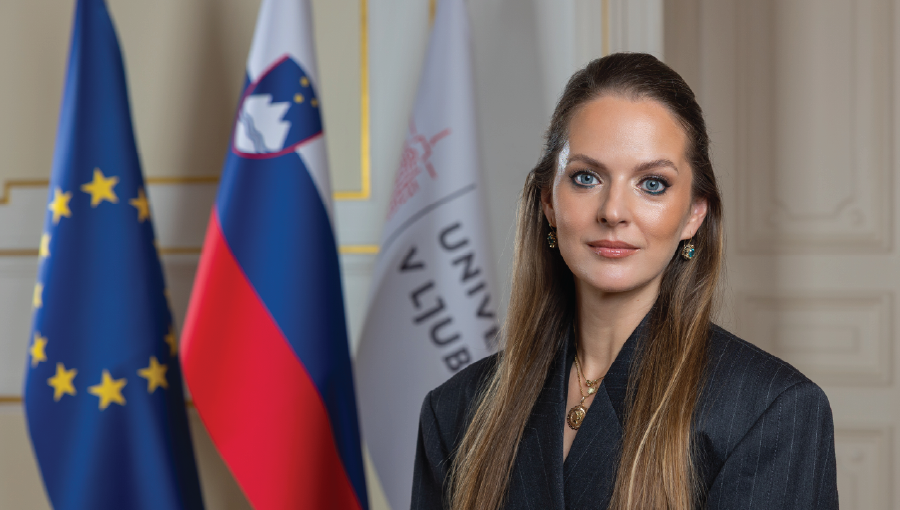
Nina Narat Meden is Head of the Rector’s Cabinet and Head of the University Communication and Events Office at the University of Ljubljana, one of the largest and most successful universities in the region. Before joining the University, she led communications at the Centre for Information Service, Cooperation and Development of NGOs (CNVOS). She also spent several years in the music industry as Head of Public Relations and Marketing at the international record label Universal Music.
She remains actively involved in the non-profit sector, delivering workshops on impact communication and mentoring civil society organisations through the Slovenian-Croatian programme Impact4Values. Within the Slovenian Public Relations Society (PRSS), she initiated and co-founded a network of communications professionals from research and higher education institutions, established to strengthen public trust in science and improve the way scientific knowledge is communicated to wider audiences. In May, she was elected President of PRSS.
In this interview, she discusses how the position of public relations is changing in Slovenian organisations, why communication professionals are increasingly involved in decision-making, and what responsible use of artificial intelligence requires from the profession. She also addresses the communication challenges of a university with 23 faculties, three arts academies and around 38,000 students, as well as corporate responsibility, greenwashing, climate misinformation and the importance of integrity in building public trust.
You have recently been elected President of the Slovenian Public Relations Society. How would you describe the current position of public relations in Slovenia? Do organisations and management teams sufficiently recognise the strategic importance of communications and the role of PR professionals?
If you had asked me this question ten or fifteen years ago, my answer would probably have been quite different. At that time, the value of public relations was not always fully recognised, and communications were often seen primarily as a support function. Today, that is steadily changing.
I can confirm this from my own experience at the University of Ljubljana. In recent years, many of the university’s faculties and academies have established or strengthened their communications teams. Leadership increasingly recognises that external support alone is not enough. Agencies can be valuable partners for specific projects, campaigns, or events. However, when more demanding situations arise, especially in times of crisis communication, it becomes clear how important it is for communications to be led by someone who knows the organisation inside out and understands its culture, values, and internal processes.
I am also pleased to see the changing position of communications professionals. We are increasingly moving beyond being task executors and becoming trusted advisers to leadership. In many organisations, we are involved already at the decision-making stage, rather than only in implementing decisions. That is perhaps the clearest indication that communications is increasingly being recognised as a strategic function.
We are witnessing the significant impact of artificial intelligence on almost every aspect of business and society. Does the Slovenian Public Relations Society have an ethical code or guidelines regarding the use of AI in communications, or is such a document currently being developed?
Artificial intelligence is one of the defining issues of our profession today, and it is therefore addressed in the PRSS Code of Ethics, which was revised last year.
The code emphasises the principle of “do no harm” and explicitly states that AI should not be used for manipulation, the spread of misinformation, or unethical influence on the public. It also highlights the need for particular care when handling confidential and personal data. As communication professionals work in very different environments, the code primarily establishes the fundamental principles of responsible AI use. However, it is equally important that each organisation develops its own more specific guidelines, tailored to its particular environment and risks.
More broadly, when using AI it is essential to remember that it is a tool, not an authority. It can help us organise our thoughts, prepare drafts, or generate ideas, but it should never replace professional judgement. Our responsibility remains to verify facts, assess the appropriateness of messages, and take ownership of the final outcome.
3You lead communications at the University of Ljubljana, an institution with an outstanding reputation not only in Slovenia but also internationally. What are the biggest communication challenges you face, and how well does the academic community understand the importance of strategic communication management?
As I mentioned earlier, we are witnessing an important shift in how strategic communication is perceived within academia. The academic community increasingly recognises that excellent teaching and research alone are not enough if we are unable to communicate their value effectively.
One of the University’s greatest communication challenges stems from its size and diversity. The University of Ljubljana brings together 23 faculties and three arts academies, educates around 38,000 students, and employs more than 7,000 people. Even by European standards, it is a large and highly diverse institution.
For that reason, one of our main challenges is building a shared identity and strengthening the sense of belonging to the university while fully respecting the autonomy of its member institutions. This is not merely a communication challenge but a broader organisational one.
Another major challenge relates to the role of science in society. We live in an age when information spreads faster than ever before, along with misinformation and oversimplified explanations of complex issues. It is therefore crucial that scientific achievements do not remain confined to academic circles but are communicated clearly and accessibly to the public. Our role is to help build a bridge between science and society.
When discussing corporate social responsibility, what do you consider the key elements of high-quality communication in this field? How aware are organisations today of their responsibilities towards society?
It is important not to view social responsibility solely through the lens of charitable activities, sponsorships, or communication campaigns. Social responsibility begins with how organisations operate: how they treat employees, partners, users, and the wider public, how transparent they are, and how willing they are to take responsibility for their actions and their impact on society.
I therefore see the role of communication professionals primarily in promoting open dialogue and responsible conduct, both of which are essential for building long-term trust. Good communication does not hide problems; it explains them and addresses them openly. It does not promise more than an organisation can deliver and does not seek shortcuts to reputation.
The Rome Declaration on Green Communication Responsibility was recently signed in Rome. Slovenia enjoys a strong reputation as a green and sustainable destination. Do you believe the communications industry speaks enough about the responsibility of PR professionals? Do organisations understand the importance of this issue in preventing greenwashing?
Unfortunately, greenwashing remains widespread. One only needs to look at the fast-fashion industry, where some of the world’s largest companies cultivate an image of sustainability through “green” collections, while their business models continue to rely on overproduction, short product lifecycles, and the encouragement of constant consumption.
For this reason, I believe greenwashing is not merely a communications issue. Sustainability cannot remain at the level of attractive messaging; it must be embedded in the actual operations of an organisation.
What I find particularly important about the Rome Declaration is its principle that communication professionals should actively challenge misinformation and correct false claims. This is a principle we consistently uphold at the University of Ljubljana. In discussions related to the climate crisis, we frequently encounter misinformation and misleading interpretations of scientific findings. It is particularly disappointing when unfounded claims are amplified by media outlets that provide a platform to individuals who deny the human impact on climate change or seek to undermine the scientific consensus, thereby lending those views undue legitimacy.
Looking back on your professional journey, what career do you think you would have pursued if you had not chosen public relations and communications?
I have always been drawn to writing, but even more to exploring what lies behind stories and connecting pieces of information that may initially seem unrelated. That is why I chose to study journalism and spent several years working in the media. That experience taught me critical thinking, fact-checking, and a strong sense of responsibility towards the public, all of which continue to shape my work today.
Throughout my career, I have always been very selective about the organisations I choose to work with. It has always been important to me to believe in their mission and to ensure that their values align with my own. Curiosity continues to guide me, as does the conviction that integrity and credibility are the foundations of good communication.

