

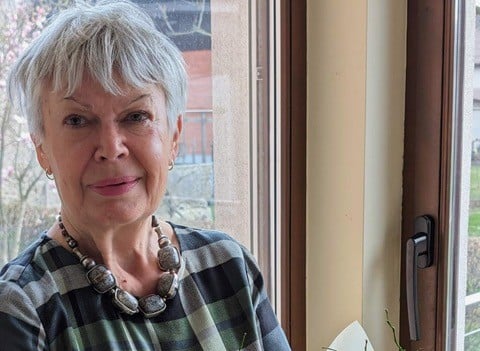
After ten years of flying with Adria Airways, Nada Serajnik Sraka was invited to establish an information and public relations service. It was the mid-eighties, when only a handful of people in Slovenia were doing this work, and knowledge was often acquired through practice and contact with colleagues from other countries. With a degree in geography and English, she accepted the task and began learning from communicators at airlines around the world, whom she met through Adria’s membership in the International Air Transport Association. She later completed a master’s degree in communication studies and earned the professional designation of Accredited Business Communicator, ABC.
During her career, she also worked at the PR centre of Studio Marketing and the Government Communication Office of the Republic of Slovenia, and led interdepartmental communication committees in national campaigns supporting Slovenia’s accession to the EU and NATO, the introduction of the euro, and the presidency of the Council of the EU. At the same time, she helped build the profession itself: she was among the founders of the Public Relations Society of Slovenia (PRSS) and the Slovenian chapter of the International Association of Business Communicators (IABC), and later served as president of both associations. She shared her experience through professional publications and teaching, covering subjects from communication campaigns to writing for public relations.
Today, when communicators have a seat at the decision-making table, Serajnik Sraka believes that the profession still needs to strengthen its contribution to shaping those decisions. She places particular emphasis on listening to publics and using the data collected to help management understand the business and communication consequences of its actions in time. We discuss this task, the professional and ethical standards that remain unchanged despite technological shifts, and artificial intelligence over which humans must have the final say, on the occasion of her PRO PR Globe People Achievement Award. After PRSS awarded her the PRIZMA Lifetime Achievement Award this spring, this recognition confirms for her that her contribution has also been recognised by the wider professional community.
When the public relations profession was just beginning to develop in Croatia, Slovenia, Serbia, Montenegro, Bosnia and Herzegovina, and other countries in the region, you had already begun your professional journey, and your work encouraged many individuals and organisations to understand the importance and role of public relations. In your opinion, how has the profession changed over all these years? What are its greatest strengths today, and what are its greatest challenges and shortcomings?
I began working in public relations in the mid-eighties. After ten years of flying with Adria Airways, I was invited to establish an information and public relations service.
I entered this field of communication by chance, without knowing much at the time about what public relations was or what it meant for organisations. I did, however, have a degree in geography and English from the Faculty of Arts at the University of Ljubljana at the time (I completed my master’s degree in communication studies much later), and I gladly accepted the challenge. Fortunately, Adria was a member of the International Air Transport Association (IATA), which had a PR Committee. This allowed me to immediately establish contact with airlines around the world, become familiar with their practices, and learn from them. In addition to the usual areas of work (internal communication, media relations, etc.), they paid particular attention to crisis communication and promoting countries, because airlines are part of each country’s identity system.
Still, I was, in a way, self-taught, because there were only a few people working in public relations in Slovenia at the time (Adria Airways, Iskra, Gorenje). This made us all the happier when, as practitioners at the time, we founded the Public Relations Society of Slovenia in November 1990. I was among its founders. Initially, there was considerable interest in the society and the profession, but also many difficulties, because we lacked knowledge, experienced lecturers, and role models. We quickly established contacts with many international associations. Even more than the society, the Slovenian chapter of the International Association of Business Communicators (IABC) helped us develop our knowledge and gain experience. While we were still finding our feet organisationally in the society at the beginning, IABC’s pragmatic organisational approach helped us know exactly what we were doing and why. The first two decades were truly productive: we organised monthly meetings, established a regular annual conference, prepared thematic workshops and seminars, published professional publications, and wrote articles. We wanted to develop professionally as quickly as possible and catch up with the rest of the world in every way we could.
Over almost 40 years, the profession has developed considerably and entered every sphere of our society. The internet, and later social media, profoundly changed communication. Artificial intelligence will also contribute to another major transformation. But we must not forget: the fundamental standards of expertise, professionalism, and ethics remain unchanged, regardless of all technological and social changes.
We are witnessing artificial intelligence becoming an increasingly powerful presence in the field of public relations every day. Do you see artificial intelligence primarily as a threat or as a challenge for the profession? In your opinion, how protected and prepared are people today for its impact?
Artificial intelligence is already bringing about a real “revolution” in communication as well. It certainly presents an enormous challenge for the profession, but to prevent it from becoming a threat, we will have to learn to use it properly, meaningfully, transparently, and ethically. Although we already use it extensively in public relations, research from other countries shows that we mainly use it for writing and generating ideas. However, we will also have to learn more so that it can truly become our useful (junior) assistant for more demanding tasks, rather than a substitute for our time, lack of knowledge, or casual approach.
Experience with writing already shows that AI can cover a great deal of interesting material, but the texts it produces remain at the level of correct yet dry language. They are mostly “soulless”, and they cannot encompass everything an organisational communicator could include in their writing. We must always be aware that AI is merely a machine that draws on a large collection of existing writing. It cannot incorporate distinctive features, specific details, new developments, new added value, and above all emotions, because it has nowhere to draw them from. A human must always have the final say, and that person must know a great deal to be able to use and oversee AI properly.
How would you assess the state of the public relations profession in Slovenia today? To what extent do management teams and businesses, from large corporations and public administration to small and medium-sized enterprises, understand the role and importance of quality public relations?
Public relations is well developed in Slovenia; there is practically no organisation (for-profit, public, or non-governmental) that does not practise it. Organisational management teams are also aware that they need it, if for no other reason, then at least in crisis situations or in media relations. The level of professionalism of the practices themselves is another matter. I cannot shake the impression that they still remain largely at the level of tactical activity. Although we talk a great deal about strategic communication and strategic plans, there is still a long road ahead towards developing the ability to think strategically. Today, public relations practitioners do have a seat at the decision-making table, but there is little evidence that they actually contribute to business decisions while those decisions are still being shaped. We communicators usually just inform selected publics about what our organisation thinks, plans, and does. What we should actually do is learn and strengthen the “listening” phase, collecting feedback through all communication channels and among all relevant publics, so that, on the basis of the credible data collected in this way, we can explain to decision-makers, or warn them about, the business and communication consequences of their decisions while those decisions are still being shaped.
Looking back on your long professional journey, which moment would you single out as one that significantly shaped your professional development? Is there a project you took part in that you would particularly highlight?
Although it may sound immodest, I must write that there have been quite a few moments in my career that shaped and defined me and brought me to where I am today. I will mention some of them: actively serving in various roles in the professional society and the Slovenian chapter of IABC, representing Slovenian public relations practitioners in international professional associations (IABC, Global PR Alliance, CERP, Club of Venice), and leading interdepartmental communication committees at the state level in national public campaigns supporting Slovenia’s accession to the EU and NATO, the introduction of the euro, and Slovenia’s presidency of the Council of the EU. Finally, my teaching work also presents a challenge through which I have the opportunity to pass on my extensive professional knowledge and experience to younger colleagues and students.
What does this year’s PRO PR Globe People Achievement Award mean to you personally, and what does it represent in the context of your professional career so far?
First, I want to write that I appreciate the fact that this award is intended specifically for individual professionals who stand out, or have stood out, through their work. Professional awards usually go to projects or organisations. Since the work of an individual communicator mostly takes place behind the scenes, it is largely taken for granted and, in a way, remains overlooked. It is nice that this award highlights the individual professional.
For me, PRO PR Globe People Achievement represents recognition of my work and, above all, my contribution to the development of the public relations profession in Slovenia. This spring, my own professional society (PRSS) awarded me the PRIZMA Lifetime Achievement Award, which means that my contribution to the development and practice of Slovenian public relations is visible, recognised, and respected. The PRO PR recognition confirms that my professional contribution is now also recognised by the wider professional community. For a professional, this is truly a great reward and recognition. And certainly an incentive to continue working.

