

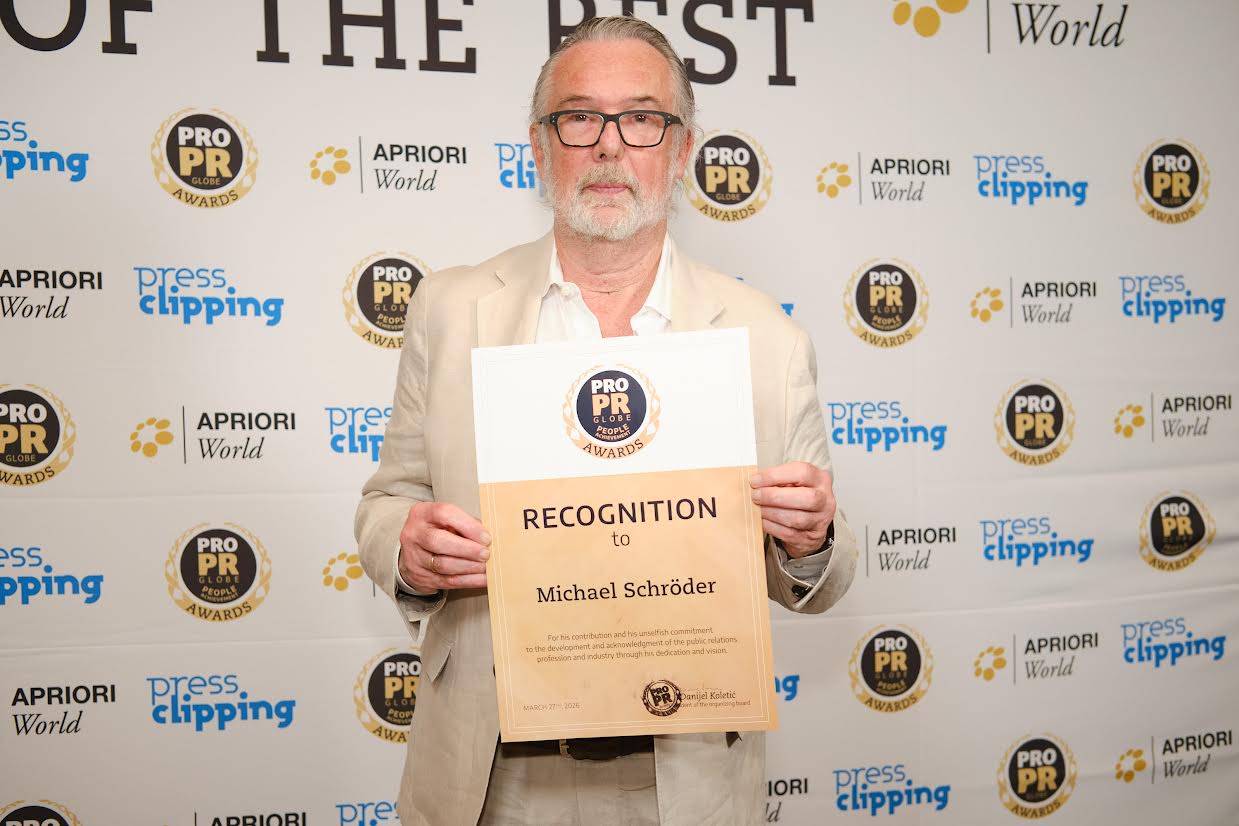
At a time when the communications industry is rapidly evolving, recognitions such as the PRO PR Globe People Achievement Awards highlight professionals who have actively shaped that development. At the 23rd PRO PR Conference, one of the award recipients was Michael T. Schröder, founder and managing director of ORCA Affairs, with more than three decades of experience in communications, public relations, and public affairs.
Throughout his career, he has led some of the most prominent global agencies, including Ketchum Germany, ABC EURO RSCG, and Hill & Knowlton Germany, and has advised leading companies as well as German government institutions. He also served as Global President of IPREX, further strengthening his international influence.
In the conversation that follows, Michael T. Schröder discusses the key challenges facing the industry, the role of artificial intelligence, and the current state of public relations in Germany.
In your opinion, what is the biggest challenge facing the communications industry today? Is it ethics, understanding new generations, AI, or something entirely different?
The biggest challenge facing the communications industry today is the rapid rise of AI. While ethics and understanding new generations are important, AI is fundamentally transforming how information is created, distributed, and consumed. The key issue is not just adopting AI, but using it responsibly, ensuring accuracy, transparency, and trust in an environment where content can be generated at scale and misinformation can spread easily.
Having led an agency, what was the greatest challenge in managing it?
To meet the expectations of my staff, who were becoming more and more demanding. There was also a noticeable lack of loyalty.
How would you evaluate the current state of public relations in Germany?
The current state of public relations in Germany can be described as evolving but still in transition. The industry is growing and remains economically stable, yet it faces significant structural and strategic challenges. On the one hand, PR in Germany is becoming more digital, data-driven, and strategically important, with trends such as personal branding, corporate activism, and AI integration gaining relevance. On the other hand, the market still shows a relatively slow adoption of digital PR compared to other countries, partly due to the strong role of traditional media.
A key issue is the need to build and maintain trust in an environment shaped by misinformation and changing media consumption habits. At the same time, many organizations struggle with internal alignment, where PR often has less strategic influence than marketing and tends to react rather than lead. Overall, public relations in Germany is at a turning point: it is professionalizing and expanding, but must adapt faster to digital transformation, strengthen its strategic role, and address growing expectations around transparency and credibility.
Can we say that public affairs is closely linked to lobbying processes? What is the culture of these processes in Germany? Are they bound by financial or material interests, or are they transparent?
Yes, public affairs is closely linked to lobbying processes. Public affairs often includes lobbying as one of its core activities, focusing on influencing political decision-making and maintaining relationships with policymakers. In Germany, the culture around lobbying is increasingly regulated and moderately transparent, but still somewhat cautious compared to countries like the US.
The introduction of the Lobbyregistergesetz (Lobby Register Act) has improved transparency by requiring organizations and lobbyists to disclose their activities and financial expenditures. However, lobbying in Germany is still partly influenced by economic and sectoral interests, especially from large corporations and industry associations. While there is a strong emphasis on ethical standards and compliance, critics argue that informal networks and access to decision-makers can still play a significant role. Germany’s public affairs environment can be described as structured and increasingly transparent, but not entirely free from the influence of financial interests.
If you were not working in public relations, what would you be doing?
Writing books and painting. This is what I really love. In terms of another profession, I would be an architect.
Which moment in your career has left a special mark on you, aside from the awards you have received?
Maybe the honor of creating and executing the communication campaign for the German government under Chancellor Angela Merkel for „30 years of reunification of Germany“. Also, the honor of leading the international communication network IPREX as its global president, executing a major strategic shift into „IPREX – the global communication platform“. And not to forget the opportunity to meet so many incredible colleagues and employees.

