

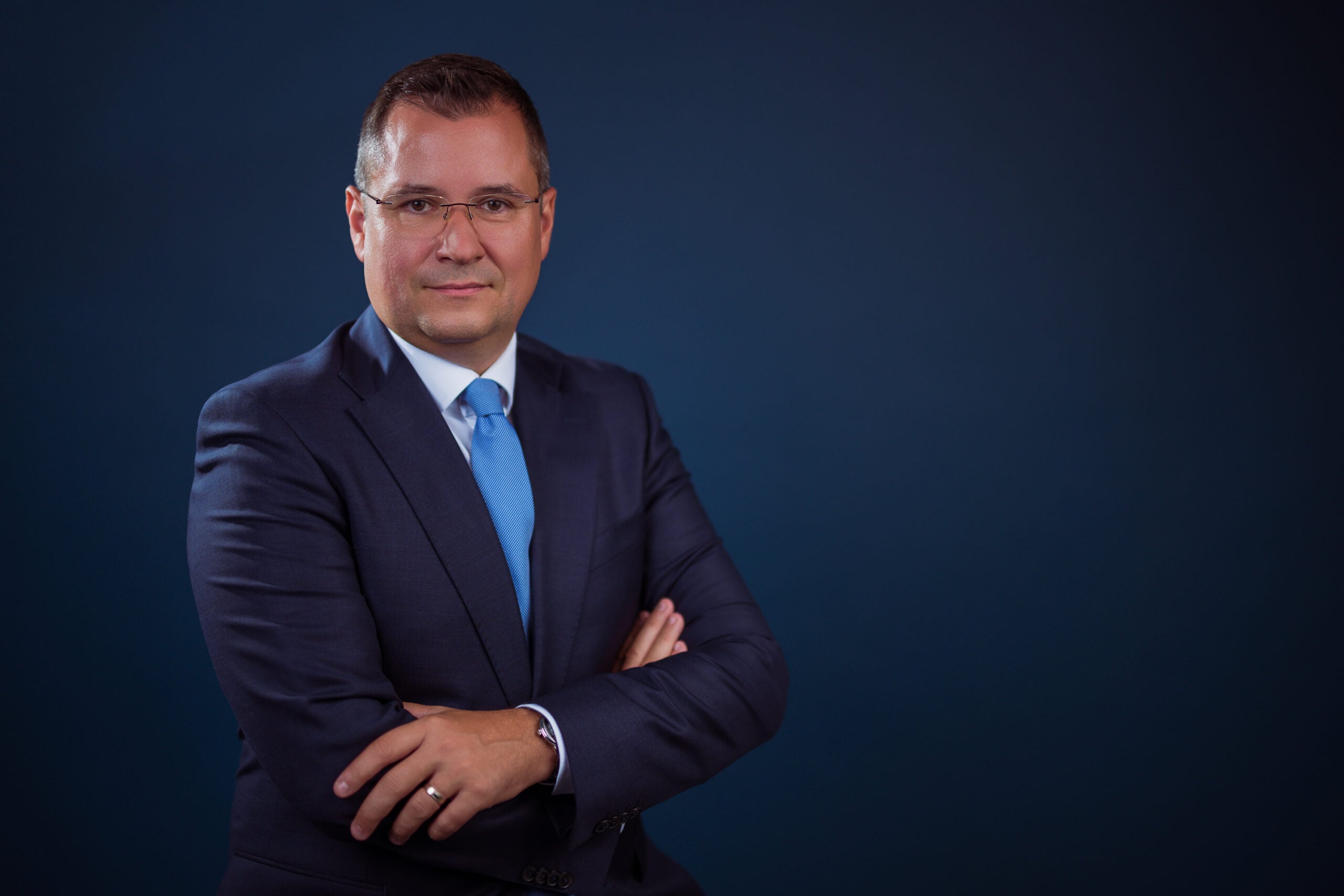
The career of Jernej Kovač can hardly be reduced to a single area of communications. An agricultural engineer by education, he began his professional journey in journalism before spending more than two decades building experience in public relations, marketing, crisis communications, public affairs and diplomacy. He worked in several Slovenian ministries, advised senior decision-makers, participated in two Slovenian Presidencies of the Council of the European Union and, as a diplomat in Brussels, managed sensitive public and regulatory issues.
Today, as Director of Corporate Communications at the Chamber of Commerce and Industry of Slovenia, he leads the communications of an institution that must simultaneously understand the needs of companies, employees, politicians, the media and the wider public. He completed an MBA with a specialisation in marketing at HEC Paris, while the combination of natural sciences, communications and business education shaped his highly structured approach to the profession.
In an interview with Media Marketing, he discusses why a single degree can no longer be enough for an entire career, how artificial intelligence is changing the work of communicators and why the ability to build trust will remain the profession’s most important competency.
You are one of the few professionals from the communications and marketing sector to have earned a master’s degree in France, at the renowned HEC Paris (École des hautes études commerciales de Paris). How important is continuous education and which skills, in your opinion, should a public relations professional possess today?
Continuous education is no longer simply something desirable to have, but a necessity. I have also tried to follow that principle. I am a graduate agricultural engineer by education, and I entered the world of communications through a student job at a radio station. I then developed my communications knowledge at the London School of Public Relations, in the field of digital communications, and through an MBA and a specialisation in marketing at HEC Paris. However, I learned the most from the different professional roles I held, from operational work, media relations and crisis communications to strategic management, marketing and, finally, working as a diplomat in Brussels in a highly sensitive international, political and public environment.
In my opinion, a modern public relations professional must combine three groups of competencies. The first is strategic thinking: understanding the business, geopolitical and regulatory environment and different stakeholder groups, managing an organisation’s reputation and advising management when making strategic as well as operational decisions. The second consists of digital skills, from content creation and understanding platforms to the use of artificial intelligence and analytics. The third consists of fundamental communication abilities: clear expression and storytelling, critical thinking, empathy, crisis communications, listening and managing relationships with different stakeholder groups.
The world is changing very quickly today. Younger generations differ from older ones, media habits are changing, expectations regarding transparency are growing, and crisis communications must be increasingly rapid. Artificial intelligence has accelerated these changes even further. All of this also affects the communications profession. A single degree can therefore no longer be enough for an entire career, which is why I consider continuous professional development extremely important.
If you asked me to identify one key competency for public relations professionals, I would highlight the ability to build trust in and credibility for an organisation. At a time when we are overwhelmed by information and artificial intelligence, and when the public is increasingly, and often justifiably, sceptical of information, credibility has become the most important value in public relations.
Your experience in public administration and diplomacy in the field of communications is extremely valuable. How important are social media and digital communications today for political leaders and those who want to enter politics?
I have not worked in party politics, but during more than two decades of working in ministries, I collaborated with ministers and senior decision-makers and became very familiar with how politics operates. For all entities operating in the public sphere, including both businesses and public institutions, a presence on digital channels is more important today than ever before. It is even more important for political leaders, allowing them to reach the audiences they address. Digital channels enable direct communication with citizens and potential voters, rapid responses, the adaptation of messages to different groups and continuous monitoring of reactions. They are particularly important when addressing younger people, who receive a large proportion of their information about social and political issues through digital environments.
However, presence alone is not enough. Consistency, authenticity, dialogue and, as I have already mentioned, the credibility of information are important, rather than simply the quantity of posts. Unfortunately, those same channels also accelerate the spread of disinformation, populism, polarisation and unethical communication. As users, we must therefore assess the credibility and objectivity of sources, while political leaders must assume greater responsibility for the standard of their communication and the truthfulness of their messages.
The Chamber of Commerce and Industry of Slovenia is an important institution in Slovenia today and probably has a highly demanding communication role because of its numerous and very different audiences. How do you manage to develop relationships and communicate with such diverse audiences?
The greatest challenge is that businesspeople and entrepreneurs, employees, politicians, the media and the wider public often have different, and sometimes completely opposing, interests regarding the same issue. It is therefore necessary to preserve the core of the message while adapting the explanation, context, emphasis, format and channel to each individual audience. Communicating with such different target audiences requires significantly more work and more people because several different versions must be prepared for a single message. I believe that artificial intelligence tools can help us with this, although the messages will always be finalised within the CCIS.
On the other hand, communications at the CCIS are made more complex by its extensive system of sectoral and regional chambers and associations, which represent an important source of knowledge, information and experience. If we want to present ourselves externally as a unified voice of the economy, we must plan well internally and coordinate the communications of more than 35 chambers covering different fields. According to this year’s public opinion research, the CCIS is the most recognisable, respected and professional business organisation in Slovenia among both the business community and the general public. We understand this as confirmation of our work so far, but also as an obligation to continue improving.
As a certified sommelier, you also follow the wine industry. Recent research shows a decline in alcohol and beer consumption among young people. What, in your opinion, can we conclude from this trend?
Younger generations certainly differ from ours, and this is only one of the many differences between generations. The fact is that, largely because of alcohol abuse, there has been considerable public discussion over the past decade about its harmful effects, much like the discussion surrounding tobacco. Less frequent alcohol consumption among young people is part of a broader shift towards greater concern for health and well-being. What is important is that, rather than quantity, consumers are increasingly interested in quality, origin, the story of the winery and the experience that can be offered alongside the wine. The message for the wine industry is clear: less emphasis should be placed on quantity and more on quality, origin, sustainability, authentic experiences and brand stories.
As a sommelier, I see wine as part of the gastronomy and culture of a particular place and time, as well as a companion that can enrich genuine time spent with people and give certain occasions a special, celebratory note. Together with my colleagues, I work to raise awareness of an appropriate attitude towards wine and responsible, moderate consumption. This trend does not therefore necessarily signal the end of wine culture, but rather a step towards more responsible consumption and a call for the industry to connect tradition with innovation and adapt to the changing habits of new generations.
If you were not working in public relations, what would you be doing in your professional career and which path would you choose?
The natural sciences have always been close to me, which is why I studied agronomy. Honestly, my engineering background helps me today to understand many professional and technical subjects, while also teaching me to think and work in a structured, organised and analytical way. However, if I were choosing a field of study again today, I would probably choose economics and marketing, which I later developed further through my MBA studies in Paris. I am also interested in the development of people and organisations: employee relations, workplace climate, talent and careers. After all, this area is closely connected with internal communications.
Which moment in your career left a particularly strong impression on you, apart from the recognition you have received?
Two moments. The first came when I was 27 and, relatively early in my career, was given the opportunity to become Head of Communications at the Ministry of Agriculture. I took responsibility for leading a team and managing communications for a highly demanding government department. I learned that a leader is responsible not only for strategy, the budget and the quality of implementation, but above all for people, relationships and the workplace climate. No two teams are the same, and that diversity continues to enrich me as a leader today.
The second moment was my MBA studies at HEC Paris. Because I studied alongside my regular job, the experience pushed me out of my comfort zone. At the same time, it showed me that Slovenians, because of our history, the small size of our country and perhaps our culture, often hesitate to put ourselves forward. However, in a global class with talented people from different parts of the world, I saw that we can understand the world well and compete with the best on equal terms. At the same time, I directly experienced different perspectives on the world, as well as different approaches to solving challenges.

