

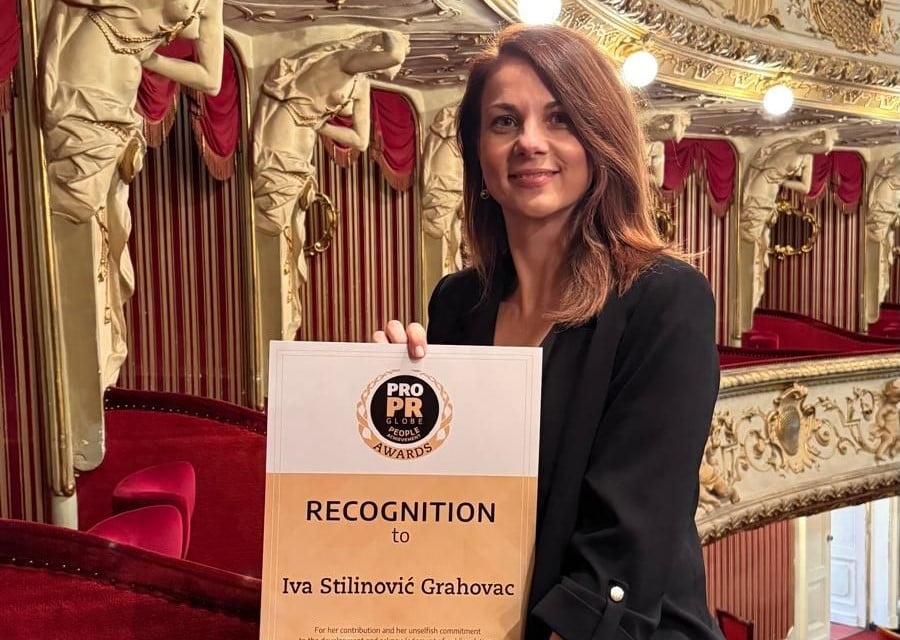
Iva Stilinović Grahovac belongs to a generation of communications professionals who built their careers simultaneously through journalism, editorial work, and public relations, which gives her a very precise understanding of both media logic and audience expectations today. During her career, she worked for some of the most prominent media houses and publications in Croatia, including Adria Media Zagreb, Styria, Story, Globus, and Večernji list, while in recent years she has led public relations for the Croatian National Theatre (HNK) in Zagreb.
Since joining HNK Zagreb in 2019, Stilinović Grahovac has been part of the team that significantly changed the way one of the most important cultural institutions in the region communicates with its audience. Alongside strategic communications, media visibility, and the promotion of key projects, Zagreb’s HNK has in recent years succeeded in expanding its audience, opening the institution to younger generations, while simultaneously maintaining the status of a theatre whose performances are continuously sold out.
The occasion for the interview is also the PRO PR Globe People Achievement Awards recognition, which was presented to her as part of the 23rd PRO PR Conference for her contribution to the field of communications and public relations. In the interview, she talks about the challenges of communication in culture, changes in the audience’s relationship with theatre, the status of the PR profession in Croatia, as well as the experience of journalism that shaped her professional path.
The Croatian National Theatre has significantly transformed its national perception over the past five years, which certainly depends on the repertoire, but also on PR and communication activities. In that regard, we are interested in the challenges you face in your position?
The role of public relations in an institution such as the Croatian National Theatre in Zagreb involves a constant balance between tradition and modernity. HNK Zagreb is an institution with an exceptionally strong heritage and responsibility towards its audience, but at the same time it must remain open, relevant, and accessible to new generations. One of the greatest challenges is finding a communication language that respects the artistic seriousness and historical significance of the theatre while also being close to today’s audience, especially those who are only just discovering theatre.
The transformation of Zagreb HNK’s perception in recent years is the result of teamwork, a clear strategy, and consistent communication. We strive to show that theatre is not a closed space reserved for a narrow circle of people, but a living place of encounters, dialogue, and emotion. Digital channels, direct communication with audiences, and opening the institution to the wider community all play a major role in that process.
At the same time, one of the greatest challenges is maintaining a level of constant excellence, not only artistically, but also in audience perception. When you are in a position where performances are continuously sold out, where audiences have high expectations, and where you are expected to always deliver at the highest level, communication must follow that standard with equal dedication and precision. The challenge is not only achieving success, but confirming it every day, building audience trust, and justifying the institution’s status.
How would you evaluate audience culture and their relationship towards theatre? Is there interest among younger generations for culture, and do they recognise those values?
I believe audiences today are showing increasing interest in cultural content, but their relationship with theatre is also changing. Theatre today is a space of authentic experience, dialogue, and belonging.
What especially makes me happy is the interest of younger generations. Although it is often said that young people are losing interest in culture, our experience shows the opposite. When content is presented to them in a way that feels understandable and relevant, their response and engagement can be exceptional. That is precisely why it is important for us to continuously open new formats and spaces for meeting audiences.
The opening of our new HNK2 stage is an important step in that direction as well. This new space allows us to offer audiences, especially younger ones, different kinds of content and experiences, from talks, presentations, and special programmes to events that create a more direct and relaxed relationship with theatre.
Croatia has a well-positioned public relations profession. How would you evaluate the status of the profession in society? Is it sufficiently recognised, or does it primarily depend on institutional management?
The public relations profession in Croatia has progressed significantly and today is much better understood than it was ten or twenty years ago. Still, its full potential largely depends on how much institutional management recognises the importance of strategic communication.
Public relations are not just promotion, sending press releases, or reacting to crisis situations; they are a key tool for building identity, trust, and long-term relationships with audiences. When there is understanding of that role at the management level, the results become visible and measurable, especially in culture where communication becomes a bridge between art and audiences.
At the same time, it is important to emphasise mutual trust within the institution and quality internal communication, which are also an integral and extremely important part of public relations. Without that, external communication cannot be consistent or credible.
If you were not working in public relations, what would you be doing in your professional career and which option would you choose?
I studied journalism and worked in journalism through all of its segments, from my first reporting steps to editorial positions. It was a beautiful and extremely formative period, full of learning, experiences, and people, as well as many friendships that still last today, and that is something I would not change for anything. Journalism, writing, and working in media have always felt naturally close to me, and that path shaped me significantly.
Honestly, the question of what I would do in a completely different career is always difficult. Today, at this stage in my life, I think I would choose the same path again, although perhaps at the very beginning I would enter the profession with a slightly different attitude, with more calmness, less internal pressure, and different expectations of myself and my surroundings.
Which moment in your career left a particularly strong impression on you, aside from the recognitions you have received?
The greatest impression, however, was left by people, wonderful acquaintances, colleagues, and friendships that developed over the years, some of whom became almost like family. I also especially remember many human gestures, situations in which we selflessly helped one another and supported each other, often beyond the professional framework itself. Those are values that are never forgotten and that give special depth to every professional experience.

