

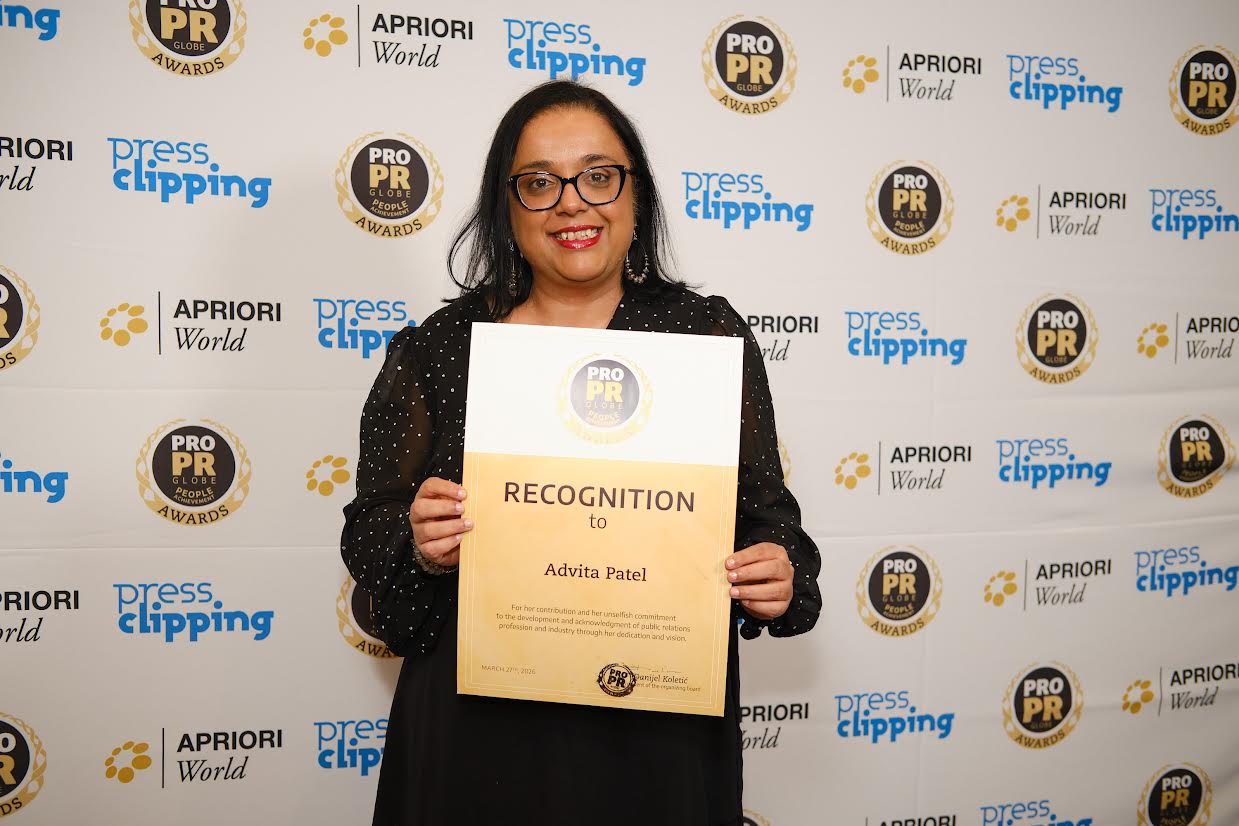
At a time when the communications industry is facing new challenges and redefining its role within organisations, recognitions such as the PRO PR Globe People Achievement Awards highlight professionals who are pushing the boundaries of the discipline. At the 23rd PRO PR Conference, among the award recipients was Advita Patel, an award-winning expert in internal communications and employee experience, as well as the founder of CommsRebel.
With more than two decades of experience, Advita Patel has dedicated her career to empowering organisations through effective and inclusive communication, helping leaders build working environments where employees can thrive, not just survive. Through CommsRebel, as well as initiatives such as A Leader Like Me, The Belief Builders and The Asian Communications Network, she actively contributes to the development of more open and equitable organisational cultures.
As the current President of the Chartered Institute of Public Relations and co-author of the bestseller Building a Culture of Inclusivity, Advita Patel continues to shape the global communications landscape, while through her work and future projects further emphasising the importance of confidence, leadership and authentic communication.
In the interview that follows, Advita Patel discusses the role of internal communications today, the challenges brought by artificial intelligence, and how to build trust within organisations.
How do you view the role of internal communications today?
Internal communications has never been more important, and honestly, it’s also never been more misunderstood. For years, it sat in the corner, treated like a broadcasting tool, but today, it sits right at the heart of how organisations survive change. With AI reshaping how we work and hybrid models still being figured out in real time, colleagues need more than information. They need context, clarity, and a genuine sense of belonging. And internal comms professionals are the people who make that happen. That’s not a small thing.
Has CommsRebel met your expectations, and what is its purpose?
CommsRebel started from a place of frustration. I kept seeing the same patterns, the same gatekeeping, and the same tired approaches being recycled in our industry. I wanted to create a space that challenged that. A place where communications professionals could think differently, push back on conventional wisdom, and actually evolve their practice. Has it met my expectations? In some ways, it’s probably exceeded them, and in others, the work is very much still in progress. But that’s exactly how it should be. A brand called CommsRebel probably shouldn’t be declaring itself finished any time soon.
How should the PR industry approach artificial intelligence?
Curiously and critically. Not with fear, and not with uncritical enthusiasm either. AI can be genuinely useful if used ethically and appropriately. It can speed up research, support content production, and help us analyse data we wouldn’t have had the capacity to touch before. Those are real advantages but the risks are also real. If we’re not careful, AI becomes a shortcut that erodes the quality of our thinking. Relationships, nuance, ethical judgment, knowing when not to say something, those things can’t be automated and shouldn’t be automated. The industry needs to get clear on what AI is for and what it absolutely isn’t for, and stick to that line.
What does it mean to be at the head of public relations, and what responsibilities does this role entail?
It means being accountable for how an organisation communicates with the world, and that’s a serious responsibility. You’re shaping perception, yes, but you’re also shaping trust. And trust, once lost, is incredibly hard to rebuild. At a leadership level, you have to be the person who asks the uncomfortable questions before a decision becomes public. You’re often an advisor, a strategist, and sometimes a voice of reason when the room has decided to go in a direction that needs challenging. Our role requires courage as much as it requires technical expertise.
What are the biggest challenges in internal communications today?
Right now, the conversation about technology dominates, but honestly, the real challenge is older than AI or hybrid working; it’s how we build trust. Colleagues don’t just want to be informed; they are surrounded by noise every single day. They want to feel like the communication they receive is honest, transparent and adds value to the work they are doing to help them be their best selves. When leadership uses internal comms as a broadcasting tool rather than a dialogue, people notice. Add to that the reality that different generations genuinely do have different expectations around transparency, speed, and tone, and you have a real complexity to navigate. Technology amplifies all of this, but it doesn’t cause it.
If you were not working in public relations, what would you do?
Working in IT without question. I’ve always been drawn to technology and the possibilities it can bring. I studied Information Technology at university, and I learned a lot about how technology can transform how we communicate.
Which moment in your career has left a special mark on you?
It’s not one single moment, it’s a collection of them. The conversations after a workshop where someone says it changed how they see their role. The messages I’ve received from communications professionals who felt unseen in the industry and found something that spoke to them. Those hit differently than any award. Recognition is wonderful, don’t get me wrong, but the moments that stay with me are the ones where the work actually reached somebody. Isn’t that the whole point of what we do?

