

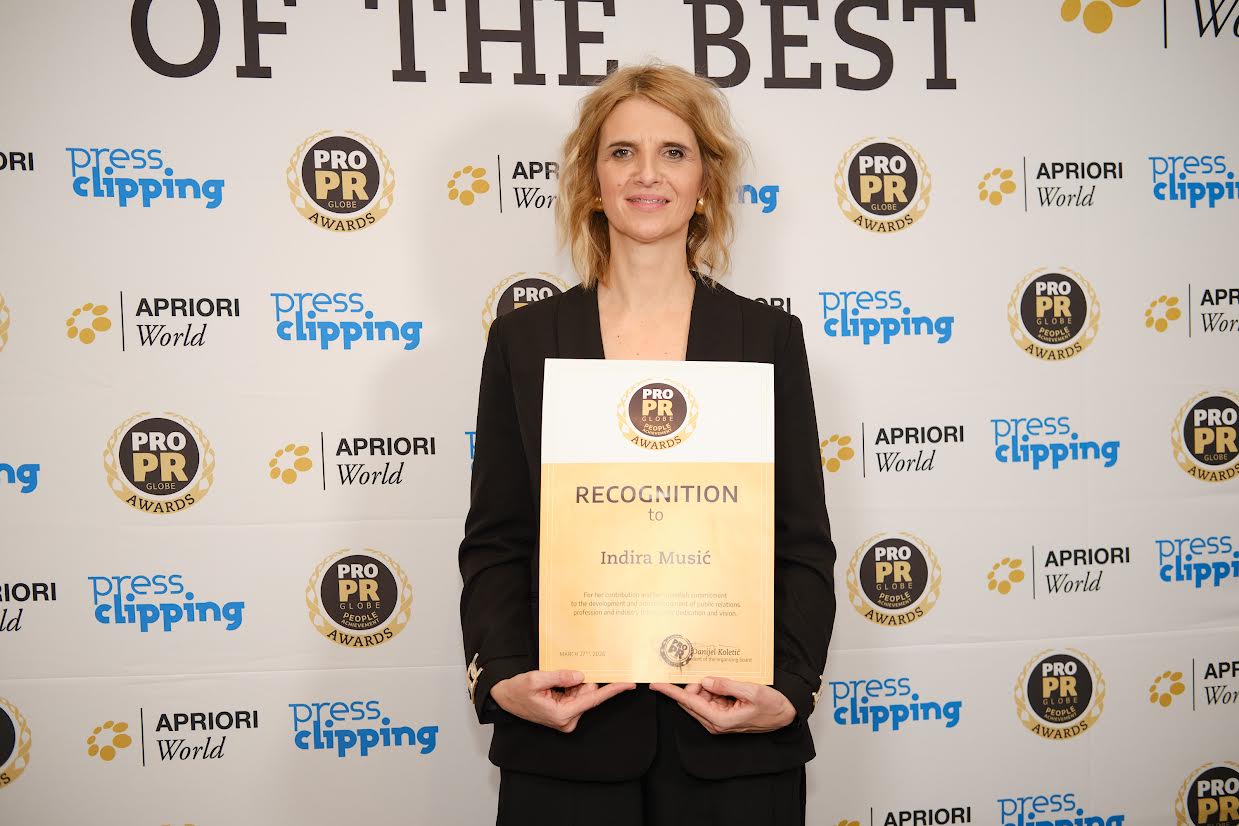
Indira Musić, a Brand & Business Growth Strategist from Sarajevo, has spent more than 20 years building her career through marketing, business development, and strategic communication across the healthcare, FMCG, and retail sectors. Today, at ASA Bolnica, she leads brand positioning, communications, and reputation management, with a focus on trust, reputation, and the long-term development of communication processes.
Through her work on brand development, digital transformation, CRM projects, and major business events, she has particularly established herself in areas where communication has a direct impact on the relationship between organizations, people, and the community. That is why, in an interview for Media Marketing, she speaks about the role of strategic communication in management, the specific nature of hospital communication, and the challenges of reputation management in the healthcare sector.
In the interview, she also discusses the position of the PR profession in Bosnia and Herzegovina, the impact of artificial intelligence on the communications industry, and the importance of responsible, ethical, and contextual communication in a time of rapid change.
How would you assess management’s perception of strategic communication?
The perception of strategic communication among management is changing, but I would say it is still an ongoing process. More and more managers understand that communication is not just the final step, something that comes after a decision has already been made, but an important part of the decision-making process itself.
The biggest shift happens when management stops viewing communication as operational support and starts seeing it as a strategic function that influences reputation, trust, stakeholder relations, and the long-term positioning of an organization.
In healthcare, this is especially important because communication is not only a matter of image, but also of responsibility. Patients, families, employees, and partners must have clear, accurate, and timely information. That is why I believe serious organizations increasingly recognize that communication teams should be involved from the very beginning in planning, risk assessment, message development, and understanding the broader context.
Strategic communication is not only about “what we are going to publish,” but also why, to whom, when, in what tone, and with what consequences for the organization’s reputation.
Are public relations professionals in Bosnia and Herzegovina sufficiently recognized?
I believe that public relations professionals in Bosnia and Herzegovina are becoming increasingly visible, but they are still not fully recognized in the full capacity of their role. PR is often viewed through what the public can see – announcements, media appearances, events, or campaigns. However, much of the important work happens behind the scenes.
This includes strategic consulting, reputation management, internal communication, crisis communication, risk analysis, understanding different stakeholders, and protecting trust. It is precisely this part of the job that is often not visible enough, even though it is essentially the most important.
In Bosnia and Herzegovina, there is still room for public relations to be positioned more strongly as a managerial and strategic function, rather than only as executive or technical support. A good communication professional should not only be involved when a press release needs to be written or an event organized, but also when decisions are being made that may affect the public, reputation, and trust.
I believe that awareness is developing, especially in serious systems that understand how much communication can contribute to stability, credibility, and the long-term development of an organization.
What is specific about a hospital’s communication strategy, and what are potentially the biggest crises?
A hospital’s communication strategy is specific because its core is never just the service, but the person. The patient, the patient’s family, the doctor, the medical team, and the wider community. All of them have their own expectations, fears, questions, and need for trust.
In healthcare, the line between promotion and responsibility is very sensitive. Communication must not be sensationalist, superficial, or exclusively marketing-oriented. It must be accurate, measured, ethical, and empathetic. When communicating about health, illness, treatment, or medical procedures, every word carries additional weight.
The biggest potential crises in a hospital environment relate to patient safety, adverse treatment outcomes, dissatisfaction with services, protection of privacy and personal data, misinterpreted information, as well as situations in which public emotions can very quickly override facts.
That is why prevention is especially important in hospital communication: clear internal protocols, strong coordination between management, medical staff, and the communications team, employee education, and the ability to respond quickly, responsibly, and transparently.
In healthcare, trust is built over a long period of time, but it can be damaged very quickly. That is precisely why communication must be continuous, professional, and deeply aware of the responsibility that healthcare institutions have toward people.
How would you assess the position of artificial intelligence? Does it represent a threat to the public relations industry or a necessity?
I do not see artificial intelligence as a threat, but as a necessity and a tool that will significantly change the way we work. AI can help us become faster, more organized, and more efficient, especially in research, data analysis, trend monitoring, audience segmentation, content preparation, and communication planning.
However, AI cannot replace what is most important in public relations: understanding context, emotions, ethics, responsibility, intuition, and the ability to assess the right moment. It is not enough just to produce text or a message. It is necessary to understand who we are addressing, why we are addressing them, what kind of reaction the message may trigger, and what impact it may have on the organization’s reputation.
AI can help us become faster, but it must not make us more superficial. In my opinion, that is the key difference.
I believe that artificial intelligence will not replace good communication professionals, but it will replace the way of working of those who are not willing to learn and adapt. Professionals who know how to use AI responsibly, critically, and creatively will have a significant advantage.
Technology can accelerate processes, but trust, relationships, and reputation are still built by people.
If you were not working in public relations, what would you do in your professional career, and which option would you choose?
If I were not working in public relations, I would probably still choose a field connected to people, organization, development, and creating tangible value. I am drawn to roles that combine strategy, communication, education, responsibility, and work on projects that have broader social significance.
I could imagine myself working in management, business development, education, or projects that connect institutions, people, and communities. I have always been motivated by the opportunity to be part of a process in which an idea becomes a result, and communication becomes trust.
Still, public relations feels naturally close to me because it brings together everything I consider important: strategic thinking, dynamics, responsibility, creativity, empathy, and continuous learning. It is a profession in which you cannot remain in the same place because the market, the public, technology, and organizations are constantly changing, and communication professionals must evolve with them.
What moment in your career has left a special mark on you, aside from the awards you have received?
The moments that left the strongest mark on my career were those in which I had the opportunity to participate in the development of major projects from the very beginning, especially in the healthcare sector. When you work within a system that is developing, growing, and building patients’ trust every day, you realize how important communication can be and how directly it can affect people.
Working in a hospital environment especially shaped me. It taught me that communication is not just a public message, a campaign, or a media appearance. It is also the way a patient receives information, how employees understand a shared goal, how an organization deals with challenges, and how trust is built in situations that are often very sensitive.
For me, the most important moments are those in which you see that communication has a real purpose, when it helps people understand, make decisions, feel safe, or gain trust. These are moments that may not always be publicly visible, but professionally they leave the deepest mark.
Awards are important and represent a beautiful confirmation of one’s work, but what remains as the strongest feeling is the awareness that through communication you can contribute to something greater than the message itself – trust, understanding, and responsibility toward the community.

