

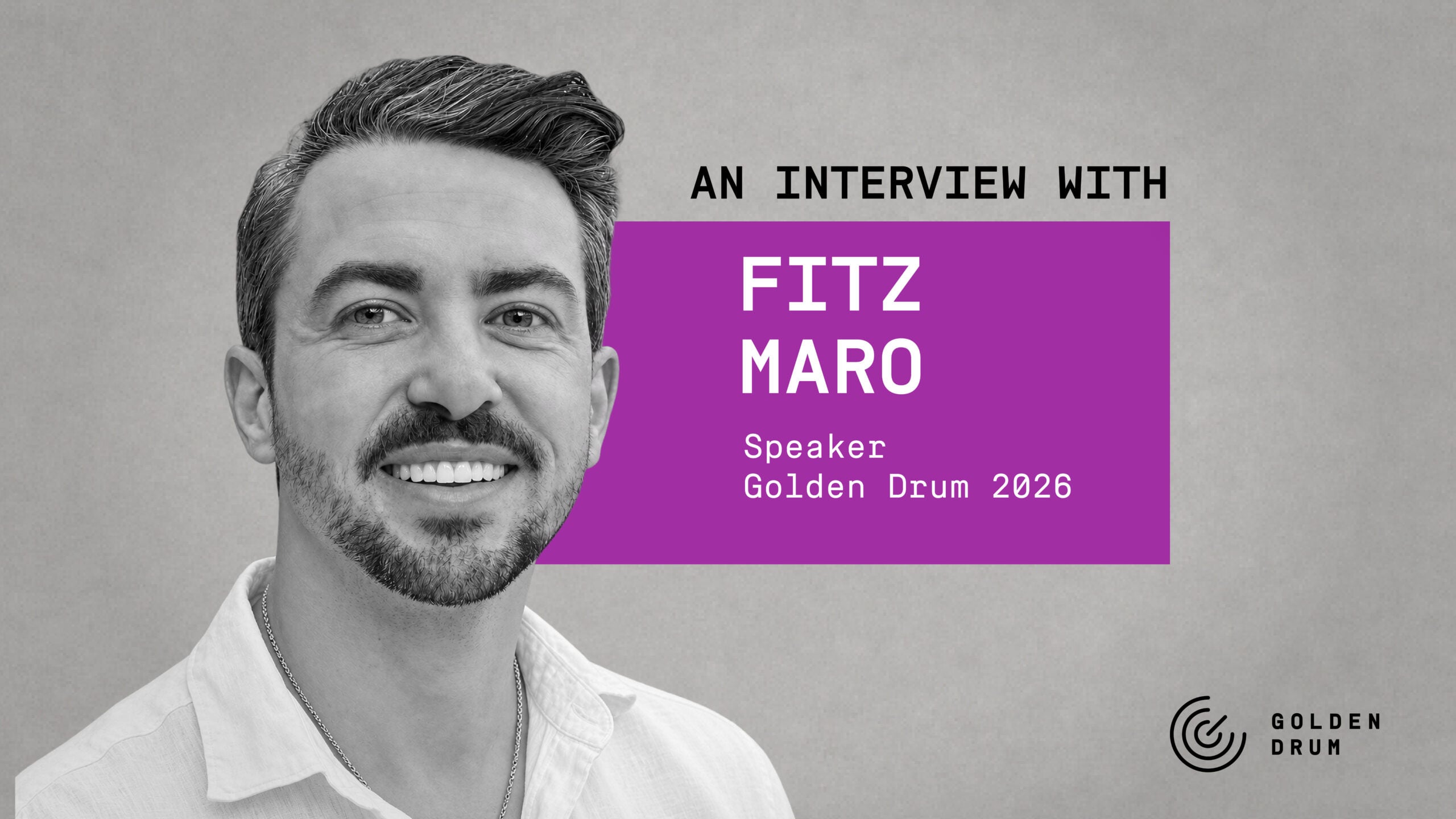
As technology becomes more powerful, accessible and deeply embedded in advertising, the real creative challenge is no longer simply what we can build, but why we should build it in the first place. Few understand that intersection better than Fitz Maro, Head of the Americas, Design Technology at Brand Innovation Lab, Amazon Ads, whose career has been defined by bringing creative ideas and emerging technology together.
Before joining Amazon, Maro led creative technology globally at Pinterest and worked in agency innovation, building a career that has earned him many industry awards, including a Cannes Lions Grand Prix, alongside recognition from The One Show, Effie’s, Clios, D&AD and the Webby’s. He was also named one of Ad Age’s “Creatives You Should Know” in its 2016 Cannes edition.
Ahead of his appearance as a speaker at Golden Drum 2026, Maro discusses why technology should never become the idea itself, how AI could give creatives back more time for actual creativity, and why curiosity, craft and human judgement will become even more valuable as polished execution becomes increasingly accessible.
At Amazon’s Brand Innovation Lab, your team develops advertising experiences that haven’t been done before. When working with emerging technology, how do you make sure the technology serves the idea rather than becoming the idea?
Advertising has a long history of shoehorning emerging technology into ideas, and consumers can smell it from a mile away. Award judges can too. Technology is a tactic, albeit an incredibly diverse one. It should help bring the big idea to life, not become the reason the idea exists.
Tech for tech’s sake is never the answer. Sometimes creatives force it into the work because they want a technologically ambitious piece in their portfolio. That’s a trap. It usually signals the opposite: that the team understands the technology but not why anyone should care.
My test is whether the experience would still have a compelling idea at its centre if you removed the novelty of the technology. If the answer is no, we probably don’t have an idea yet.
Before Amazon, you led creative technology at Pinterest and worked in agency innovation. How has moving between the agency, platform and technology worlds changed the way you think about advertising?
I think much more about scale now that I’ve moved out of the agency world. One of my biggest frustrations about agency life was building incredible work with emerging technology, only to watch it live for a few weeks or months based on the campaign flight. You could put an enormous amount of thought and invention into something, and then it simply disappeared.
Moving to platforms like Pinterest and Amazon changed that. I started thinking about how innovation can move from a one-off execution into a system that compounds on itself. A strong innovation doesn’t have to die on the vine when one campaign ends. It can be reimagined for different clients, verticals and use cases.
There’s a lot of anxiety about AI replacing jobs in the creative industry. Which parts of the creative process do you believe we should happily hand over to AI – and which should remain fundamentally human?
For me, the dividing line is fairly simple. Anything repetitive that doesn’t require someone’s craft or creativity should be handed over to AI.
In agencies, an enormous amount of my time was spent doing everything but concepting: updating decks, resizing assets, making endless tweaks, triaging client asks, writing status updates and checking in on work. That churn was exhausting. Most people entered this industry because they wanted to be creative, but they ended up spending the lion’s share of their time and energy on work that wasn’t unique to their skills.
What should remain human is the reason we joined the industry in the first place: the concept, the craft, the judgment and the point of view. AI should remove the administrative and (some) production friction so creative people can spend their best hours on the work only they can do.
You describe yourself as a “bridge builder” between engineers, creatives, sales teams and the C-suite. Why has being able to speak across disciplines become such an important skill in today’s creative industry?
“Bridgers” are incredibly important people who connect silos and bring different perspectives together. I think that role is seriously undervalued in creative organizations.
Being able to wear different hats helps me get people on the same page and keep an idea moving forward.
But language is only half of it. We live in a world of incentives. You also have to understand what each person is trying to accomplish, how they measure success and what they are rewarded for. Once you understand those ambitions, you can frame a path forward that gives everyone a reason to help advance the idea. The job is to translate across disciplines, constraints and incentives, then find the path through.
As technology makes it possible for brands to create increasingly personalized and interactive experiences, do you think we’re entering a new era of brand creativity – or are we simply getting better tools to execute the same ideas?
I’m not convinced the creative’s job has fundamentally changed. The craft and the goal are largely the same, but the tactics and the ways ideas can be expressed have expanded dramatically. Personalization and interactivity are part of that much larger toolkit. Creatives need to be curious and willing to experiment with technology, now more than ever.
The biggest change is that developing/building technical ideas used to be a massive barrier to entry. Technical time was scarce, so we protected it and built only what had already been heavily vetted. Today, creatives can prototype an idea, play with it and see it come to life without becoming technical experts first. That should change how they see themselves. The creatives who win in the future will be the ones who can build, not just concept.
As AI makes it possible for almost anyone to produce polished content quickly, do you think having a truly original idea will become more valuable than ever?
Polish and originality aren’t the same thing. AI is making polish widely accessible. But in my mind, long before AI, “original” ideas were already derivative in some way.
There’s a reason the best creatives you’ll ever meet are often incredibly well-read and cultured. They visit museums, read constantly, have interesting conversations and absorb information from all sorts of places. What we call an original idea is often a remix or hybrid of the many things they’ve experienced and the perspective through which they combine them.
What AI can do to change original ideas, though, is dramatically expand those inputs for creatives. It can introduce someone to a new subject and explain it in different ways until something connects. Google made information easy to find; AI makes learning tailored, conversational and infinitely accessible. The differentiator is still the desire to learn. That curiosity is what separates people who produce a prolific volume of good ideas from those who don’t.
What’s something you’ve learned from working with engineers that you think every creative should understand – and vice versa?
One thing creatives should understand is that technologists think incredibly literally. They are often the people who turn the words into an actual experience. Vague idea writeups are the bane of their existence. The more specific you can be about the user experience and flow, the faster a technical mind can help you tailor the idea to reality.
Now, engineers should understand that early ideas from creatives are very fragile. They’re a spark, not a finished idea. If a creative shares something that isn’t technically feasible, don’t shoot it down immediately. Instead, be curious about how you can help bring it to life. What are they really trying to achieve? Which part of the idea is capable of being preserved? What adjacent solution could actually work? Technologists/engineers who help nurture that spark get invited into the creative process earlier. Those who continually extinguish it eventually stop getting invited into the room.
A world stage with a regional heart – secure your delegate pass, scroll the program, flag your must-see sessions, and get ready to join the creative community at Golden Drum 2026.

