

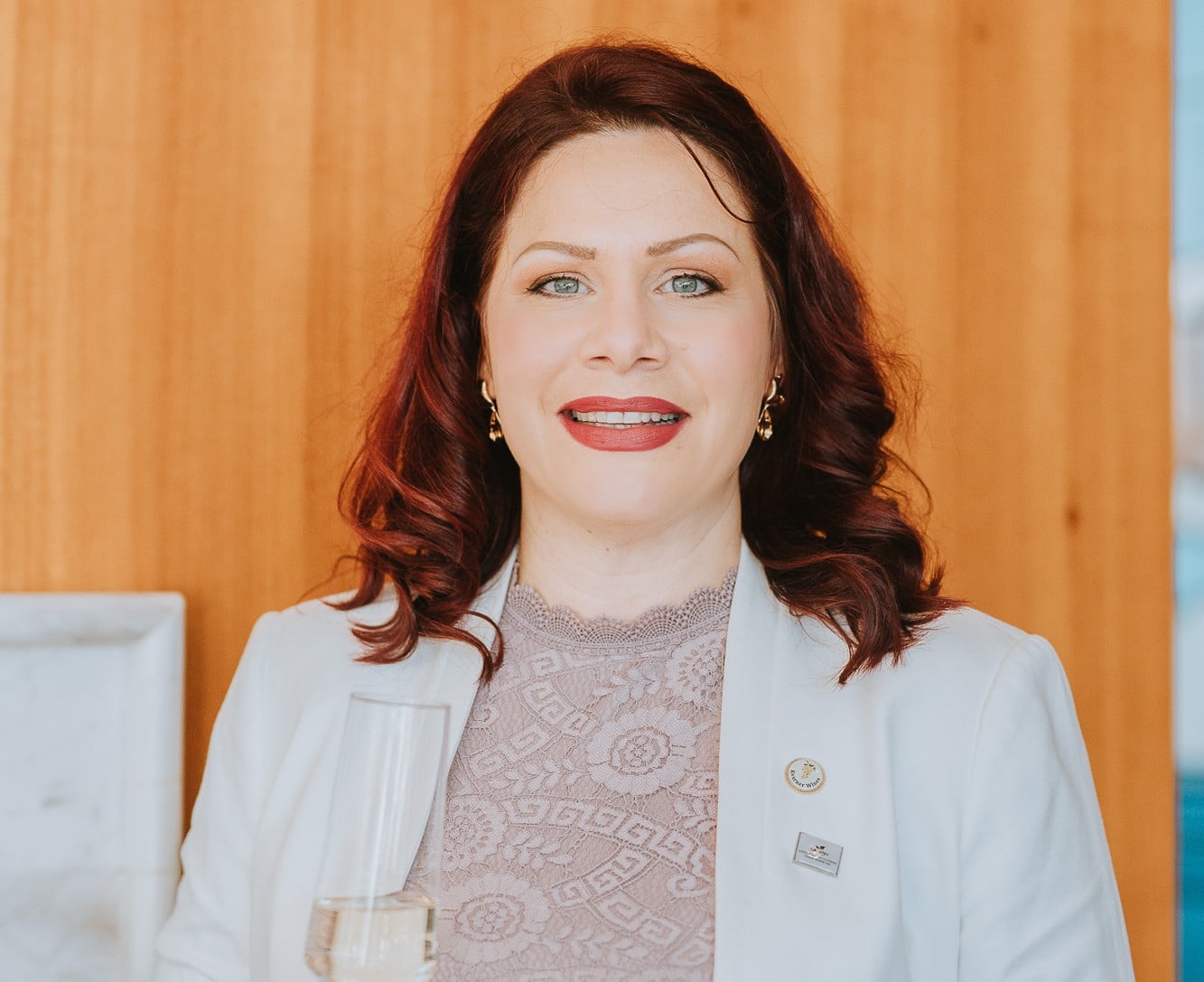
Egle Katunar, sales and marketing manager at Kuća vina Ivan Katunar, came to Vrbnik because of love, and there discovered her second great passion, wine. An Istrian by birth, today she is an important part of a family wine story in which tradition, local customs, indigenous varieties of Kvarner and the tourist experience come together in a recognizable experience of Vrbnik.
Through tastings, tours of the wine cellar and stories about viticulture, winemaking and the special features of the island of Krk, Egle brings wine closer to guests as a way of life, and not only as a product. For her contribution to the development and promotion of rural tourism, she received the “dr. sc. Eduard Kušen” award and became an ambassador of the Suncokret ruralnog turizma project. She is also a proud ambassador of the Kvarner, European Region of Gastronomy 2026 project, an active member of the Žene za otok association and a member of the European Wine Knights Order – Ordo Equestris Vini Europae.
In the conversation, she talks about how communication in the wine industry is changing, why digital channels and direct sales have become important for small producers, how difficult it is to build a recognizable brand in an oversaturated market, but also why product quality remains the foundation of every successful story. She also talks about educating new generations of consumers, trust as the best preparation for crisis situations and the role of artificial intelligence as a tool that can speed up work, but cannot replace experience, creativity and the human approach.
What are the most important communication trends in the wine industry today?
The wine industry, like many other industries, has undergone significant changes in recent years in the way it communicates with consumers. I believe that digital channels have today become a key tool for presenting wines, wineries and the people behind them. Social networks, websites, newsletters and various digital platforms enable direct communication with customers, without intermediaries, which is a major advantage for producers.
The development of direct sales is a particularly important trend. Consumers want to have direct contact with the producer, learn more about wine production, vineyards and the philosophy of the winery. That is why authentic stories and quality content are gaining increasing value. Today, people do not buy only a product, but also an experience, an emotion and the values that a certain brand represents.
At the same time, digital tools enable more precise tracking of consumer interests and the adaptation of communication to their needs. I believe that this trend will continue to develop and that successful producers will be those who know how to connect the tradition of winemaking with modern communication channels.
What challenges do you most often face? Is it consumer education, market saturation or something else?
There is certainly no shortage of challenges in the wine industry. Today, there is a large number of small producers on the market who invest a great deal of effort, knowledge and passion into their work. Precisely because of this, competition is strong, and standing out among many quality wines is becoming increasingly demanding.
I believe that one of the biggest challenges is building a recognizable brand. It is not enough to produce good wine, it is necessary to create an identity that consumers will recognize and trust. This requires long-term work, consistent communication and clearly defined values.
Of course, product quality remains the foundation of everything. Without an excellent product, it is difficult to survive on the market in the long term. Communication can help create interest, but the final decision is made by the quality that the consumer experiences in the glass.
In addition, it is important to continuously educate the market and bring wine closer to new generations of consumers. Today, people have a wide choice, so it is necessary to find a way to interest them and show them the uniqueness of your own product. It is precisely the combination of quality, authenticity and good communication that creates long-term success.
Have you encountered crisis communications during your career and what do you consider a crisis situation in the wine industry?
During my work in the wine industry, I have encountered smaller challenging situations that required additional attention and a quick reaction, but fortunately there has never been a need for serious crisis communication in the full sense of the word.
The wine industry is specific because business is influenced by numerous external factors. Climate conditions, weather disasters, market changes or logistical problems can represent certain challenges for producers. However, I believe that most potential problems can be successfully resolved through timely communication and a responsible approach.
In my opinion, the most important thing is to build trust continuously, and not only when a problem arises. When there is a quality relationship with partners, customers and the media, it is much easier to manage unexpected situations as well. Transparency, honesty and professionalism are always the best response to any challenge.
Do you use artificial intelligence in your work or are you only considering its application?
Yes, I use artificial intelligence and I believe it is important to follow the development of technology and adapt to new tools that can improve business. We live in a time of rapid change and I believe that openness to new solutions is important for every professional development.
Of course, artificial intelligence cannot replace experience, creativity and the human approach, but it can be a very useful tool that makes everyday tasks easier. It can help with gathering information, analyzing data, organizing content and speeding up certain processes, which leaves more time for strategic thinking and creative work.
In the communications industry, and therefore also in the wine sector, it is important to find a balance between technology and human knowledge. I believe that artificial intelligence should be seen as support that enables us to be more efficient, and not as a replacement for expertise and personal engagement. If used in the right way, it can be a very valuable tool that contributes to better quality and faster work.

