

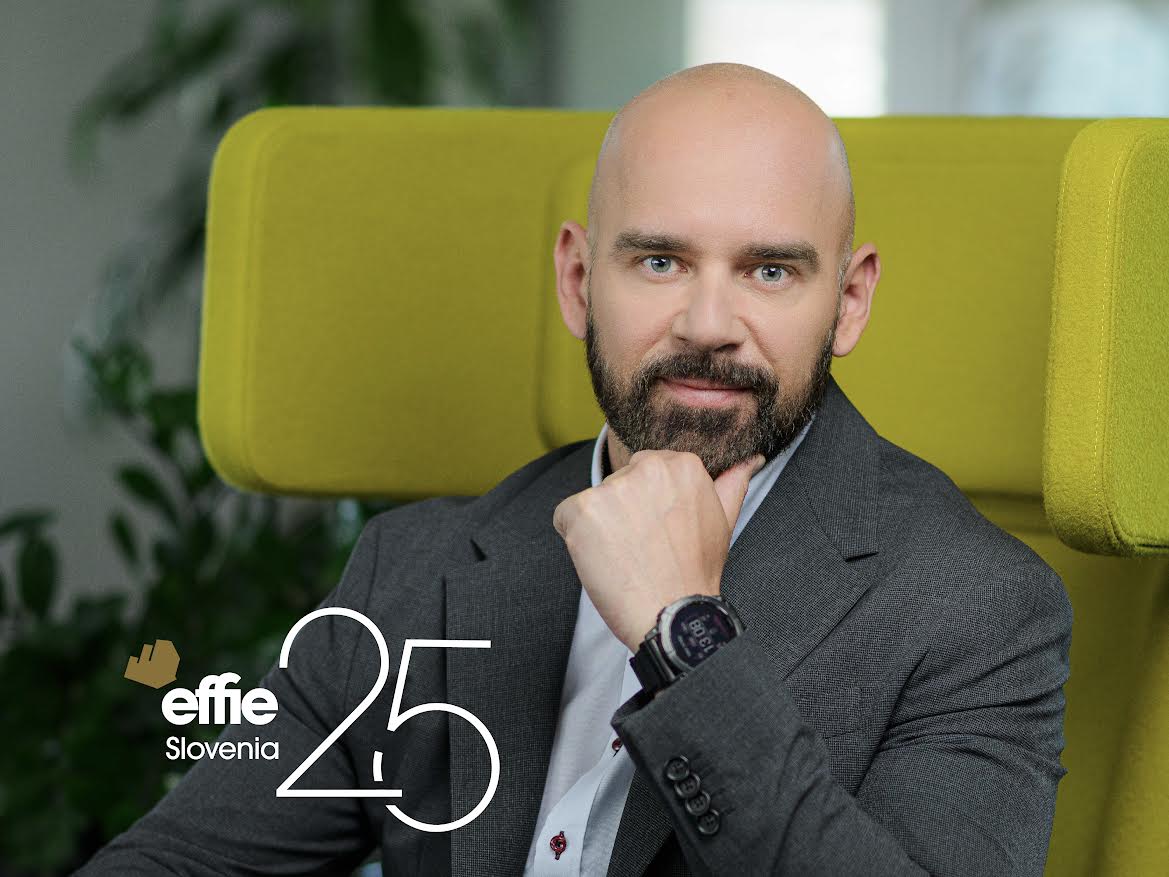
Marketing effectiveness is often measured through results, but behind every result lies a series of decisions that determine whether a campaign will truly solve a business challenge or simply attract attention. It is precisely this relationship between strategy, objectives, measurement, and business impact that Davorin Milinović, Head of Strategy and Analytics at A1 Slovenia and Co-Chair of the Effie Slovenia 2027 Jury, has been working on for nearly two decades.
Throughout his career, he has worked in strategic planning, analytics, market insights, and business consulting. Today, at A1 Slovenia, he connects data, business priorities, and marketing decisions. He leads the process of setting strategic objectives across the entire company through the OKR methodology and participates in the development of commercial and communication projects, from initial insights and challenge definition to measuring and proving their effectiveness.
In this interview, he discusses how he distinguishes strategically effective marketing from marketing that owes its success to luck, why well-defined goals are the foundation of every effective campaign, what he has learned through his experience as both an Effie entrant and jury member, and how he sees the role of the jury chair in ensuring objective and high-quality judging. He also reflects on long-term brand building, the importance of measuring business results, and the competencies marketing teams will need in a world where artificial intelligence is becoming available to everyone.
Many marketing campaigns attract attention, but far fewer generate business impact. In your opinion, what is the definition of effective marketing?
Marketing can create impact in different ways. I would highlight two approaches that differ in how they are executed. The first is strategically effective marketing, which we can also call Effie marketing. The second is lottery marketing.
Strategically effective marketing is marketing where decisions are made based on the goals we want to achieve, an understanding of the challenge, the situation, and the customer, as well as the limited resources that need to be used efficiently. If a brand’s key challenge is low awareness in a homogeneous market, then achieving high attention with limited investment is an example of strategically effective marketing. On the other hand, if a brand is already highly recognizable but its key challenge is poor quality perception, then simply attracting attention is ineffective marketing because resources have been spent on something that was not a priority.
The second type of marketing that can generate impact is lottery marketing. In this case, effectiveness is achieved as a result of intuition, a good idea, luck, or a random combination of circumstances, rather than goals or an understanding of the context. Intuition and luck are welcome, but in such cases we are not talking about effective marketing, but rather about a bet that happened to pay off.
Effective marketing does not only generate results; it understands and can explain why certain decisions were made. If we look at this from the perspective of company owners or management, a logical question arises: “Would you rather invest your resources in strategically effective marketing or in a gamble?”
You know Effie from the perspective of both an entrant and a jury member. Has that experience influenced the way your company works?
Absolutely. Writing an Effie entry reminds you of things you did not think about enough while the project was being developed. What objectives were we actually pursuing? Why didn’t we measure this? Did we even ask what the customer truly wants? Why is it not clear from the solution which target audience we were addressing?
At A1 Slovenia, these kinds of questions helped us adapt our way of working. We begin by preparing quality insights to understand the context, then set direction through clear objectives using the OKR methodology, followed by group ideation to define the path towards the goal, strategy and operational planning, and finally implementation, measurement, and learning.
As a jury member, reading other Effie entries gives you a broader perspective, while listening to fellow jurors helps you step outside your own bubble. There are many smart professionals, valuable perspectives, and useful insights that you can apply to your own work.
I also think that this kind of guidance and knowledge sharing could be even more valuable before projects are implemented. That ideas and concepts could be tested not only with end users but also among other marketing professionals. As a kind of marketing know-how platform. Maybe one day.
How do you believe you can contribute to excellent judging as Co-Chair of the Effie Slovenia 2027 Jury?
Rather than repeating experiences from my biography, I would prefer to focus on how I understand the role of the jury chair and where I can specifically contribute to the quality of the judging process.
It would be useful to gather feedback from previous jurors and the most recent jury chair to understand what worked well and should be maintained, as well as where opportunities for improvement exist. I do not see the role of jury chair as being the loudest voice in the room, but rather as teamwork involving the entire jury and collaboration between the two jury chairs.
I expect and welcome different perspectives from jurors, which is why I will encourage open and respectful communication and a high level of psychological safety during group discussions. I will strive to ensure that all jurors have a shared understanding of the judging criteria and guidelines, as this is the foundation of professionalism and objectivity.
In doing so, we can also contribute to greater fairness for all entrants. In an ideal scenario, winning an Effie award should primarily depend on the effectiveness of the project and the quality of the submission, not on the subjective preferences of individual jurors.
As a jury member, you have had insight into different business models and marketing approaches. What impressed you most about the entries, and where do you still see room for greater strategic maturity?
What impressed me most was the large number of high-quality and interesting projects being delivered in Slovenia. It seems to me that many entries had the potential to win an Effie award, but they needed to be better structured during the project phase or more clearly presented in the submission itself. I felt sorry for some highly visible and effective projects where the potential was obvious, but the jury objectively could not award them.
The greatest opportunity for improvement lies in the ability to write an Effie submission as a coherent whole with a clear narrative thread. A strong entry must connect the situation, challenge, objectives, insights, strategy, execution, and results into a story that is clear, well-argued, and convincing.
Another major area for improvement is goal setting. Not only what the objective was, but why that objective, why at that level, and how it was connected to the challenge at hand. This is directly linked to clearer interpretation of results so that the jury understands why a particular achievement was truly exceptional.
Marketing today operates in an environment of short attention spans, fast metrics, and instant results. How important is long-term brand effectiveness in your view?
There are probably few people who would deny the importance of long-term brand effectiveness. However, I believe it is not at odds with short-term attention and fast metrics. On the contrary, the two can complement each other. Short attention spans, fast metrics, and instant results are necessary in certain situations, for example as a response to unexpected circumstances or a quick reaction to an identified customer need.
The important thing is that these rapid actions do not change the already established long-term strategic direction and essence of the brand, but rather reinforce it. Problems arise when there is no clear direction and every sprint heads in a different direction. That is certainly not effective and cannot contribute to long-term brand effectiveness.
If I were to summarize it in one sentence: there is nothing wrong with sprinting, as long as you know which direction you should be running.
Which competencies, knowledge areas, or ways of thinking will the marketing profession need to develop most in order to create even more effective, measurable, and long-term business results?
I’ll start with a cliché and finish differently. Artificial intelligence is here. It will be available to everyone, but the advantage will belong to teams that know how to connect it more effectively to their business challenges.
We know it can help us reach better solutions faster and at lower cost. We know it can support different areas, from understanding competitors, markets, and customers to data analysis, prototyping, and content production.
Artificial intelligence will help us find many answers and solutions, that is a fact. What it will not do is ask the right questions for us. It will not be able to fully understand a company’s business context, the relationships between departments, between sales, marketing, and finance, the interests of individuals, management sensitivities, or the ambitions of owners. All of these factors have a significant influence on the importance of certain decisions within a company.
That is why competencies such as strategic thinking, data literacy, and above all quality goal setting, alongside the alignment of different teams, will be extremely important. Personally, I strongly believe in the OKR methodology for goal setting, which we have been using at A1 Slovenia for many years.
If we do not have clear objectives, artificial intelligence will simply generate more options for us more quickly, while we still will not know whether those options are leading us in the right direction.

