

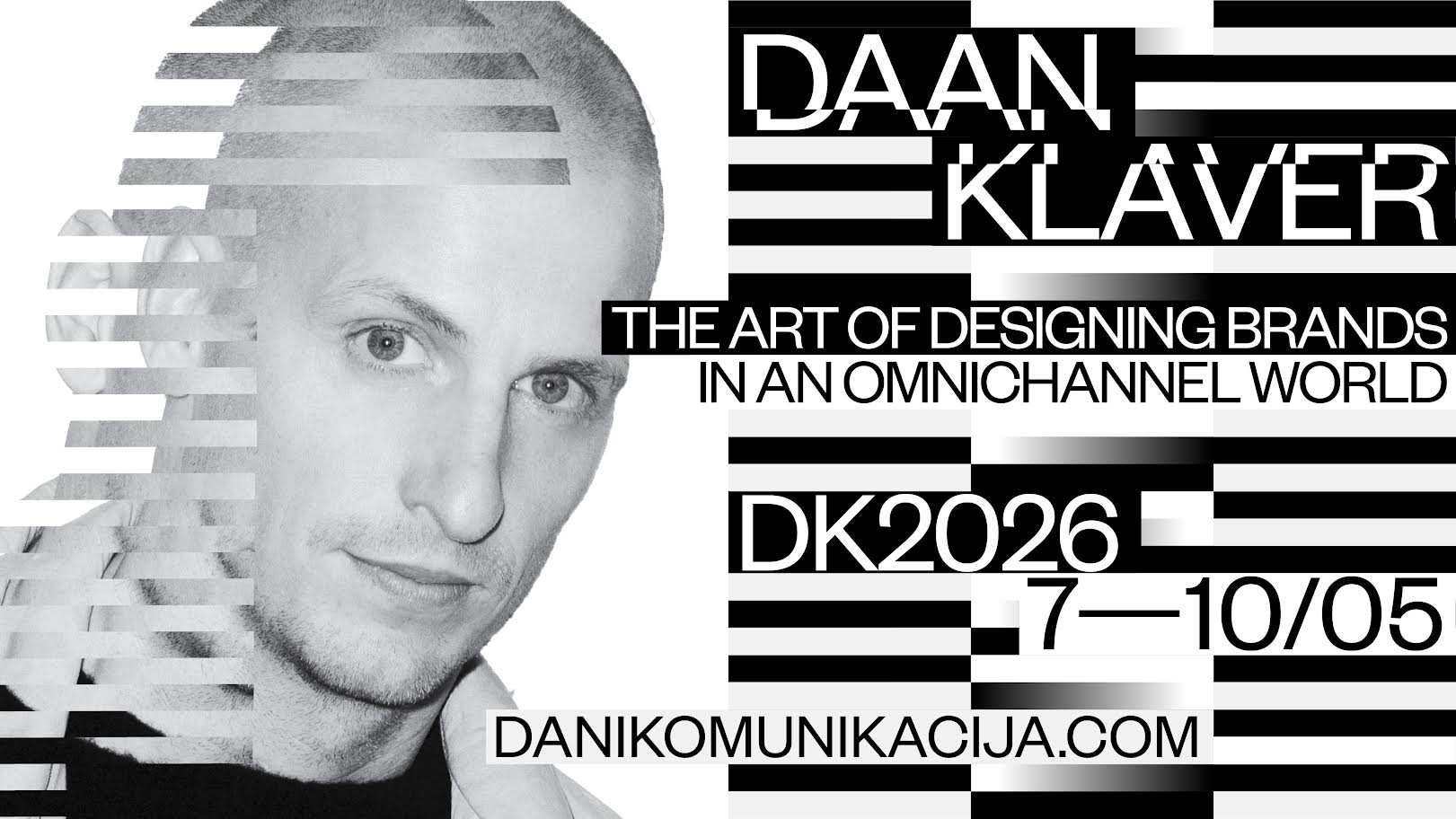
As brands increasingly invest in platforms they do not control, the question of digital ownership is becoming one of the more important strategic issues in modern marketing. Daan Klaver, co-founder and creative director of Build in Amsterdam, has for years advocated through the concept of the digital flagship for the web as the central space where a brand builds identity, emotion, and conversion without compromise.
At this year’s Dani Komunikacija, Klaver brings a perspective that is becoming increasingly relevant as brands continue to invest more heavily in external platforms, algorithms, and short-term reach, while simultaneously losing control over their own identity. His talk raises the question of how design, strategy, and technology can function together not only as a conversion tool, but as a system for building lasting competitive advantage.
Ahead of Rovinj, we spoke about the real power dynamics within the omnichannel environment, the role of emotion in digital purchasing, the balance between data and creativity, and how to preserve design integrity at a time when e-commerce is becoming increasingly shaped by global performance-driven structures.
You have said that a brand’s website is the only territory it truly owns, and that everything else is foreplay in someone else’s space. That is a fairly brutal summary of what omnichannel actually means in power terms. If that is the honest structural reality, how should a brand think about where to invest design energy, and where it is essentially renting attention, it can never convert into something lasting?
All touch points matter of course. Consumers stand in-store, check the dot-com, and compare prices on marketplaces. That means the shopping journey has gotten more complex. The average shopper interacts with nearly six touchpoints before making a purchase, up from two, just fifteen years ago. They move fluidly between channels before committing, and the brand’s website is almost always part of that path.
Each channel plays a role. But none of them are built for brand ownership. That’s why we see the dot-com sits at the centre of the commerce ecosystem. It’s the only place where a brand can fully control its narrative, structure its data, and design its experience without compromise. The digital flagship, as we call it, lives at the intersection of two forces that most brands treat as separate problems.
Emotion builds desire. It creates meaning, aspiration, and the cultural relevance that makes a brand worth choosing. Logic drives conversion. It structures the journey, removes friction, and enables action, making the brand worth buying. Most digital environments are built for one or the other. Marketplaces optimize for logic. Brand campaigns optimize for emotion. The flagship is the only environment where both have to work at the same time.
Build in Amsterdam was founded on a specific observation: that design agencies lacked technical depth and development agencies lacked design sensibility, and that the market was paying for that gap in lost brand experience. That gap still exists in most regional markets. Beyond the obvious answer of hiring across both disciplines, what conditions are actually required to close it?
We bring brand strategy, design, and development together under one roof, but more importantly, we integrate them from the very start. Every project begins with a clear strategic foundation that guides all creative and technical decisions that follow.
In practice, that means our teams work side by side, not in silos. Designers and developers collaborate closely throughout the process, constantly influencing each other’s work rather than handing things off.
But the real key is in our team’s DNA. Our strategists have a strong creative instinct. Our creatives understand both strategy and technology. And our developers have a deep appreciation for design, many of them even started their careers on the creative side.
That overlap is what makes the difference. It’s not just about having all disciplines present. It’s about having people who can think beyond their own. That’s how you truly close the gap and what enabled us to set the industry benchmark for over a decade.
You have described emotion as the driver of purchasing decisions online, a conviction you have held against the industry’s sustained movement toward behavioral optimization and conversion metrics. How do you construct a coherent internal argument for emotion-led design when the primary language of your clients is data?
It starts with a simple truth: when people love a brand, they choose that brand. Especially in the premium and lifestyle space, purchasing decisions are rarely purely rational. They’re driven by meaning, aspiration, and emotional connection.
We absolutely take data seriously. It’s essential. But data tends to optimize for what already exists, like incremental gains, short-term conversion. Emotion is what creates differentiation and long-term preference. Without it, brands may become efficient, but they also become interchangeable.
So internally, we don’t position emotion and data as opposites. We see them as complementary forces. Emotion creates the desire; data helps us refine and validate how that desire converts.
That’s where we focus: designing experiences that feel distinctive and resonate on a human level, while ensuring they perform. In our work, emotional design isn’t at odds with conversion, it’s often what drives it.
The acquisition of Build in Amsterdam by Front Row in 2025 brought a significant structural change, from independent creative agency to part of a global e-commerce accelerator. That kind of integration changes the conditions under which design decisions are made. What is preserved, and what becomes more difficult to protect?
The biggest shift is that we now have a much broader set of capabilities around us. With Front Row, we’re supported by data analysts and e-commerce specialists who allow us to validate and strengthen our design thinking with real performance data. That enables us to work with larger, more complex global clients without compromising the design quality we’re known for.
It also expands our scope. We’re no longer focused solely on the digital flagship, but can support brands across their entire commerce ecosystem, from direct-to-consumer to marketplaces like Amazon, where our New York team plays a key role as a growth accelerator.
Because we design modularly, using scalable systems, our work can now extend consistently across all those touchpoints. That adds significant value: one coherent brand experience, everywhere the brand shows up.
What we’re careful to preserve is our perspective. Our role has always been to lead with brand and experience, not just optimize for performance. In a more data-driven environment, the risk is that everything becomes incremental.
So the balance is key. We use the added data and capabilities to inform and scale what we do, but we protect the creative ambition and brand thinking that make the work distinctive in the first place.

