

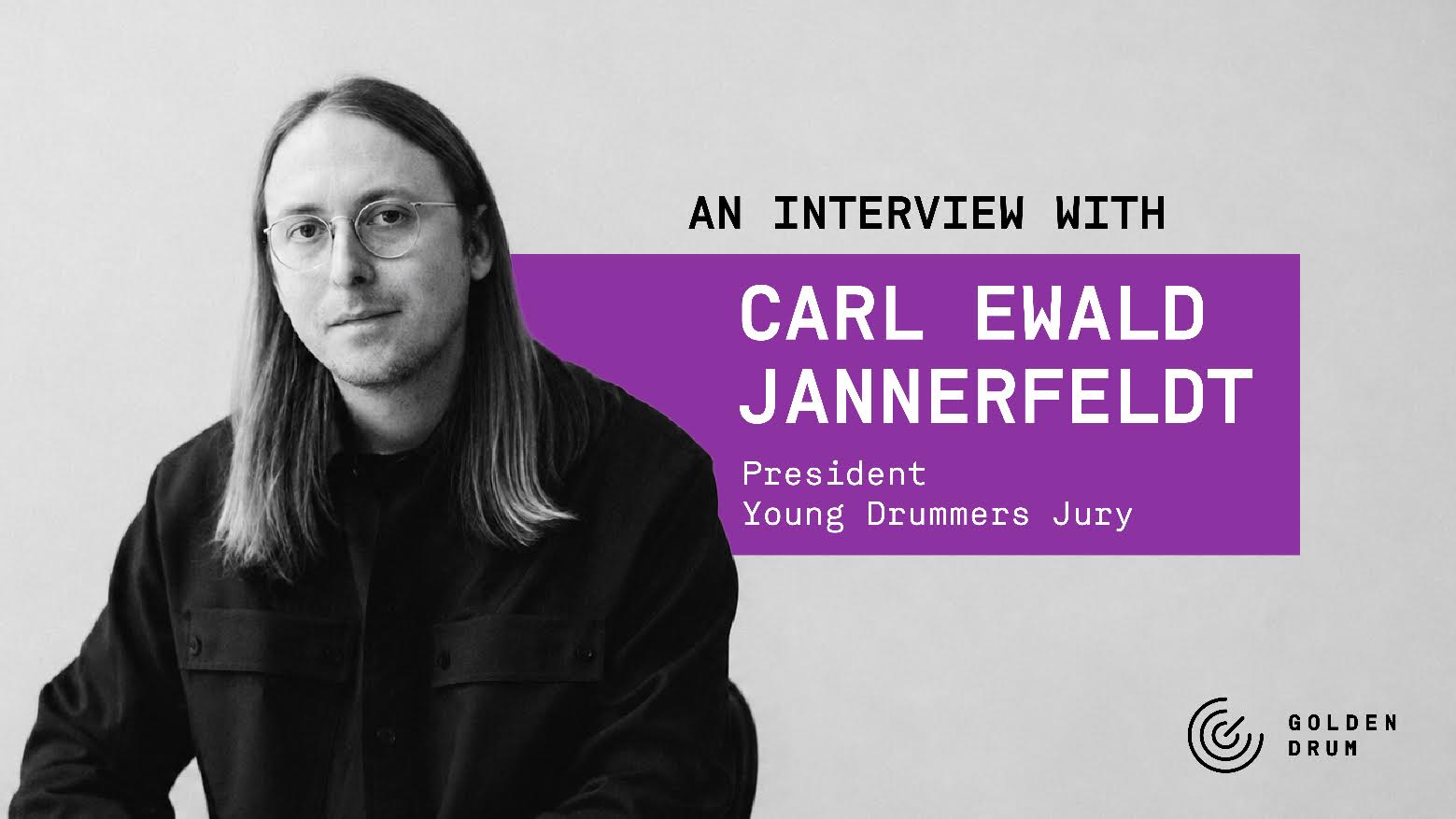
Making creative work has never been easier – but getting people to notice it has never been harder. As AI accelerates production and competition for attention intensifies, Carl Ewald Jannerfeldt believes the real advantage lies elsewhere: in taste, curiosity, a distinctive point of view and the courage to create work that refuses to blend in.
As Creative Director and founder of Rocket—Science, President of this year’s Young Drummers Competition Jury and one of the featured speakers at Golden Drum 2026, Jannerfeldt brings a perspective shaped by an international career spanning BBDO New York, Wieden+Kennedy, R/GA and some of the industry’s most recognised creative work. In this exclusive interview, he discusses what the next generation needs to succeed, why bold creativity is a business imperative rather than a risk, and how creative leaders can make a stronger case for creativity where it matters most – in the boardroom.
You described Young Drummers as a platform for discovering “new energy, new bravery, and new ways of thinking.” What does creative bravery look like in 2026?
It used to be that bravery could hide in craft — a weird typeface, a clever film technique. In 2026, when anyone can produce anything in an afternoon, the only scarce resource left is nerve. Bravery is having an actual point of view and accepting that some people won’t like it. The best work makes the room slightly uncomfortable for ten seconds before it moves you. If everyone’s instantly relaxed, you’ve made wallpaper.
Having worked at agencies such as BBDO New York, Wieden+Kennedy, R/GA and now Rocket—Science, what advice would you give young creatives trying to stand out in an increasingly competitive industry?
Most portfolios today are polished, competent, and identical. So my advice is: don’t compete on polish — compete on insight. The best ideas come from spotting the small, true things about how people actually behave that everyone else walks past. I’m a firm believer those discoveries come from having obsessions outside advertising — strange books, unfashionable niche interests, people, history, science, whatever it is you can’t stop caring about. Then — and I can’t stress this enough — bring stuff over the finish line. Talent gets you into the room; getting stuff shipped gets you invited back.
Do you think today’s young creatives are facing greater opportunities or greater challenges than previous generations?
Both — and they’re the same thing. Making has never been easier; attention has never been harder. Previous generations competed with the agency across the street — this one competes with everyone on earth who owns a smartphone. But the flip side: today a tiny team with no famous address can win at Cannes or D&AD in its first year. What used to take a building and forty people now takes an idea and some stubbornness.
You’ve built your career across different agencies, markets, and disciplines. If you were advising a young creative entering the industry today, what skills, or mindsets would you prioritize to remain relevant in an increasingly automated world?
Taste, writing, and curiosity — in that order. Taste, because when machines generate a hundred options, the job becomes choosing well. Writing, because writing is thinking made visible, and clear thinkers will run this industry whatever the tools become. Curiosity, because AI is trained on everything that already exists, which makes it magnificent at producing stuff we’ve already seen. As a creative, your entire value is deviation from the average, so protect whatever makes you a strange, specific person. That can’t be automated.
Many marketers still struggle to connect bold creative work with commercial performance. In your experience, what are the strongest indicators that a creative idea is likely to drive business results rather than just generate attention?
As much as it sounds like a cliché, it’s absolutely true: the most expensive mistake in marketing is looking — and acting — like your competition. Many marketers believe they need to resemble the rest of the category to be taken seriously. But blending in means spending your budget building somebody else’s fame. Boldness and memorability aren’t decoration, and they aren’t vanity — they’re business-critical. A campaign people remember keeps selling long after the media stops running.
In your experience, what is the biggest mistake organizations make when trying to balance creative ambition with commercial objectives?
Treating them as opposites — as if creative is the risk and safe is safe. It’s backwards. Like I mentioned before, the most expensive ad ever made is the one nobody notices, and it’s almost always the one everyone in the room agreed on. Invisibility is the real financial risk; there’s just no line item called “money spent being ignored.” The other mistake is committee sandpaper: approving a brave idea, then smoothing it through fourteen reviews until the reason it worked has been politely removed.
How can creative leaders better demonstrate the value of creativity in boardroom conversations that are primarily focused on revenue, growth, and ROI?
My honest advice? Use jealousy. It’s the most reliable persuasion tool ever invented — it works on juries, and it works even better on boards. Every board is envious of somebody: the competitor whose campaign got quoted at the conference, the brand their kids actually talk about, the company that keeps showing up in their own strategy deck. Find that brand. Show what its bravery is buying — the fame, the pricing power, the talent — and let human nature handle the rest.
Secure your delegate pass and step into the world of bold thinking, fresh perspectives and creative inspiration at Golden Drum 2026. Submit your boldest work to the Golden Drum Competition and let your creativity make its mark. Calling all creatives under 30: take on the Young Drummers Competition and give your ideas the stage they deserve. See the full brief and submit by 9 September.

