

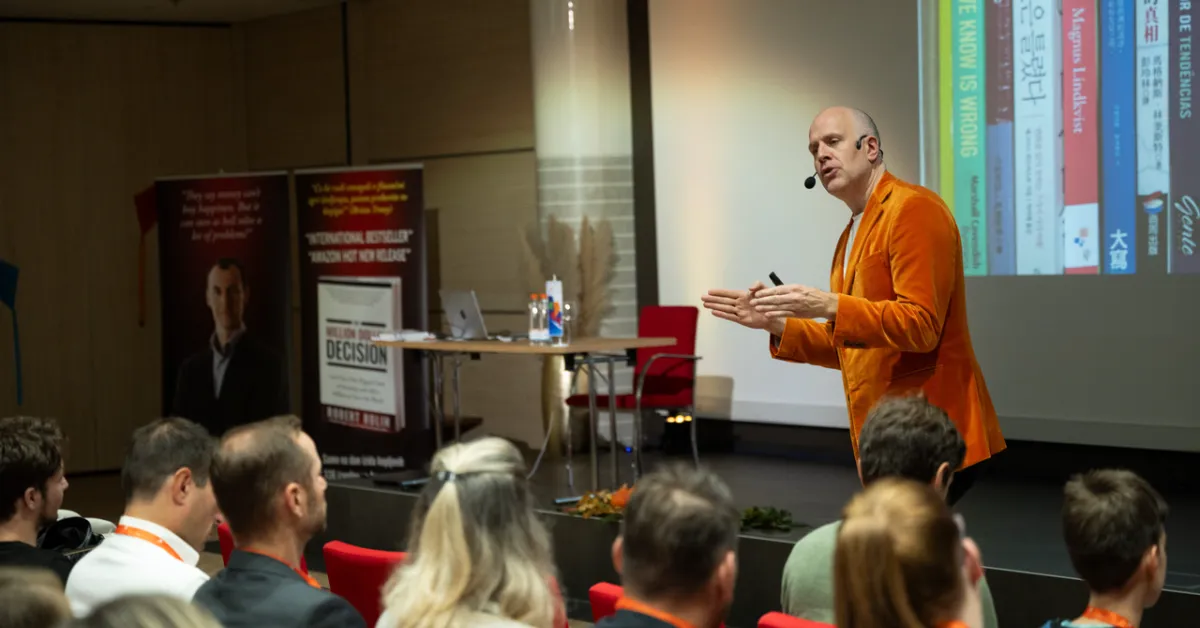
“Dear Magnus, Google says this about you: “a futurologist and a trend-setter.” Did you just know that you know things or did people start calling you this and you simply embraced it yourself?
Magnus Lindkvist: It’s a great question! As I say in my talks, we become in life what we don’t fail at!
I actually started calling myself a futurist in the early 2000s, because I was interested in the idea of the future. And then somebody said, you know, the futurists were kind of fascist Italian poets in the 1920s.
And because I’m neither a fascist nor a dead Italian, I thought, ah! And then there was a gentleman at the British Telecom who had the title futurologist and I was like it’s the closest. So these labels are by chance, by accident, by failure and for 20 years they have fueled my career and my speaking engagements.
The second word is trendsetter! Well, actually it’s trend-spotter! As a trendsetter, you’d have to be really good and cool, which I’m obviously not. A trend-sporter is interested in what are people considering interesting, what are impactful ideas, and I’m interested in mega trends, long-term shifts.
Lenja Faraguna: What is your latest “futurologistic and trend-spotting baby” that you are super proud of?
Magnus Lindkvist: Well, it depends. I mean there have been so many ideas! I’m a DJ of ideas so I usually don’t invent but I sample and I use it to make new stories.
Magnus Lindkvist: In early 2009 I started talking about a very useful word, which is infobesity. People are well informed, but their brain is full of junk food. I didn’t come up with that term, but I talked about it, so I was often credited with it. I believe in 2010, it became word of the year in the world. You know that was 14 years ago. So, I obviously need to focus on the next “baby”, to come up with new good ideas (laughter).
Lenja Faraguna: “The gene of trying things out, going into the unknown has died out”, you say. Tell us more what you believe is so sexy about the comfort zone for so many people and how come that even when the comfort zone is uncomfortable, they stay in.
Magnus Lindkvist: Yeah, that’s a great question – I mean we are comfort seeking animals! We want to preserve energy.
And at the same time one of the strongest forces in the universe is also denial – it’s why we stay in a shitty marriage for too long even though we should give up, or why it’s hard to start a diet regiment to lose weight. We keep denying it, we keep saying, “Oh, it’s fine!” or “It’s going to be OK.” It’s easier to put problems under the carpet.
Denial is the spell that has to be broken. It’s not comfortable. It’s not the comfort zone – the place where you don’t have to go into an uncertainty and the unknown.
I mean we don’t have the energy to go on an adventure every day, we like rituals,
we like normalcy. So, yeah, being aware that denial is such a strong and often invisible force in our life is important.
I think we are fundamentally, as humans, not rewarded for taking risks, going out into the unknown.
What I would maybe say is that I think there’s a sense of unease in society today. We have seen recessions and pandemics and war.
So, I think the feeling of danger is greater today. I mean 20 years ago nobody wanted to live a normal life; nobody wanted a steady boring job. Today I meet a lot of people who dream of having a steady paying boring job, of having a normal life. So maybe that’s part of it too, the fact that the world around us has become a little bit more dangerous.
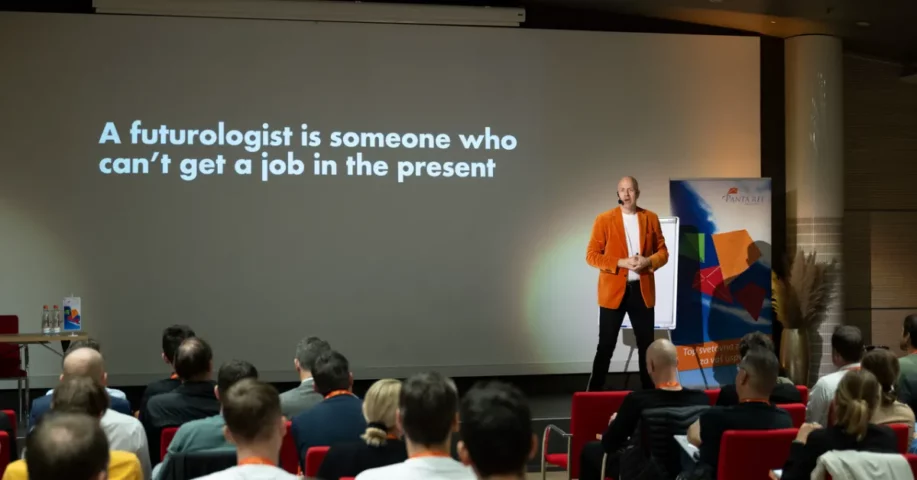
Lernja Faraguna: How do you leave your comfort zone?
Magnus Lindkvist: I’m not sure I do. I mean, I’m a 50-year-old, white, middle-aged man. My dad used to say it’s very difficult to live something different than a normal ordinary life and I find with age I’ve become more and more of a cliche so maybe I need to remind myself to do that.
Let me give you an example: Being a speaker constantly on tours it’s a very bad idea if you want to have a functioning marriage. My wife and I got divorced five years ago but then we cancelled the divorce and stuck together.
Did I retreat back into the comfort zone or was the divorced life going to be a comfort zone?
I don’t know. I’m happy that we stuck together but did I miss out on a more adventurous life?
I find the most interesting journeys are the ones you take in your mind. There are lots of places you can go in the world and books you can read. But ultimately, it’s all about mind change and thoughts.
I went to psychoanalysis, which I can wholly recommend. Old school Freudian psychoanalytical work. It taught me to be unafraid of the mind shaft, the human soul which is deep, dark, mysterious.
It taught me to at least be unafraid of it even when I don’t enjoy exploring it.
I think the default voice for many of us is negativity in our inner voices. It’s like you’re not good enough, you’re poor, you’re not this, you’re not that, you’re too this, you’re too little that.
Lanja Faraguna: So, you always have to break the negative spell first or at least accept it and try to work around it.
Magnus Lindkvist: Yeah, I mean, I think the permissive voice is important. The one who tells you, “Yeah, okay, so this is what you’re feeling.” I mean, I, for a long time, I had a problem with the evil in me. I was very unforgiving of the evil sides of my spirit and thoughts.
To the point of, like, thinking of ending my life, which is, of course, would be a phenomenal waste for anybody to do that. And eventually I realized “hold on, I don’t want to die I’m just angry or afraid!” That’s different! As long as you have some kind of intensity in your emotions, there’s hope!”
Some of these emotions are bound to be unpleasant. Some of them are going to be positive, but I think for me, it’s often wrestling with that the loudest voice, trying to find a voice of acceptance and then find clarity and adventure inside and outside.
What is your approach to people when you see them lurking in the muddy waters of comfort and the predictable?
Magnus Lindkvist: I love these questions.
I’m a miserable git sometimes who thinks very bitter and cynical thoughts my com-patriots and their choices but it’s a bad idea to judge on the surface. We tend to be very surprised as soon as we start to engage with people, look at them deeper.
One of the toughest places for me to be is in a queue at the airport I usually want to kill other people when I’m queuing up an airport, it’s very hard to me to keep my mental sanity there. So, I try to remind myself the power of gratitude, be happy that I get to do this, that I get to be here, that I get to be me, that I’m in hopefully good health.
Yeah, so that’s why I don’t like to judge whatever the choices people make.
I try to refrain from judgment. Not always succeeding, but I try.
Lenja Faraguna: What are three biggest changes in your life where you were scared and brave at the same time and went for it?
Magnus Lindkvist: Well, I left my speaking profession in the pandemic to study at the police academy – yeah that was brave! Then I left the police academy to go back to speaking that was probably also brave but maybe less so.
We were going to get a divorce and I wanted to escape the problems but I decided to face my demons and repair things.
Thirdly I have a son who is on the autism spectrum and he had epilepsy growing up and so on and that was always scary and frightening. It forced me and my wife to be brave parents. It taught us maybe what bravery is too.
Bravery is being aware of the risks, being aware of the pain, feeling the fear, but then like… Is this being brave or being responsible? When it comes to the child, it’s a responsibility but that doesn’t necessarily help us you know.
I think tyranny is feeling that there are only musts and no choices but if you give yourself a choice, then you can take the responsibility needed sometimes.
I mean, I’m not really religious, but I’m a big fan of the scene in the Bible where the devil tempts Jesus and says, “You don’t have to suffer. I’ll end it for you right now and sense a snake forward. Just let the snake bite you and it will all be over.”
And Jesus decides to kill the snake and face torture, crucifixion and so on – that’s responsibility! That’s facing the pain and it’s a level of bravery and courage that I’m not sure I have in me.
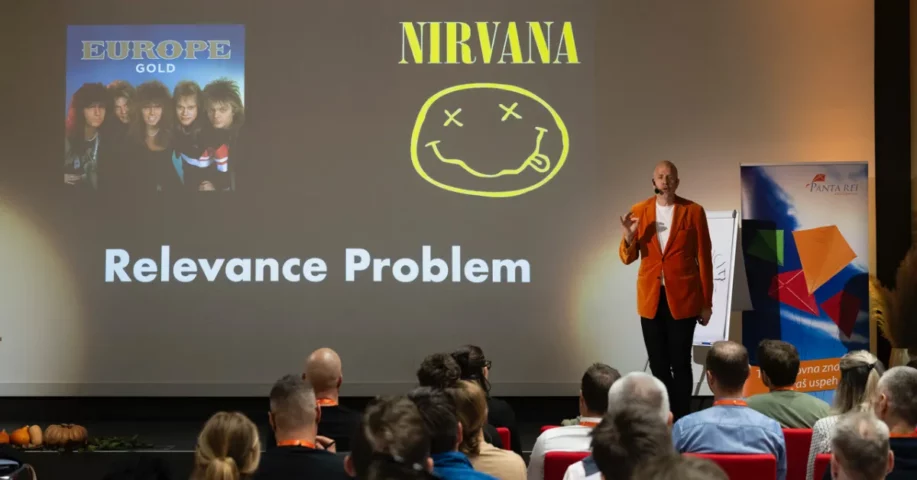
Lenja Faraguna: If you were given a billboard for the whole world to see, what seven words would you write on it?
Magnus Lindkvist: I would only write three words. They would be words from Warren Zevon, the late rock star who was dying of cancer and he was asked what advice would you give us and he said: “Enjoy every sandwich!”
I still think about that almost every day! Every time I have a sandwich, I’m like “you know this is just about enjoying the bite out of this ham and cheese sandwich.”
Lenja Faraguna: What is your definition of creativity?
Magnus Lindkvist: It depends. I like to use the word creation because I find creativity has become a cliche. You have posted notes in a workshop or you have some red wine and you try to come up with ideas and the ideas tend to be fairly bad because they are safe. And there is no commitment.
Creation is the ability to bring new ideas into this world, things not from this world, to bring something previously unknown and mysterious. We tend to be censored if we do.
Famous example, Ignaz Semmelweis had the idea of hygiene and washing your hands. Famously he got hated and spat in the face by the medical establishment in Austria-Hungary and he ended up dying lonely in an Austrian mental asylum. Yet he was right. His ideas about hygiene were correct.
Creation is courageous, it’s difficult, it tends to be a very bad idea in the short run.
If we are hoping to live in a different world, we need creators and we need to protect our creators and we need to reward them even, and especially if they fail. That’s what I would say.
Lenja Faraguna: What or who inspires you and makes you think?
Magnus Lindkvist: Me, alone after one beer tends to be an inspirational person. Myself alone after three beers tends to be a very depressive person.
Inspiration is always where you find it.
If you want to talk about some individuals that changed my mind, I like a historian called Neil Ferguson. I find him very interesting to listen to.
I’m also inspired by clarity of thought of the autistic entrepreneur, Peter Thiel.
So yeah, inspiration is where you find it.
I always find that when information is mixed with your own brain, that’s when you come up, you see something, a remix, a misunderstanding. You know, there’s something uniquely happening in that. I often find the most interesting ideas when I’m busy doing other things. So, you have a lot of input, you read, you see things, you overhear things, then it marinates in your head yeah and then something new can get born!
Lenja Faraguna: Are there specific conditions you create for yourself to go into creative mode or you wait for it just to come?
Magnus Lindkvist: Yeah, I mean it usually happens when there is a deadline. So, Panta rei academy asked me to speak for two 90 minute sessions! I normally speak for 45 minutes. It was a “deadline”, I had to come up and bring in new stuff so that that’s helpful for my creativity!
I like to read a lot but I’m not so good at reading complex stuff. I like reading Yulal Noah Harari’s new book, Nexus, about information in AI. I really like his writing style.
I like to write, but I’m not sure I’m particularly good at it.
Conditions, like I said, a little bit of alcohol, micro dosage of alcohol is good.
There’s a great quote actually I think it was Kevin Hart the comedian: “Comedians make their money night clubs in the evening telling jokes but he said no no no, I make my money during the day, I collect it in the club at night!”
I think that’s a great perspective – I make my money when I read, when I write what I think and then I collect it at my speaking gigs.
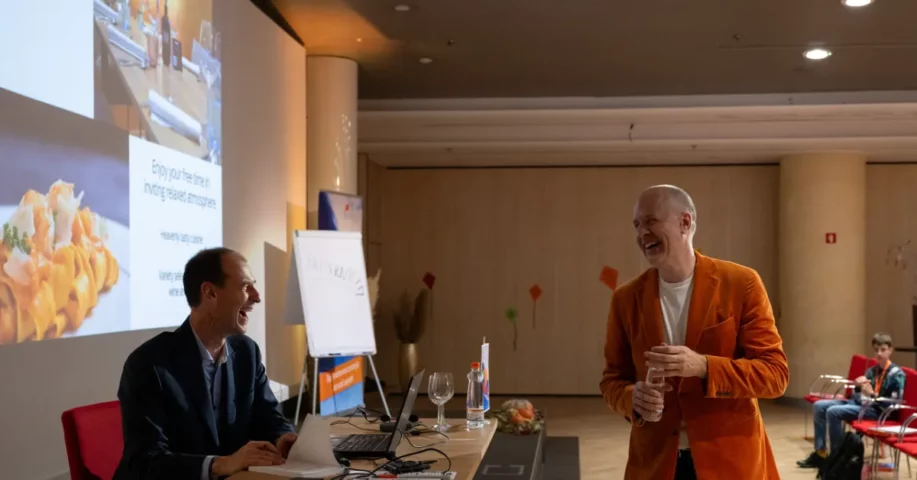
Lenja Faraguna: If you have ever been called too crazy, too fast, too futuristic, how do you deal with the potential clients who simply don’t get it?
Magnus Lindkvist: They say “you’re an idiot and we’re not going to pay you”.
Lenja Faraguna: Really? Does it still happen even when you’ve been doing this for 20 years?
Magnus Lindkvist: Yeah, less now. I mean, being a speaker is a lot like being a pilot. You have to learn if the engine stops working, or if there’s too much fog, or you’re running out of fuel. You still need to fly.
You learn from fuck ups.
I mean, I had a Danish client who really hated what I did. I mean, I showed up, I did the work and the next day I got a really long email (and you know you can tell by the amount of text this is not going to be a nice read). Yeah, it hit me hard for a year. I think the pain is gone now.
I think the answer is you suffer through it. The problem in my line of work is that the customer is always right even when they are wrong. If you’re some kind of really cool person, like Michel Wellbeck, he’s a very controversial French author – but I don’t have the strength and stamina to speak truth to power.
I’m not really brave enough to make enemies. I tend to say I’m sorry and suffer and I don’t gloat.
I mean a lot of my friends were like, “but maybe you were just too good for the Danes, maybe you were right.” I didn’t help me. I don’t like the feeling of people not liking me when I do my professional work.
Lenja Faraguna: How do you know that a client is a perfect match for you?
Magnus Lindkvist: I mean sometimes you feel that in advance, your head is already buzzing, you feel in your soul that this is going to go well. Sometimes you’re like, “This will be a challenge.”
This feeling is something what artificial intelligence won’t be able to do.
I think Nick Cave, pop star, the singer said it well. I mean, AI has been nowhere.
It has endured nothing. It has no intentions.
And what we value in art is intentions.
What did they want to say?
Why did she create this?
Where we have to understand the meaning.
I mean, when you charge the amount of money that I do for a keynote, it has to be very good. It’s like being a three-star Micheline restaurant. It has to be very good. It’s hard to be the best because that comes down to subjective thoughts! There are many good speakers in the world and it’s like music right – if you like Radiohead maybe you will not like Coldplay, if you like Coldplay maybe you will not like Taylor Swift but it has to be good.
Lenja Faraguna: What are your top three messages for the Balkan countries?
Well, like Sweden, Slovenia for example is a small and meaningless country. Go out, go outside of Slovenia, Croatia, Serbia, Bosnia and Hercegovina, Macedonia, Montenegro, make things that resonate outside of these countries. Think less about your country.
I mean, small, meaningless countries, they could disappear. Most people would not care. Sweden, Slovenia, Switzerland, Singapore, all these small places, that’s what they’ve been good at.
Think about how can I make somebody happy in Kansas?
How could I make somebody in Kazakhstan like what I do?
Look over the borders.
I think U2 has a song called “Get Out of Your Own Way”, I think that’s good.
Be an optimist in that most things have not been invented or written and a lot of things come from small and meaningless places.
Some of the best music is made by people who were born in the middle of nowhere.
Prague has become better than Hollywood at making movies. Spotify came from Sweden!
I mean if it’s small doesn’t mean it’s a NO and even when it’s small and boring good things can happen.
Lenja Faraguna: What question would you like to answer but no one has asked you yet?
Magnus Lindkvist: I think, how did I push through in my 20s?
That for me were very difficult years. I felt like a failure, I was alone, I was confused, I was lost. Nobody’s ever asked because you don’t see that right? I’m a 2m tall, loud man! I don’t expect and I don’t want charity, but I’ve never been asked that because people don’t know it because I haven’t talked about it.
My twenties were extremely turbulent. I mean, I was going in and out of relationships. I was in Sweden but I dreamt of living elsewhere. I thought that happiness lived elsewhere!
When I was lost in the darkness, I decided that I will make something on my own because nobody will come and save me. I have to pull myself out of this and I made my own profession! I think when people started to recognize it as something good and useful it calmed my inner voice!
I would love to give a moralistic answer, I mean you talked about the virtue of kindness; we talked about forgiving but I unfortunately have to say here that success became important to me. It became money and it became too much sometimes.
I told you about the fuck up in Denmark – I think one of the reasons that was so painful is that I’d become reliant on success! These days I would like to say I’m not as reliant on success, I am more comfortable with being a nobody but maybe I’m lying when I say that!
Part of the pain in the past year was that spring was very slow and I thought “I’m a wash-up, it’s finished, it’s over!”, so probably I still need to learn to not be so reliant on success yeah.
Lenja Faraguna: What have you learned about yourself in the last year?
Magnus Lindkvist: That I’m stronger than I thought! Two years ago, my dad died from a very quick, rapid cancer. It was a horrible time. Well, it’s part of life, but it was about three months he went from being really,
really healthy to being also a little bit almost like demented. His brain was not functioning properly. He could still walk and so on, but it was weird. I had to help my mom out to put our life together.
Then I became very angry with my youngest brother who I felt did not take responsibility because we grew in different ways. That didn’t help me at the time. I put on weight. I felt lost lonely and then I started online therapy with betterhelp.com.
I really liked their slogan “you deserve to be happy”. I know it’s American and cliched, but I liked it. It resonated with me. And now, like I said, I’ve been into lots of different kinds of therapy. Freudian, Jungian.
But for some reason, maybe because I’m now 50 and ready to make amends, you know, the sessions were magical. I had a therapist, her name is Carol, British therapist.
Maybe because I’ve done so much work in the past, finally it made sense, finally it was constructive and I also, it was all online and I didn’t even use video phone, I only used voice. Okay. So, then it could be my time, I went to sit in the car sometimes in the afternoon and our session would begin, it was only voice, like she was a voice inside my head and it was so useful.
I learned to accept success and to be proud of what I’ve accomplished and to accept the uncertainty in my profession and to be forgiving. So last year has been a big learning journey for sure.
Lenja Faraguna: What excites you the most in life at this moment?
Magnus Lindkvist: I’m 50. I sometimes long for simplicity and kindness but it’s exciting – it’s an adventure for sure!
I know that I’m married to a very forceful strong career woman from Sarajevo, she’s a COO, she’s very independent and it’s hard sometimes.
What excites me, I mean, I’m on a second wind. I was building my company from 2003 to 2014, and then I got lost and depressed for a few years, and then everything collapsed with the pandemic, and I feel like I’m rebuilding it now. I’m much happier doing it this time around.
I actually am happier than I’ve been in a long time, maybe ever. I feel free here. I feel that all the hard work to become happy and free paid off for now. I will take more care to make sure I don’t destroy it again this time – that excites me.
Photo: J. Marolt

