

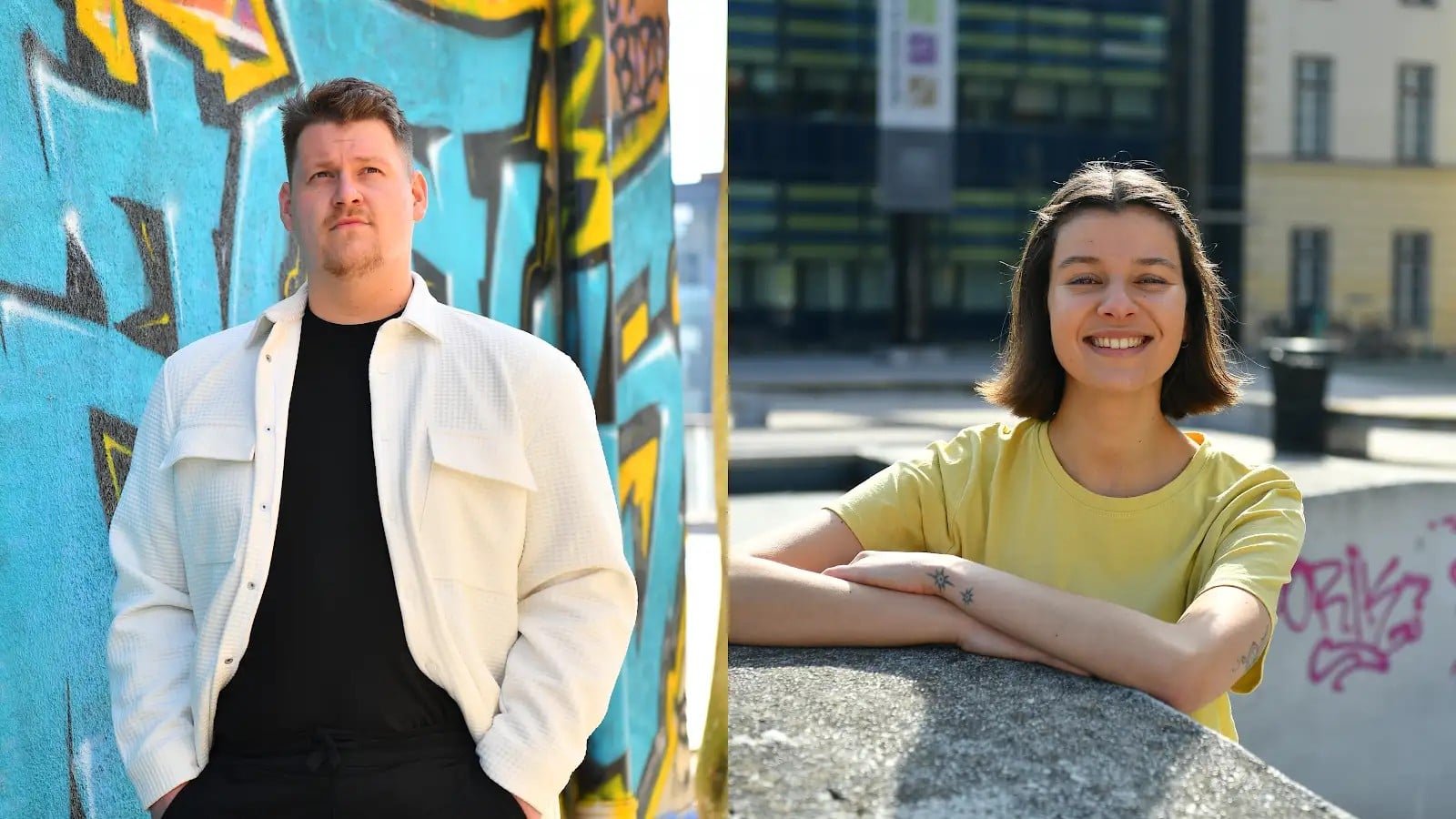
Young creatives Amber Škrabec and Gašper Potočnik will represent Slovenia this June at the global Young Lions competition, held as part of the Cannes Lions festival. They earned their place among the world’s best young creatives by winning the Slovenian edition of the competition, where they developed the idea “Direkt pred faksom” in just 24 hours for a new product by Zavarovalnica Triglav.
Their solution addressed the challenge of connecting the topic of insurance with a generation that is only beginning to enter the world of independent decision-making, while at the same time securing them a place among the teams that will test their creative abilities on one of the most prestigious global stages of the creative industry.
In an interview with Media Marketing, Amber and Gašper talk about what it is like to create under the pressure of a 24-hour deadline, what led them to their winning idea, how much agency culture influences the development of young talent, and how they see today’s Slovenian creative industry and the challenges awaiting the next generation of creatives from their own perspective.
Your winning idea, “Direkt pred faksom”, earned you a place at Cannes Lions. Can you present the concept and explain how it responded to the brief you received?
So first, the challenge. Zavarovalnica Triglav’s new product, Direkt car insurance, had to be introduced to young people aged 20 to 26, encouraging them to start managing their own insurance policies and fostering independence, while placing the communication within universities and faculties.
Our idea stemmed from the insight into the current problem of the lack of parking spaces in larger cities. That is why we designed a special parking spot positioned directly in front of faculties and universities. This would then be followed by a fun game in which only those who had purchased Direkt insurance could participate, competing every day for the parking space in front of their faculty and thereby earning the title of ParKING.
From the first reading of the brief to the final presentation, only 24 hours passed. What did that process look like, what were the key stages of the work, and how different was the final idea from the initial directions you considered?
A: The 24 hours passed very quickly. We started with brainstorming and a walk by the river. We gathered ideas and discussed all the connections to the brief. Before deciding to move forward with the parking idea, we took a break and gave our brains a short rest. Then came the idea development phase. The final phase went by too quickly. We submitted the solution just before the deadline.
G: The process had actually started before the competition itself. Amber and I had only been working together at the agency for three months at that point, so we still had to get to know each other a little better. After that, everything became easier. On the day of the competition, we devoted the first few hours to brainstorming, and once we had chosen our direction, we refined it down to the smallest detail. When we found out that we had made the shortlist, we quickly prepared the presentation, and that was it.
The idea of parking spaces was the first thing that came to my mind during the briefing itself. During the brainstorming phase, we explored several other potential directions, but we always returned to this one. So the final result was really just a refined version of that first thought.
Agency 101 has a tradition of winning this competition – 2020, 2023, and now 2026. Do you feel that this agency culture actively pushes young people towards challenges like these, or is it something you created for yourselves?
A: I would not have applied for the competition without the support of the agency and Gašper. I am happy that I had this opportunity, despite the fact that my career at the agency has only just begun.
G: The agency has an exceptionally talented team of young and motivated creatives, and there is definitely encouragement for us to showcase our talent. Every team member who achieves an exceptional success, such as this one, raises the bar and encourages others to try to push it even higher. That is how we motivate one another, and besides healthy competitive energy, there is also an extraordinary sense of connection and collegiality among us. More than the victory itself, we will remember our colleagues’ reactions, because some of them were moved to tears and genuinely happy about our success. So yes, the culture and the collective encourage achievements like this.
As a designer and a copywriter who are only just building your careers, how do you perceive the Slovenian creative industry today? Where do you see the greatest opportunities for young people, and where do barriers still exist that are difficult to overcome?
A: Slovenia certainly lacks more boldness in advertising. I would love to see more campaigns in which clients step outside of their comfort zones. I am very much looking forward to Cannes, where I will see “jaw-dropping” projects that win the world’s biggest awards firsthand.
G: If I am being completely honest, the Slovenian creative industry is currently somewhat asleep. It seems to me that we are too conservative. We lack playfulness. Above all, it seems to me that it is clients who lack playfulness and courage. I understand that the goal is usually to increase sales and that success is generally measured through ROAS, ROI and other KPIs. But sometimes you need to have the guts to create something truly noticeable. AND ABOVE ALL, THAT. We are too eager to please everyone. Great campaigns spark discussions. It is better for someone not to like something than for it to be generic and simply overlooked.
Therefore, we young people can contribute to this above all through boldness and persistence.
You are now heading to Cannes, where you will meet the best young creatives from around the world. What do you think will surprise you the most in Cannes – the brief itself, the competition, or the way other teams think?
A: I am looking forward to meeting the other creatives. I think that is exactly what will surprise me the most – how creatives think in other parts of the world, especially those from larger countries.
G: I think the entire Cannes Lions experience will surprise us. Above all, I hope that we will surprise ourselves at the competition and prove that we belong among the best creatives in the world.

