


Drive safely. Don’t speed. Rest if you’re tired. Let me know when you arrive. These are the sentences we say almost without thinking to the people we care about. They are short, familiar, and usually stay behind the closed doors of the car as soon as the journey begins. And then come the kilometers during which, if we could, we would most like to send that same concern along with them.
Ahead of the holiday period, when the number of trips and longer drives increases, INA once again wanted to talk about road safety. Speed, traffic, fatigue, and loss of concentration remain real problems, but traditional warnings have one limitation: we have heard them so many times that it is easy to register them only in passing. It was therefore necessary to find a message that would not simply pass the driver by, but would address them personally enough for them to truly hear it.
With the Better to Stop Than Fall Asleep campaign, Imago Ogilvy had already connected the issue of driver fatigue with music. With the help of technological tools, songs were created in different genres carrying a message about the need to rest, distributed according to the music drivers listen to, their location, proximity to INA rest stops, and the time of day. The new campaign retained what music had done well, but changed the perspective from which the message came.
Instead of having the brand once again tell the driver to be careful, the campaign started with the people who already tell them that before a trip. Parents, partners, friends, colleagues, and everyone else who sees someone off with the words “drive safely.” This meant that the target group was no longer only the people behind the wheel, but also those who want someone to reach their destination safely. The safety message thus gained an emotional value that a general warning can hardly have: it was no longer the same for everyone, but came from a person who knows the traveler and knows exactly who they are speaking to.

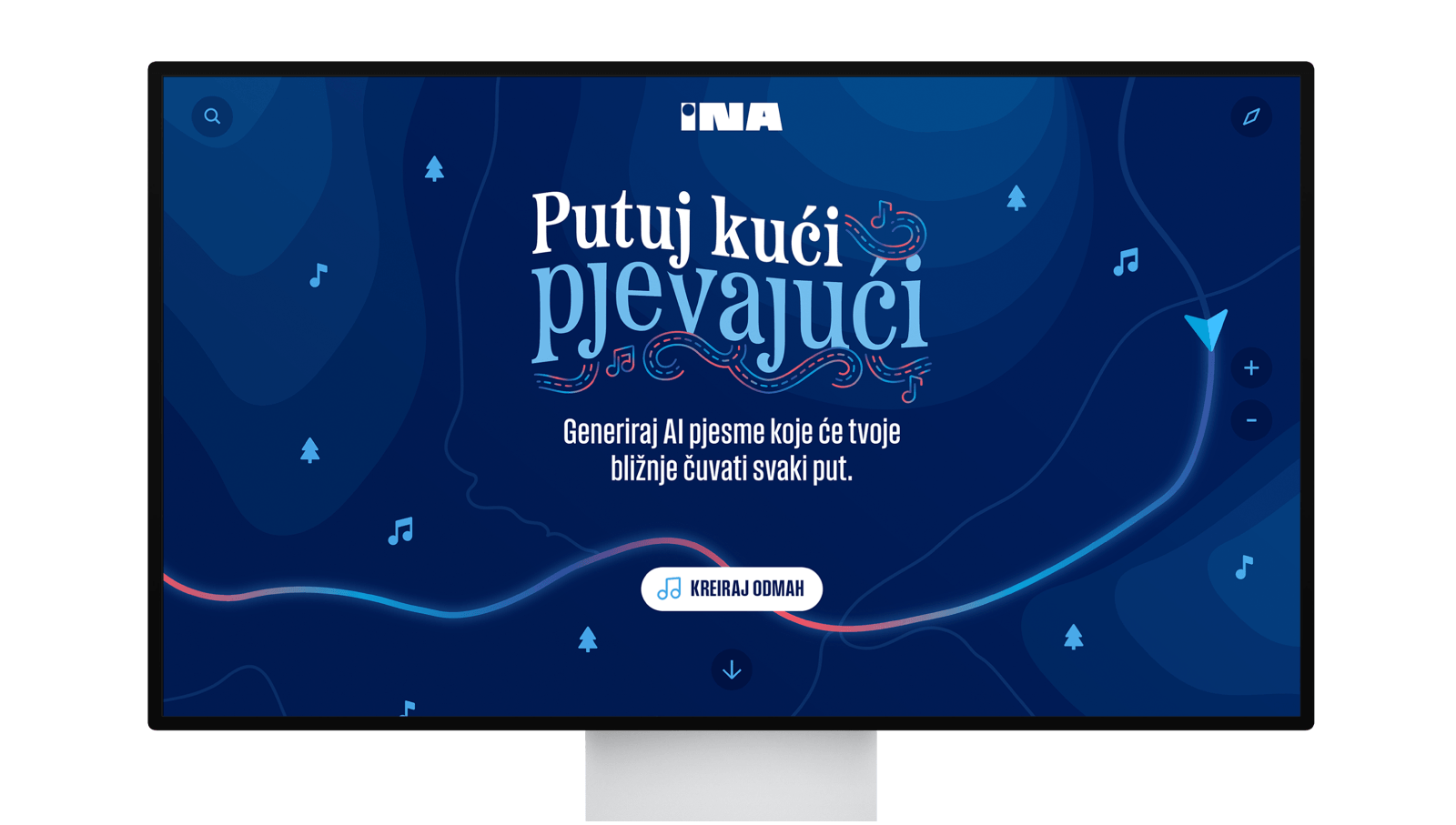
From one message to six songs
That idea gave rise to the Travel Home Singing campaign. The starting point was simple: if we already tell people to take care of themselves before a trip, can that message stay with them for longer than a few seconds?
Music was a natural answer because it already belongs to driving. We listen to it in the car, choose songs according to our mood, and remember them alongside particular journeys. Instead of another text message, users were therefore given the opportunity to create a playlist of six original songs for the person traveling.
On the platform, they entered the person’s name, destination, and details such as interests, preferences, or a personal characteristic. Based on that information, songs were created that addressed that specific person, mentioned their journey, and used the details entered by the sender. At the same time, they included messages about safe driving, rest, and the need to take a break at an INA rest stop during a longer journey. The safety message therefore did not stand separately at the end of the communication, but became part of the content the traveler could listen to while driving.
Technology was necessary for the idea to function for thousands of different people, but it did not determine the idea itself. The creative team defined the tone, the structure of the songs, the type of data users entered, the narrative, and the way the safety message was integrated into the content. AI made it possible to apply that system to a large number of individual combinations, while Drap developed the digital platform, integrated the technological solution, and connected the entire process from data entry to the generation and sharing of the finished playlist.
Behind the simple user experience was a fairly demanding production task. Each song had to use the entered details naturally, retain the same emotional tone, and at the same time include the message about safe driving, without making it feel as though it had been added afterward. The system also had to allow a large number of generations within a short period, while the creative freedom of the technology had to remain within the rules of the brand and safety communication.
The campaign did not remain only on screen
The platform was the central point of the campaign, but the rest of the communication was organized to bring the audience to it and show them what they could do with it. The hero video explained the basic idea, while influencers on Instagram and TikTok showed how the playlist was created and invited their followers to make one for someone who was traveling. INA’s social media channels supported the campaign, while paid formats on social media, YouTube, and the Google Display Network provided additional reach and visits to the platform.
One element connected the digital idea directly with behavior on the road. The campaign included a coffee coupon for INA locations, so the reminder to rest did not remain only part of the song. The user also received a concrete reason to stop, take a break, and continue the journey more rested.
Alongside INA, Imago Ogilvy and Drap, the campaign was carried out by Robson Media as the audio studio, Null studio on video animation, dentsu Croatia on media planning and buying, as well as influencers and INA PR.
The extent to which the audience embraced the idea is best shown by what they created themselves. A total of 27,778 playlists were created, 39% above the set KPI of 20,000, resulting in 166,668 personalized songs, also 39% above the target. The campaign also generated 20,723,597 impressions, or 22% more than the planned 17 million, as well as 8,451,043 video views, exceeding the KPI of 6.5 million by 30%.
The strength of the campaign lies in the fact that it moved a familiar safety message from the language of warnings into the language of relationships between people. “Drive safely” can hardly surprise someone who has heard it countless times. But the same concern, spoken in the voice of someone we care about and turned into a song that accompanies us on the road, takes on an entirely different meaning.
When the same warning comes through a name, a destination, details someone knows about us, and the music we listen to while driving, it no longer asks for attention in the same way. AI made the scale of personalization possible here, but it did not carry the campaign; what carried it was the very human fact that it is easier for us to hear a message when we know who is sending it and why. And for a brand that is physically present precisely in the places where a driver can stop, rest, and continue the journey, the idea did not end in communication but had a logical continuation on the road as well.

