

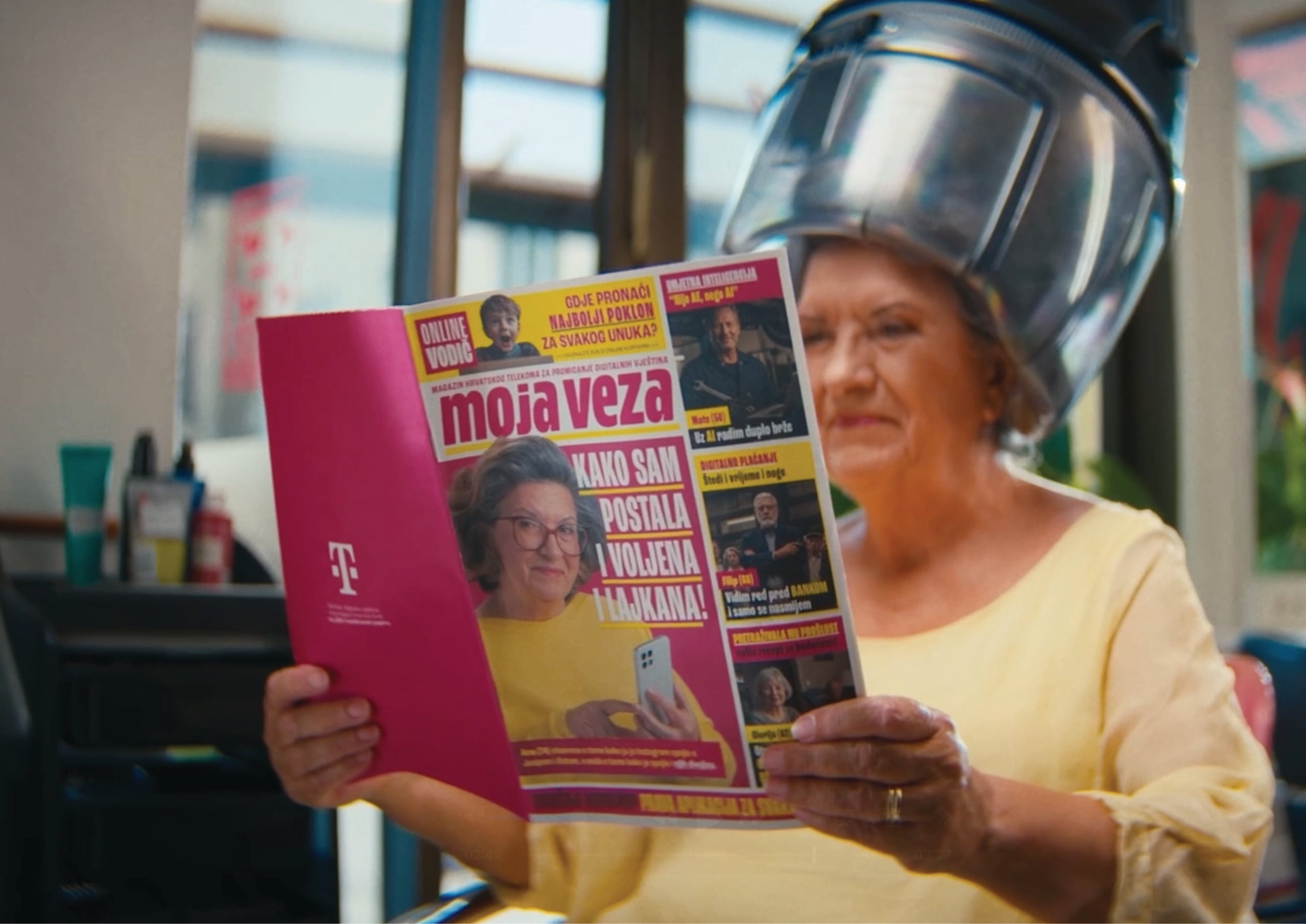
For someone who uses WhatsApp, mobile banking, QR codes or apps almost without thinking, it is difficult to imagine how one small digital action can become a major obstacle. Not because it is technically particularly demanding. A sense of uncertainty about what will happen if the wrong button is pressed, an unfamiliar link is opened or a step is taken that the user does not know how to undo can be enough.
In Croatia, a large number of older people have a mobile phone, internet access and access to digital services, but they do not always use them safely and independently. Unfamiliar terminology, a lack of confidence and the feeling that technology was made for someone else can be enough to make them give up on a simple task. The consequences are not only missed conveniences. It can mean greater exposure to scams or reliance on children and grandchildren for things users could, with a different kind of support, do themselves.
Hrvatski Telekom and Imago Ogilvy therefore started with a question that has little to do with technical specifications: how do you explain technology to people who do not want to feel as though they have gone back to the classroom?
The Moja veza project, developed with production and technology partners, found the answer in a place where digital education would almost certainly not be sought first: in a tabloid.
First a reason to read, only then a reason to learn
The key insight was simple. Older generations do not necessarily reject technology. Much more often, they reject the feeling that they have to admit they do not know something and sit down for a kind of “computer class”.
On the other hand, people do not need special motivation to read content that interests them. A romantic plot, family drama, shopping situation or unexpected twist already gives them a reason to turn the page. The team therefore changed the order.
Instead of first asking the audience to take an interest in digital education, it gave them content they would want to pay attention to. Technology comes later, as part of the situation the reader is already in. In other words, education is hidden inside the story.
That also determined the entire logic of the project. If the user never opens the content, a perfectly written tutorial does not mean much. The first problem Moja veza had to solve was therefore not how to simplify a technical explanation as much as possible, but how to earn a few minutes of attention.
Technology enters through the side door
Moja veza started from the problem of digital exclusion, but the education could not look like education. That is why the team chose a format the audience already intuitively understands: a tabloid. Romances, shopping, sport, horoscopes, dramatic headlines and clear sections provided a familiar framework for content that was actually teaching something completely new.

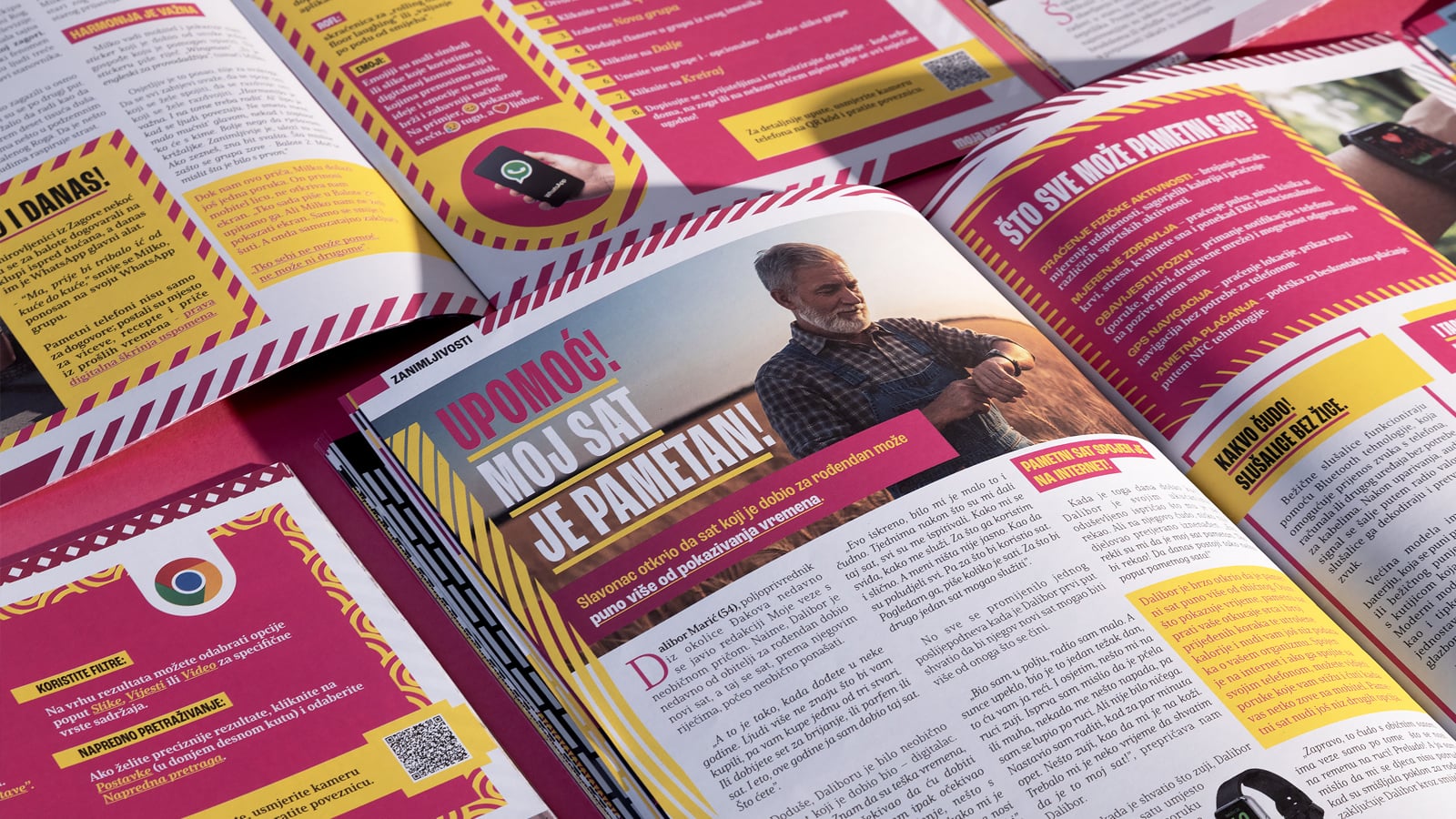
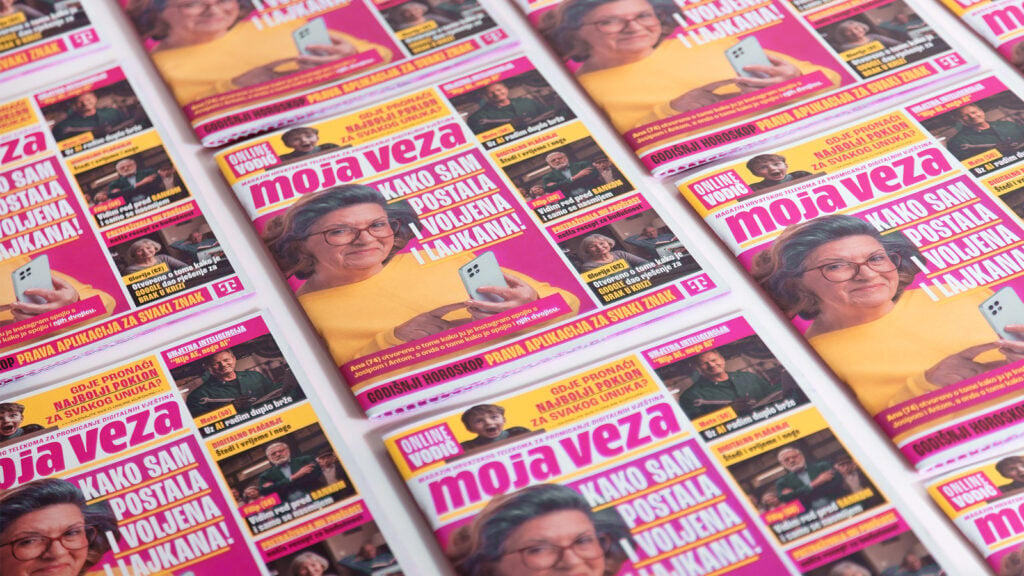
The name gained an additional function here. “Moja veza” sounds enough like the title of a familiar magazine, but the word veza can at the same time refer to a relationship between people, a phone connection or an internet connection. Combined with the word “moja”, the technology topic becomes personal: the conversation is not about digitalisation as a large process, but about things someone can use in their own daily life.
Another important decision was to use the tabloid as a format, rather than as an excuse for its poorer habits. The stories were fictional, and entertainment and curiosity were intended to help people enter the educational content, not deceive them or turn them into the subject of a joke.
From WhatsApp to paying bills
Once the format had been found, a considerably more demanding part began: real digital skills had to be placed within it.
The team first mapped everyday situations in which users most often need technology or in which misunderstandings can easily occur. The topics included WhatsApp, apps, the camera, digital bill payment and other terms that have long been part of everyday digital life. More than 50 of them were ultimately explained in the magazine, but not a single story began with a definition.
For each term, the team looked for a real-life situation in which it could appear naturally. Only once they had a plot could technology enter the story. The structure was precise: a familiar situation, a problem or twist connected to technology, a simple explanation of the term and, finally, a concrete tutorial showing what needs to be done.
This was also where one of the project’s more difficult creative tasks emerged. The story had to work as a story even if the educational intention were removed from it. At the same time, the digital instruction could not become so playful that it lost its practical value.
That is why the instructions were written in everyday language, without unnecessary technical jargon, while the technological part was checked with Hrvatski Telekom. One instruction explained one specific thing, instead of overwhelming the user with a series of new terms.
Paper as the first step towards digital
One of the more important decisions was that a digital literacy project would not begin on a screen.
Print was chosen because it did not represent a new obstacle for the target audience. The magazine was printed in 20,000 copies and distributed free of charge through T-Centers across Croatia, as well as retirement homes, reading rooms, cafés and hair salons. It was printed on 100 percent recycled paper.
The digital part was built directly into the reading experience through a QR code that, alongside the story, led to the corresponding video tutorial. There was no need to type a term into a search engine, remember an address or independently look for the next step. By scanning the code, the user could immediately see how a specific action is carried out.
Moja veza also received its own online edition, while the campaign used portals, Google, Facebook and Instagram, influencers, PR and social media to try to reach two different audiences: older users for whom the content was primarily intended, and younger family members who could show it or take it to their parents and grandparents.
In this way, the same content was not simply distributed across several channels. Each had a specific role in how the audience would reach it and what they would do with it.
20,000 copies did not stay on the shelves for long
The campaign ran from 9 May to 19 September 2025, and all 20,000 printed copies were distributed. The digital part showed that the transition from paper to screen did not remain merely a good idea in the presentation.
The online magazine recorded 94,977 active users, almost ten times more than the set communication KPI, as well as 161,133 page views. The video tutorials collected more than 900,000 views, and 75 percent of viewers were over the age of 45.
Google Display Network achieved a CTR of 1.23%, 23% above the stated global average for that type of ad, while Meta and GDN together generated 15,720,649 impressions.
For a project that started from the assumption that the target audience often avoids content that looks like a lesson, the data on the age of tutorial viewers says a great deal. The entertaining format did not keep people only at the headline and the story. A large part of the audience for whom the campaign was intended also reached the practical explanation.
Attention first, education second
Moja veza was recognised at BalCannes, IdejaX and MIXX Awards Croatia, across disciplines that evaluated corporate communications, print, social contribution and digital execution. What the different parts of the project had in common was a very concrete decision: not to start from what the brand wants to explain, but from content the audience will actually give its time to.
The tabloid served as an entry point into a topic that part of the audience might otherwise have skipped. A familiar format attracted attention, the stories helped digital terms make sense, and the video tutorials made it possible to immediately try everything in practice.
The final result can therefore be reduced to a fairly practical lesson for the communications industry as well: sometimes it is not necessary to simplify further what we want to explain. First, it is necessary to find a reason why someone would want to listen to us at all.

