
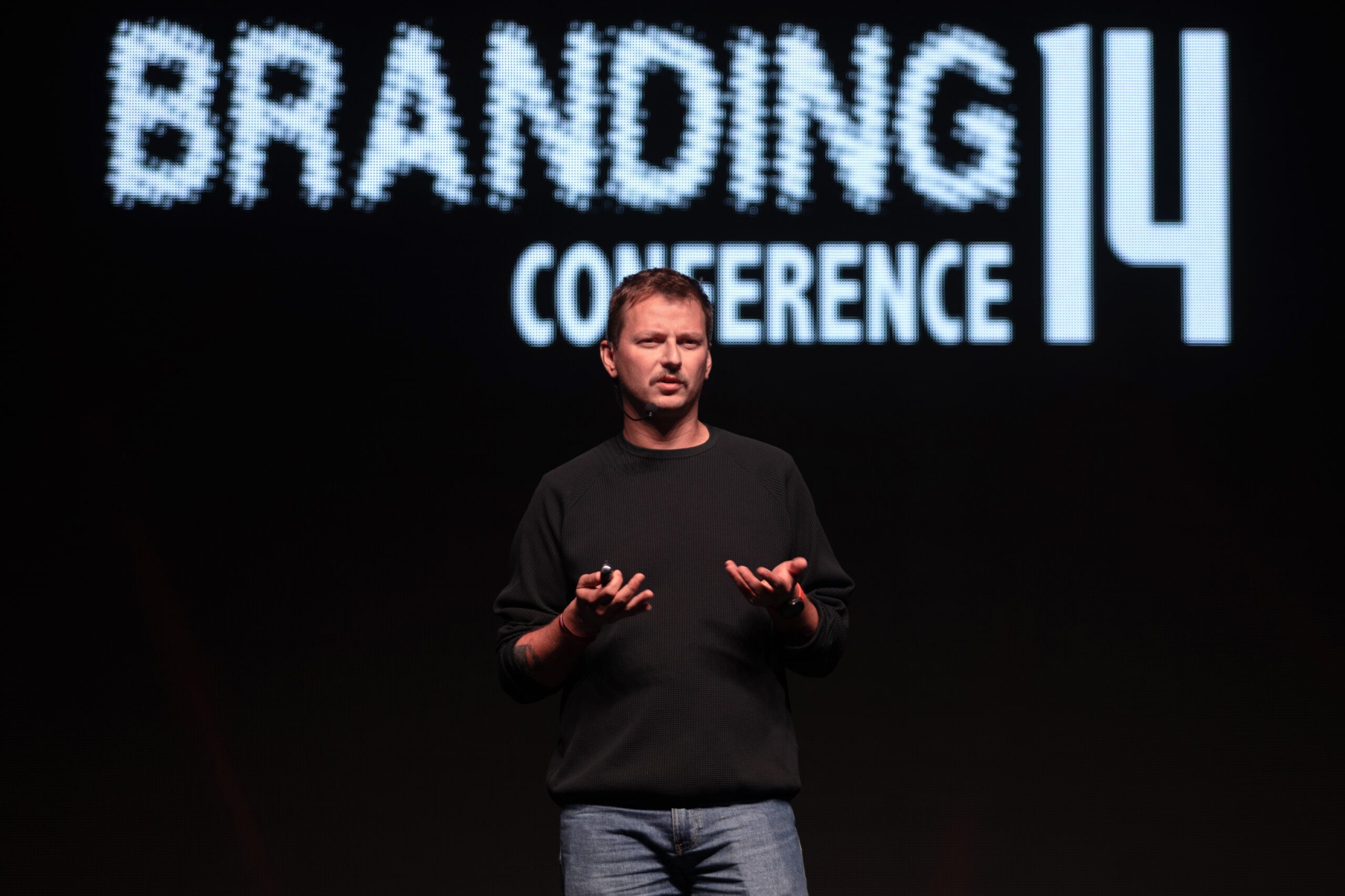
At Fran Mubrin’s talk at the 14th Branding Conference, we learned that the creative industry’s problem may soon no longer be a lack of good images. We will have more of them than we can look at, increasingly convincing in technical terms and produced in ever less time. It will be much harder to find a reason to truly linger over any one of them.
Mubrin summed up that feeling almost in passing, with one of those lines that stay with you long after a talk: so much generating had led him to degenerating.
Therein lies an important difference between what artificial intelligence already enables us to do and what we, as creatives, still need to do with those possibilities. Getting another beautiful image is no longer particularly difficult. Recognising an idea that deserves time, attention and further development is a much more serious task.
Fran does not speak about technology as someone observing it from a safe distance. Throughout his career, it has enabled him to move between digital products, major brands, culture and projects that bring the creative community together. At the same time, as creative director at 404, he leads a department of 35 people. He speaks about them with particular warmth, as people he truly loves and without whom none of what he does would have the same life or emotion.
He finds himself, then, at a point where much of our industry stands today. Technology enables us to do wonderful things, while we ask ever more loudly where humanity and the future of the people we create with fit into them. For Fran, the question is deeply personal: will AI take his job and those of his dear colleagues?
He did not try to answer by promising that everything would stay the same. It will not. He approached the fear through play, allowing himself to explore what might happen if he used artificial intelligence as more than a shortcut to an expected result.
In Croatian naïve art, he found a fitting parallel for the time we live in. Naïve art brought materials and the possibility of creating closer to people outside academic circles, and with them came different subjects, experiences and perspectives. Today, generative tools allow a much wider group of people to turn an idea into an image. It is hard not to see the beauty in that freedom, even as we fear what it might do to the value of the knowledge we have spent years building.
Mubrin’s work with naïve art showed how quickly that value is already changing. People liked the same images more when they believed he was behind them, and less when they learned they had been generated with the help of artificial intelligence. The visual result remained the same, but the story of how it was made took away some of its value.
That inflation of value is caused not only by attitudes towards AI. Quantity causes it, too. When every image can produce ten new ones with almost no resistance, technical polish is no longer enough to make us give any one of them more than a few seconds of attention.
That is why the most interesting part of Fran’s experiment began only when he stopped looking for more images.
The prompt Think with Your Head produced a form somewhere between a chicken and an egg, drawing on motifs from the naïve art of Podravina. That is how Jajeftiček came into being. It could have remained an amusing mistake in a series of generated works, but Fran saw in it a chance to keep thinking.
Jajeftiček became a meeting point for AI, local heritage, his memories and curiosity. It moved from an image into wood and textiles, and it led Fran to learn techniques he had never worked with before. The project eventually had an exhibition, too, but its value did not lie in the number of formats it covered. It lay in the fact that technology did not speed up the path to a familiar result, but led him towards something he had not known to look for at the outset.
It was especially lovely to hear him talk about it. He did not hide the fact that, at first, he was almost ashamed to admit he was working on a project with AI and feared how his colleagues in the industry would react. Nor did he hide his excitement when he realised that the new tool had not taken the process away from him, but opened it up to new materials, knowledge and ideas.
That honesty gave the talk a warmth that is hard to preserve when we speak about technology. Fran did not defend people with grand claims that they are irreplaceable, nor did he present AI as the answer to every creative problem. He showed that fear and curiosity can exist at the same time, then invited us to seek more from that relationship.
Adaptation is imperative, but it is not the goal. If we use artificial intelligence only to produce what we were already making more quickly, we will become more efficient, but not necessarily more creative. Far more exciting is the possibility of challenging it, pushing it beyond expected solutions and allowing it to open up areas we have not yet explored ourselves.
We live in a world where, with AI, everything can look perfect. That is precisely why humanity can bring the magic, while our imagination remains the magic wand that decides what we will do with all those possibilities. Fran did not know where Jajeftiček would take him when it appeared in his experiment, but he decided to give it room to grow. We are glad he did.

