
Author: Naira Čamdžić
Today, we can get from a blank slide to a finished campaign much faster. Research, visualization, production, content adaptation and distribution rely on tools that give creative teams possibilities that, until recently, required much larger budgets and longer timelines. The boundaries of what is possible have shifted so quickly that the question “Can we make this?” increasingly has an affirmative answer.
It is much harder to judge whether it is worth making. Technology can help us develop an idea further, but it can also get us to the first acceptable result faster. Likewise, a message can attract attention because it means something to people or because it has been precisely adapted to the way they watch, listen and scroll.
The relationship between what the industry can produce and what people recognize as valuable shaped this year’s Branding Conference. The Brand New Control programme did not reduce it to a single formula. Each talk began from a different experience and professional perspective, opening up an aspect of creative work that neither faster tools nor more data can make simple.
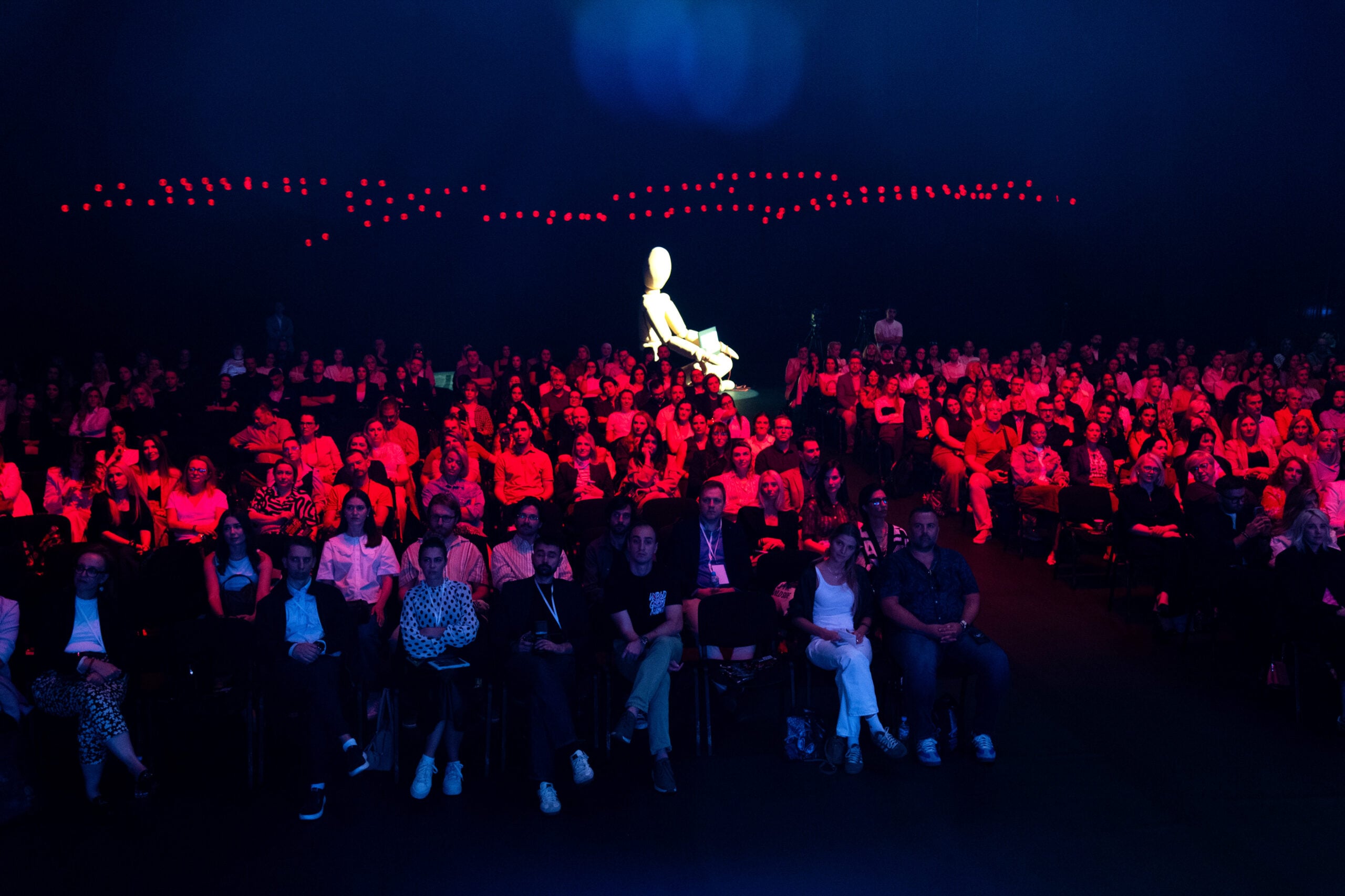
The fourteenth edition of the conference, organized by the agency Via Media, brought together more than 500 participants at Zetra in Sarajevo. Sean Poropat, David JP Phillips, Radim Malinić, Fran Mubrin and Butool Rizvi took turns on stage, speaking about the origins of ideas, the psychology of attention, creative blocks, artificial intelligence and brands’ relationship with culture.
Throughout the day, it was interesting to follow how control took on a different meaning with each talk. In one, it was tied to the security of familiar patterns; in another, to the ability to direct attention or overcome limitations we place on ourselves. The talks also raised questions about our relationship with new technologies and how a brand builds trust within the culture it addresses. Instead of one conclusion we could neatly write down and take away from Zetra, we gained five perspectives on the processes that come before what the audience ultimately sees.
As technical execution becomes more accessible, what distinguishes creative work is changing too. The ability to produce something is no longer enough. Choosing a direction, understanding the problem and being willing to develop an idea without a guaranteed outcome become important. Knowing the techniques used to attract attention also brings responsibility for what we direct that attention towards.
Attracting attention, however, is only the beginning. As the distinction between love for a brand and trust in it was discussed on stage, it was hard not to think about how often marketing tries to skip everything in between. We adapt the language, localize the content, find a topic that will provoke a reaction and expect a sense of closeness. People may watch, and they may even buy, but for a brand to become part of their world takes much more than one successful campaign. It takes time, consistency and experiences through which such a relationship is actually built.
None of this sounded like a discussion of changes that will only reach our market one day. The pressure to work faster, the question of how AI will change creative professions, the fight for attention and the need for brands to build a genuine connection with local culture are already part of the daily work of agencies and companies here. In its 14th edition, the Branding Conference examined them through the experiences of people working in design, communication psychology, creative team leadership and international brand management.
The industry will not wait for definitive answers. New tools are already entering projects, audiences’ attention is divided among an ever-growing volume of content, and decisions must be made before their outcomes become certain. After a full day of programming, one question remained worth taking into the next brief, meeting or creative process: it is not enough to ask whether something can be made, but why we are making it, what we are offering people and whether it is worth their attention.
The conversation that began at Zetra does not end here. In the coming days, on the Media Marketing portal, we will return to each talk separately to present in more detail the ideas, examples and questions that deserve more space than a single conference overview can give them.

