

Sometimes a person has to go far away to understand what was close to them all along. When you come to America, a country where identity is worn openly, on jerseys, flags and the facades of houses, in songs coming from cars and in the way sport becomes an event for an entire city, you begin to look differently at the country you come from. At first, you miss the small things, words that no one here pronounces in quite the same way, coffee that lasts longer than it should according to every American rule of efficiency, people who know where you are from, who your parents are and what hurts you, even when you never specifically asked them to remember any of it.
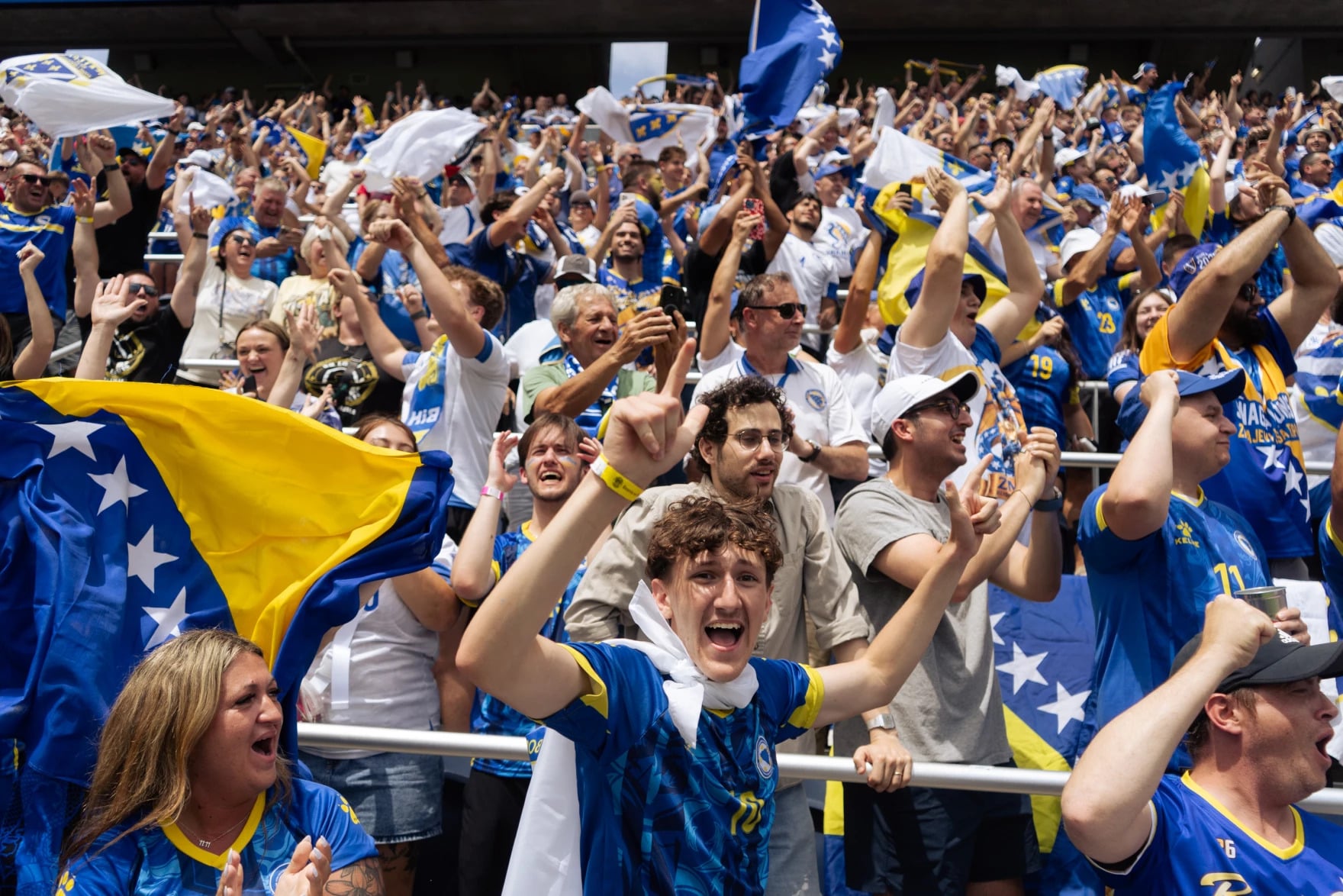
And then the World Cup arrives, and Bosnia and Herzegovina, somewhere far from Sarajevo, Tuzla and Mostar, appears before you in a colour that we sometimes no longer even notice at home. It appears through flags on the streets of American cities, through packed restaurants, through people who do not know one another but recognise each other as soon as they hear our language. It appears through children born in America who stand still while the wordless anthem plays, with their hands over their hearts and a sense of belonging that requires no additional explanation. And many of them do not even speak Bosnian fluently.
Before the match against the United States of America, a question asked by an American woman circulated on social media and went viral precisely because of its almost childlike logic: how is it that every other national team plays against one country, while America has to play against Bosnia and Herzegovina? The joke relied on our long name, on the fact that, at first glance, Bosnia and Herzegovina sounds to a foreigner like a combination of two separate places, but there was also something much more interesting in it than simple confusion.
Those few words, as well as another viral American comment saying that she would not know how to point out Bosnia on a map, contained our entire old international dilemma. A country about which many people know too little, a country whose name often requires additional explanation, a country they spent years learning about through war, divisions and complicated political lessons. Yet this time, the question did not come from a lack of interest, but from attention. Bosnia and Herzegovina was on the map of a major sporting event, present enough to spark curiosity, visible enough to be talked about. And then you realise how wrong it is to think that Bosnia is small. Perhaps it is small on the map. Perhaps it often speaks more quietly than it should. Perhaps it spends too much time trying to explain itself instead of showing the world what it can be. But Bosnia and Herzegovina is not small where it matters most, among the people who have carried it across borders, oceans and generations.
During this World Cup, the national team gave the world far more than results, although the result itself was strong enough to attract attention. The journey from a draw with Canada, through difficult moments against Switzerland, to victory over Qatar and qualification for the knockout stage created a sporting story that was easy to follow. However, what remained with people was not the table, but the image of Bosnia and Herzegovina appearing where it was perhaps least expected, while seeming as though it had always belonged there.
In America, a country that understands sport as spectacle, market and part of its own character, Bosnia and Herzegovina did not arrive with a major marketing machine. We did not have the production teams of the greatest football powers, nor global brands ready to turn every match into a television series, a digital event and a commercial ritual. But we had people. We had a diaspora that turned supporting the team into something much greater than a sporting event. In cities across America, Canada and Europe, among people who left five, ten or thirty years ago, the national team opened the door to a feeling that had long remained on the sidelines. People found one another. Flags appeared on windows, cars, streets and the shoulders of those who may never have lived in Bosnia and Herzegovina, but who carry it as an inheritance that you do not have to explain in order to understand.
In marketing language, this could be described as enormous organic reach, increased visibility and the kind of earned media that brands spend years trying to generate. However, none of those expressions says enough about what truly happened. People did not share the flag of Bosnia and Herzegovina because an algorithm offered them a good video. They shared it because they recognised in it a part of themselves, a part of their parents, a part of the city they left and a part of the country that, despite every reason for disappointment, they never stopped loving.
In a world where almost every national team has a communication strategy prepared in advance, a set of graphics, sponsor messages, social media videos and precisely planned moments for sharing, Bosnia and Herzegovina attracted attention in a way that no agency can fully design. The Football Association’s official communication provided the framework, necessary and functional, but the story was written by the people, through their journeys, gatherings, songs, children in jerseys and a pride that, when it is genuine, spreads faster than any paid campaign.
The great football nations learned long ago that a national team carries much more than eleven players on the pitch. America turns that potential into a media event in which every match has to capture the attention of an audience choosing between ten sports, hundreds of channels and endless digital content. England has spent years building its story on tradition, nostalgia and the constant tension between hope and disappointment. Brazil has an emotion that is taken for granted: football as an extension of everyday life. Morocco showed how far a national team can go when it becomes a symbol of a people living across several continents but gathering around the same idea.
Bosnia and Herzegovina has its own version of that story. It is less tidy, less institutionally shaped and perhaps still insufficiently aware of its own value, but that is precisely why it feels real. The Bosnian story does not come from a perfectly designed identity or from a brand book trying to explain what a nation should mean. It comes from people who have learned to live between two homes, two languages, two continents and one feeling that remains the same even when you spend years trying to explain it to yourself.
When international media outlets write about Bosnia and Herzegovina, they still often begin with our difficult history. War, displacement, loss and everything that marked the 1990s left a deep trace both in our lives and in the way the world sees us. That cannot be erased by one victory, one tournament or several days of positive attention. But the World Cup opened space for another frame, for an image of a country that people do not view only with pity, confusion or political curiosity, but also with genuine affection.
In that frame, Bosnia and Herzegovina becomes a place with energy, a voice, humour, food, music, emotion and a rare kind of loyalty that is difficult to find among nations that have not had to prove to themselves so many times that they exist. Its diaspora stops being merely the number of people who left. It becomes a network of people who carry the country with them, often more strongly than we are able to see while we are inside it. This is also where the most important marketing conclusion of this tournament can be found. Bosnia and Herzegovina does not have a problem with its story. The problem is that it too often allows others to tell that story.
For years, we have been described through divisions, instability, complexity and the past. Much of what those descriptions say is true, but no country should remain trapped in what happened to it. A country must have the right to show what is happening to it now as well, especially when it is alive, beautiful and strong enough to remind people of a feeling they may have forgotten. Bosnia and Herzegovina reminded people this summer. It reminded them that it is home, even when they leave it. That it is the colour on a jersey someone wears in the country where they were born, while their heart beats faster when they see the name of Bosnia and Herzegovina on the scoreboard. That it is a group of people in an American restaurant who, several thousand kilometres from Sarajevo, create a small Bosnia for a moment, without anyone needing to explain it in any particular way.
From America, perhaps for the first time, it became completely clear to me how much that country is mine. I do not idealise it. There are too many reasons for a person to be angry, disappointed, tired and impatient. There are too many things we have to change in order to become the country we deserve. But there is something special in the moment when you see people who had to leave, yet still return through the flag, through the jersey and through the national team. Then it becomes clear that belonging is not always a matter of geography. Sometimes belonging is what stays with you when you leave everything else behind.
That is why the World Cup should not be remembered only for the results, the final standing and the matches we wished had ended differently. It should be remembered as the moment when Bosnia and Herzegovina reminded both itself and the world that it has something that cannot easily be measured but can be felt very clearly. It has people. And when a country has people who carry it with them, who find it even when they are thousands of kilometres away, who show it to the world without instructions and without calculation, then it also has a story worth far more than a single football campaign.
Perhaps that is exactly what I thought I was missing as I left for America. Not a perfect country. But a country that, when you see it from afar, finds you again.

