

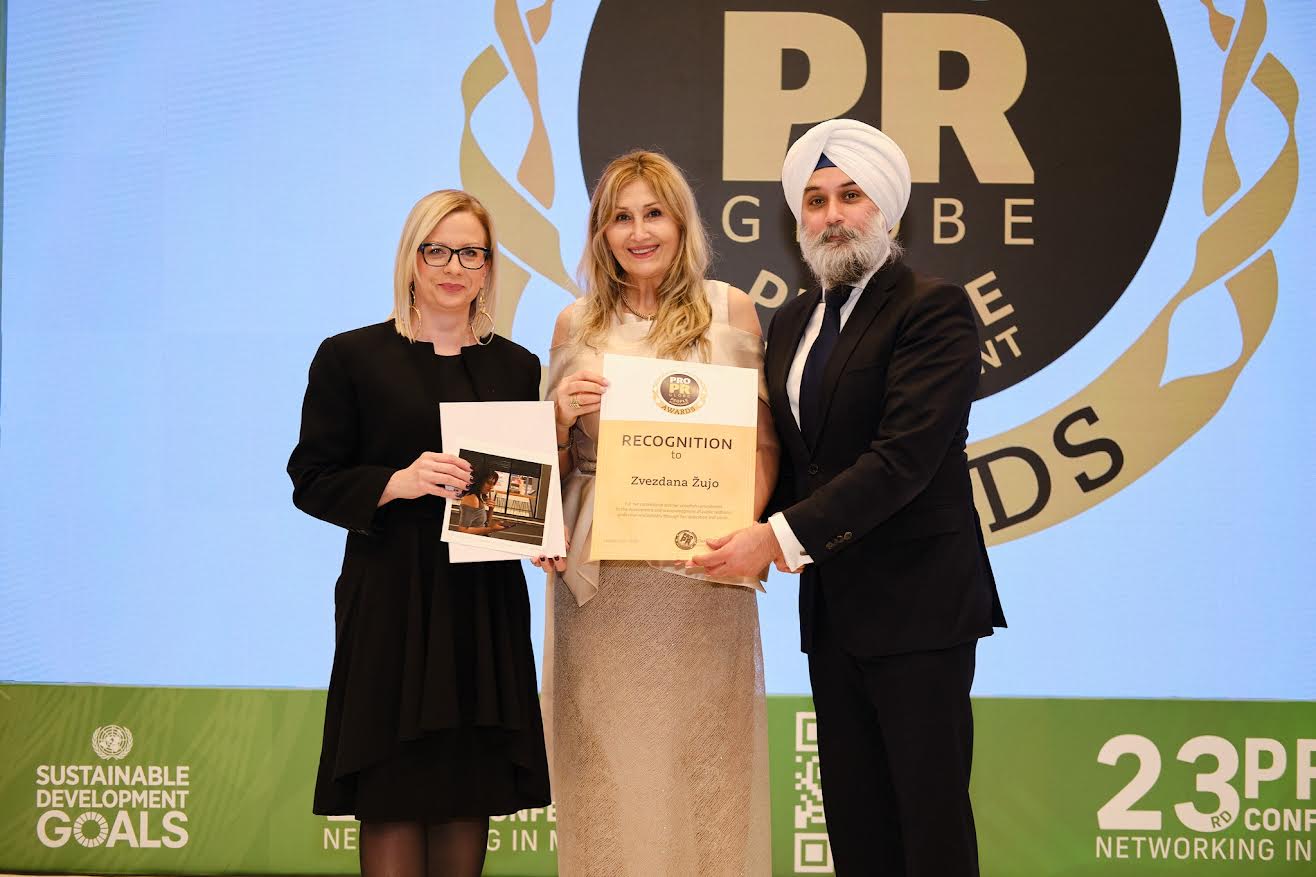
The arrival of Zvezdana Žujo among this year’s recipients of the PRO PR Globe People Achievement Awards is not only recognition of a long and successful career, but also confirmation of how much the communications industry in the region has been shaped by people who built it patiently, systematically, and long before communications became one of the key topics of modern business. As co-owner and director of Communis from Sarajevo, an agency that has operated for 27 years across more than 15 markets and collaborates with dozens of clients, Žujo belongs to the generation of communications professionals who developed the profession while simultaneously building the market in which they operate.
Over the years, she has particularly stood out through the development of young professionals, mentorship, and a continuous insistence that communications cannot be reduced merely to visibility and campaigns, but that their real value lies in trust, understanding context, and responsibility toward the public. This is precisely what she discusses in this interview, opening questions about the status of the communications industry in Bosnia and Herzegovina, the relationship toward artificial intelligence, new generations, and the changes currently shaping the market.
In the conversation that follows, she also explains why she sees AI primarily as a tool rather than a threat, why she believes younger generations are often unfairly underestimated, and which professional and personal moment perhaps left the greatest mark on her career, her move from Belgrade to Sarajevo and the building of Communis from the very beginning. Throughout the interview, the same idea runs consistently through every answer: that serious communication is not built through noise and short-term attention, but through people, relationships, and trust that remains long after campaigns are over.
You represent one of the charismatic and recognizable figures in the marketing and communications market in Bosnia and Herzegovina. How would you assess the status of the industry in Bosnia and Herzegovina today? Is it sufficiently recognized, and what, in your opinion, is still missing?
Thank you for the compliment. I still see myself simply as someone who works hard every day, learns, adapts, and tries together with my team to respond to increasingly complex market demands. When we talk about the communications industry in Bosnia and Herzegovina, it is logical that today it is far more mature than it was ten or fifteen years ago. We have colleagues who understand strategy, creativity, media, digital channels, reputation, crisis situations, and everything that modern communication entails. We also have clients who increasingly recognize that communications are not just a “nice addition” to business, but one of the key elements of trust, market position, and long-term relationships with the public.
Still, I would say that the industry is not yet sufficiently recognized in its full strategic role. Communications here are still sometimes viewed as something that comes at the end of the process, when the product is already finished, the decision already made, or the crisis already underway. In reality, communications professionals should be involved much earlier, in understanding context, risks, audiences, messages, and consequences.
What the industry lacks is not talent. There is plenty of talent. What is still missing is greater trust in the profession, stronger systemic recognition of knowledge, and a clearer understanding that good communication is not the same as visibility. Visibility is only the consequence. The essence lies in trust, authenticity, responsibility, and the ability to deliver a message at the right moment, in the right tone, and with genuine meaning.
We witness the daily impact of artificial intelligence on the advertising, media, film, and music industries. Does artificial intelligence represent a threat to your agency and the profession in general, or do you see it as an opportunity?
I am known as an eternal optimist, and although there is a common belief that optimism belongs to people with insufficient information, I still remain true to my nature and see artificial intelligence as a great opportunity, if we use it responsibly and wisely. I do not think it is good to fear technology, nor to admire it uncritically. AI is a tool, and the value of any tool always depends on who uses it, why they use it, and with how much knowledge, ethics, and sense of context.
In the communications industry, AI can help a great deal. It can accelerate research, analysis, organization of information, production of certain formats, and technical processes. It can be a useful ally in everyday work. But it cannot replace what is most important in our profession: human intuition, emotion, experience, moral judgment, understanding of the social moment, and genuine creativity.
Today we have more content than ever before, but that does not mean we have more value. On the contrary, one of the greatest challenges is precisely the fact that the amount of content has increased, while trust in content is often decreasing. This logically means that the role of communications professionals will become even more important. Someone must know what is relevant, what is true, what is sensitive, what is responsible, and what truly makes sense to say.
AI will not replace good people in this industry. But people who do not understand AI, who do not learn, and who do not want to adapt, I believe, will face greater challenges in their work. We know from experience that technology will not destroy the profession. It will change it. It is up to us to decide whether we will welcome that change as a threat or as space for a new level of quality.
Throughout your career, you have devoted significant time to mentorship and sharing knowledge with numerous generations. How would you assess the values of younger generations today, and what are, in your opinion, the greatest challenges in working with them?
I value younger generations very highly. I often hear criticism directed at them, but I responsibly claim that many of those criticisms are unfair and superficial. Young people today are growing up and working in a far more complex, faster, and more demanding world than the one in which we started our careers. They are expected to be creative, digitally literate, informed, flexible, available, and fast, while at the same time their way of thinking is often questioned.
What I especially appreciate about young people is that they do not accept authority simply because it exists. They seek explanation, meaning, and space to contribute. To some, that may appear as impatience or lack of discipline, but I often see it as a healthy need to understand why they are doing something.
Of course, challenges exist. Young people sometimes want faster results than are realistically possible, and at times they lack experience with process and continuity. I particularly emphasize that the biggest challenge is not only with young people. The greater challenge lies with us, the older generations, because we often judge them too quickly, underestimate them, or try to fit them into models that belong to another era.
Mentorship is not a one-way process in which older generations simply transfer knowledge while younger people silently absorb it. A good mentoring relationship implies exchange. We pass on experience, professional standards, and the broader picture to them. They give us new ideas and energy, a different perspective, and the courage to question habits that we may have considered rules for far too long.
If you were not involved in public relations, what would you be doing in your professional career, and which option would you choose?
I believe I would still choose a profession connected to people, ideas, creativity, and communication. I am attracted to professions in which people, meanings, and stories are connected. Perhaps I would work in education, culture, media, psychology or communication psychology, or the development of creative projects. In any case, it is difficult for me to imagine myself in a profession that lacks a strong human dimension.
Throughout my career, I have been most interested in how people think, how they make decisions, how they build trust, and how one idea transforms into a message capable of moving something forward. That is why I think that even if I were not in this industry, I would still be in a field where reason, emotion, creativity, and responsibility intersect.
Which moment in your career left a particularly strong mark, aside from the recognitions you have received?
If I exclude recognitions, which certainly matter but are not the essence of a career, I would say that one of the most important moments was moving from Belgrade to Sarajevo and starting from zero. That was not only a professional move, but a major life decision. When you begin in a new environment, without the security provided by an already established system, you must build many things from the beginning: trust, relationships, a team, reputation, a way of working, and a space in which people will want to stay and develop.
Such beginnings teach you patience, humility, additional gratitude, persistence, and the understanding that serious things are not built quickly. Today, when I look back, the greatest mark was not left by a single project, campaign, or success. Much more important to me is the fact that from that beginning Communis developed not only as an agency, but as a professional space through which numerous generations of people have passed and shaped themselves.
I consider that one of the greatest achievements. Not only building a business, but creating an environment in which colleagues grow, learn, make mistakes, mature, and leave more prepared than when they arrived. If anything remains behind us in this industry, then it is not only campaigns and awards. What remains are people, relationships, knowledge, and the way you helped someone believe they were capable of more.

